


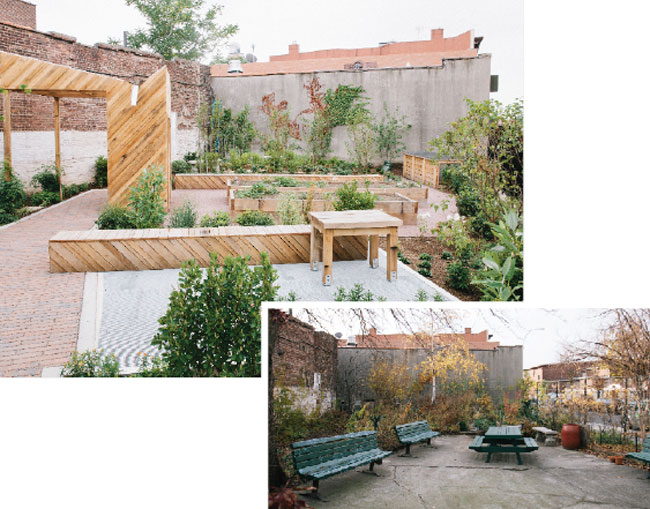
NYC&G: The Gil Hodges Community Garden in Gowanus is a start-to-finish redesign, but doesn’t the New York Restoration Project renovate parks, for the most part?
Deborah Marton, senior vice president of programs, New York Restoration Project: We actually own 52 community gardens like this one and have been renovating them to the extent that’s needed, which sometimes requires redesign. We purchased almost half of the 114 that were at risk of being sold to developers nearly 15 years ago. We own and manage ours in perpetuity.
Was any part of the original garden saved?
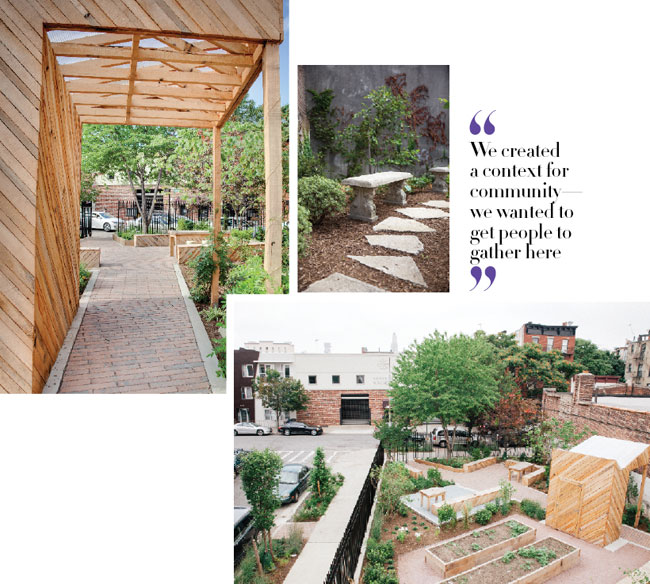
DM: Yes, a number of trees were moved out during reconstruction and then replanted with memorial plaques. The old design included a concrete patio, which we broke up and used as steppingstones in the fragrance walk.
Yvi McEvilly, director of design, New York Restoration Project: We also saved a pair of cast-stone benches and relocated them in the fragrance walk as well. The spirit of the local community endures, with the trees and benches being dedicated to neighbors.
What inspired the diagonals in the hardscaping?
YM: The first decision was to move the entrance of the park to the street corner, and then the main spine of the space fell into place following a true north-south axis. The bricks in the paths run parallel to the water garden beds and in a true east-west direction adjacent to the non–water garden beds. It drove the bricklayers crazy! But it also helps orient people to the real geography of the park, rather than the city grid.
Stantech was our design and engineering consultant and created the angled woodwork. The sharp slant of the roof on the pergola and shed was designed to send water into the catchment area in a very visible manner via the scupper, which is essentially a gutter that in this case directs rainwater to a place where it can be used.
So what have you achieved?
DM: Gil Hodges was a garden in poor repair and was not optimized for users. First, as with any garden we renovate, we created a context for community—we wanted to get people to gather here and to make an attractive working garden. What was a small 3,140-square-foot garden now has an outdoor classroom area, raised beds for a harvest garden, a fragrance walk, a passive area, a garden shed for equipment storage, and a composting bin. We also incorporated sustainable measures into the design, like the water catchment area, where water collects and percolates into the garden, irrigating it from underground.
Additionally, we made the tree pits around the garden’s perimeter larger so that trees can flourish, then under-planted them with anti-evaporative plants. When there is flooding on the street, the bioswale in one of the tree pits helps stanch the stormwater runoff on the corner of Carroll Street and Denton Place, where the garden is located.
Are you doing more projects similar to this one?
DM: Only in the past two years have we really been implementing sustainable horticulture practices. Designers like Frederick Law Olmsted intuitively understood this sort of thing in the past; today, we’re using state-of-the-art technology with the goal of being even more sustainable.
YM: For example, the ground surface here is made of permeable pavers, mulch, and aggregate that allow water to seep into the ground rather than spill off into the sewer system. The compost bin is used not only by our maintenance crew, but by neighbors who plant and harvest here. Even a local café drops off its food scraps.
What’s the connection between Gil Hodges and Jo Malone London?
DM: Jo Malone London, part of the Estée Lauder company, has a long history of philanthropy, and this is one of several collaborations with the New York Restoration Project. We were very inspired that they took on our cause.
What projects are coming down the pike?
DM: The Willis Avenue Community Garden in the Bronx. It’s not a complete renovation because it has certain aspects that already work, but it is a very prominent garden in the Puerto Rican community, with a lot of cooking, a casita, and tons of food growing in 20 raised beds.