


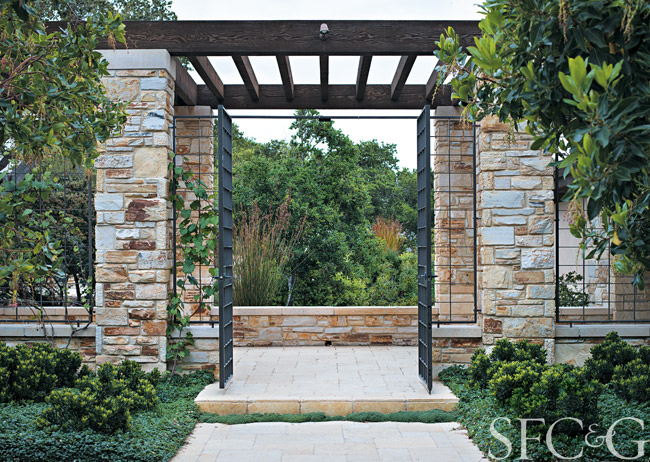
At the entry, columns of local stone from Chapelle Masonry and steel gates made by Carmel Valley Ironworks frame a lush view of Coast Live Oak (Quercus agrifolia).

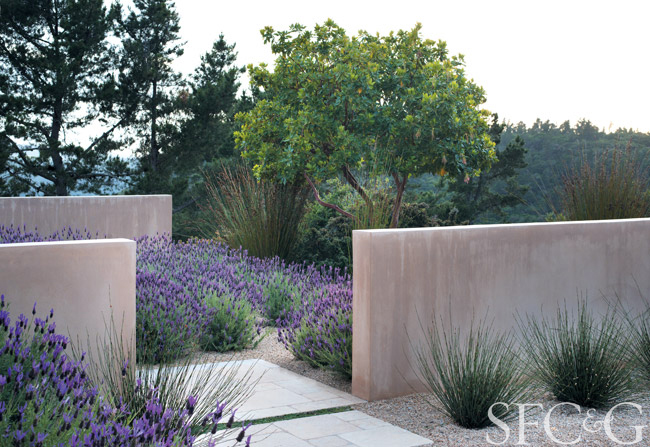
A limestone-paver path greets lavender in the north courtyard.

Succulent Euphorbia myrsinites “Myrtle spurge”—an evergreen perennial—adds a stroke of pale green.

A picturesque path is lined with California and South African species.

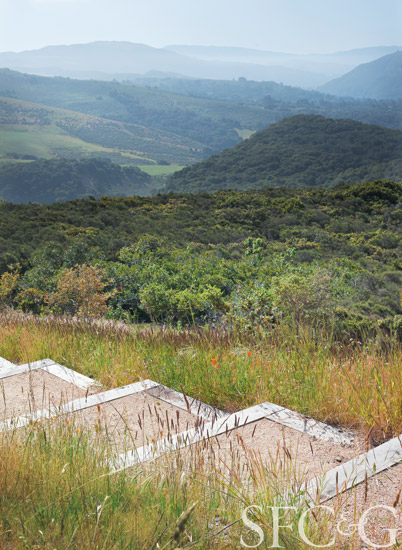
Redwood-wrapped stairs were scaled to be in proportion with the landscape—and so that a couple could easily walk side by side.

An enfilade of Coast Live Oak (Quercus agrifolia) lines the drive to the house.

A hummingbird alights on a stone water feature.

Pops of lavender form an aromatic grid on the gravel landscape.

A sublime swimming spot by Paradise Pools and Gardens is flanked by walls of local Carmel stone and a breathtaking landscape.

The lovely moments in landscape when a path descends into a wide, wild field or a thatch of lavender frames a solitary tree are what 18th- and 19th-century aesthetes considered picturesque. Every landscape is a painting, they contended, but, one might ask, how do you render the Romantic on land that flatly resists it? This was the question facing leading landscape architect Bernard Trainor when he was commissioned to cultivate an inhospitable home site in Carmel. Trainor, however, who grew up on Australia’s rugged southern coast, isn’t one to shrink from a challenge. “I like it when things are a bit more difficult, I think that’s when I’m at my best,” he says. True to that ethos, Trainor transformed the resistant terroir into a landscape that would have delighted our pictorial theorists.
That doesn’t mean it was simple. “It is such a crazy, difficult site to grow plants on,” notes Trainor. “We had to make things grow in rocky crevices. But, in a very rugged environment, you still have to give the client super-livable, comfortable spaces.” The clients hired him without really knowing what the landscape would yield. “There was a certain leap of faith for both of us,” says Trainor.
Profoundly respectful of existing plant life, and true to his reputation for creating subtle, almost imperceivable boundaries between the cultivated and wild, he preserved the native landscape while bringing in nearly 5,000 plants—predominantly Californian and Mediterranean-climate species—to enhance the 11-acre property. He noted, for example, that the west side of the house, a corner that gets south and west sun, “could make a powerful, distinct visual moment.” Leaving in place an existing Arbutus “Marina” of the Madrone family, which, with its distinctive orange bark and inherent resilience, makes it a stunning dry-garden tree, Trainor surrounded it with a lush plot of vivid Spanish lavender, a longer-flowering breed that blooms on and off over a 12-month period. The juxtaposition of three minimalist plinths with the bursts of purple blooms creates a dynamic moment that is the focal point for the courtyard.
Other pictorial moments were cultivated throughout the property. The north side proved a natural counterpoint to the west. With its view onto a field of chapparal, the site appears far more untamed. A pool that looks as though at any moment it might be subsumed by the surrounding meadow grasses reflects the clouds and their movements. At the rear of the property, a seductive path winds against the backdrop of the Carmel highlands, where Trainor strategically planted another thatch of lavender to synchronize with the purple hills beyond.
The house dwells in between these moments, connected on all sides to landscapes that are diverse, yet flourishing on what began as dry ground. “This has been a slow-growth garden because it’s a gritty site, but it looks better and better,” says Trainor. “It just continues to grow.” Like our painters of pastoral landscapes, he appreciates a composition that takes the eyes
on a journey.
BROWSE MORE PHOTOS FROM THIS FEATURE IN THE FULL GALLERY BELOW