


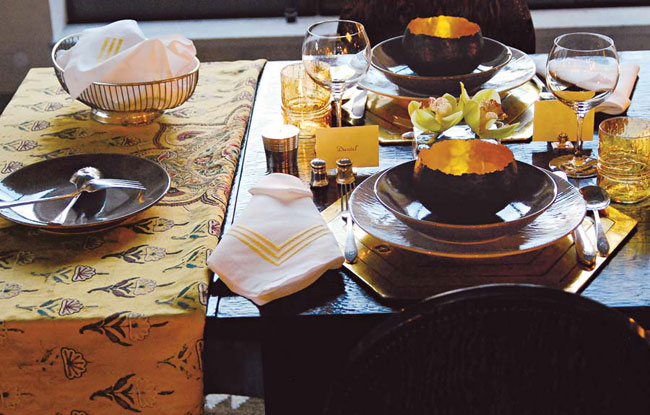
My love of entertaining came, I am sure, from the wonderful memories I have from my childhood, both of helping my mother plan my birthday parties and the excitement of going to friends’ parties. The large Sunday lunches given by my great-aunt Berta Jones, where all generations of the family got together, were something I looked forward to every week. I was lucky to grow up in a place where entertaining at home was the norm. There were not a lot of restaurants in Charlottesville, Virginia, where I grew up, and as Albemarle County was dry and you could not get a drink in a public place, everyone entertained privately. Things are different now and we are all busy, yet there is nothing more rewarding than having friends and family together in your home.
Nothing shows a person’s kindness more than entertaining. Entertaining is a gift a host gives friends and family. On a book tour in California, my dear friend Suzanne Rheinstein gave me a large buffet dinner in her beautiful home in Los Angeles to introduce me to her friends and other people in the design community. Suzanne is a masterful hostess. She makes entertaining seem effortless, and because she is organized, thoughtful and creative, her parties are magical.
PLANNING PARTIES
I could not wait to start entertaining when I had my first apartment in New York, which I shared with an old friend from home. In a small space, we would make a casserole and salad and invite other single friends who would bring a bottle of wine and, we hoped, another single friend. It was a fabulous way to meet new people. After I was married and living in a small apartment, I would serve buffets from the kitchen where everyone would help themselves to a plate and sit around the living room. Later, when I had a larger house, I could have more formal dinners, but what was always important was to plan a party that worked for the space and budget at hand so it was fun for everyone. A host should never seem stressed and should be able to enjoy the party along with everyone invited. Think out the whole event from the time people arrive until they leave and then begin to prepare and plan.
- Only host a party that you can easily handle. Keeping things simple will allow you to have a better time.
- A cocktail party with a buffet allows for a more casual party and can be done with less help. Serve food that is easy to eat.
- Make lists, lists and more lists to ensure that you have everything ready beforehand and that you have what you need, from a coat rack to cocktail napkins.
- If you are serving a meal, make sure there are enough places for everyone to sit to eat their food. No one should have to stand or sit on the floor.
- Afternoon tea parties are great for families. Kids can have hot chocolate with tiny peanut butter and honey sandwiches, the husbands can watch football, and the girls—well, they always like to get together.
- Picnics are another great way to entertain families. Pack up sandwiches, fried chicken, potato chips, and brownies and go to the backyard or the park.
- If you are able to hire a caterer or help for a large party, have them cater a small party first so they can get to know you, and how you like things done. You want to be sure the party represents you, not how someone else thinks you should entertain.
BUFFETS
For a buffet where people may be eating off their laps, serve food that does not need cutting, such as a bourguignon or meat loaf—food that can be eaten with a fork.
Wrap a knife and fork in a linen napkin, and tie it with a pretty ribbon. Put them in a basket so your guests can easily carry them while finding a place to eat.
Have someone checking the plates and taking them to the kitchen when they are empty. This is something you can often lure your teenagers to help with.
Only have two courses with a buffet. My husband John Rosselli and I use large dinner plates and offer our guests three or four choices of dishes (a meat, two vegetables, and a starch). The table is cleared and a dessert is served on small plates.
SEATED DINNERS
At our house in Connecticut, John and I always have seated dinners. We serve the food on a long buffet where the guests help themselves and then go to the table where there is a place card for each guest. I spend a lot of time thinking about the seating, which shows consideration for your guests. I always separate couples and try to place people next to each other who I think will have something in common. If one of my guests is a quiet person, I try to put him or her next to someone who is very outgoing.
SETTING THE TABLE
Years ago, I tore out a picture from Vogue of a table setting done by the stylish Pauline de Rothschild. In the center of a long table covered in faded Indian bed covers there was a grand wooden carousel horse under which she had placed masses of topiaries in small blue-and-white Chinese jars. I have been enthralled with creating interesting table settings ever since.
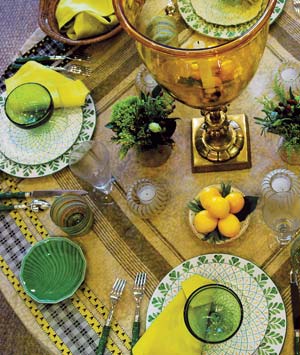
I look at each table as an empty canvas on which I can build a new still life. I love to place items from around the house with small flower arrangements or intersperse potted succulents with votives down the length of the table. Pieces from my rabbit collection and vases of spring bouquets make a lovely Easter centerpiece. In the fall, I might scatter pumpkins and gourds down the center of the table.
Make sure to keep flowers or decorative objects low so that guests can easily see over them. Conversely, if you have a tall centerpiece, guests should be able to see under it. Always sit in every seat to make sure there is nothing in the way of guests being able to easily talk to, or see, one another.
Having the correct props makes building centerpieces so much more fun and allows you to create a variety of table settings appropriate for any occasion. Add to your linen collection so that you have both solid colors and small patterns. I love to mix colors, such as yellow tulips on an apple-green linen cloth with green and white plates. Or I will choose a deep pink tablecloth to go with blue and white plates, or maybe a cloth made from simple burlap with all white plates and white hydrangeas in simple basket containers.
Once you have your table decorated, set out the dishes as well as the proper knives and forks for the meal you plan to serve.
A large dinner knife should always be placed on the right side of the plate and a large dinner fork on the left side of the plate.
If you have a first course, such as salad or smoked salmon, you need to include a small fork and knife.
If the first course is soup, place a large soup spoon on the right side next to the dinner knife.
A dessert fork and spoon should be placed at the top of the plate.
Each place should have a large glass for water and a smaller glass for wine. If you serve different wines for each course, you may need two wine glasses. (I usually use only one wine glass but serve both red and white wine and let guests help themselves.)
For a buffet, dinner plates can be set on the serving table for each guest to fill and bring to the dining table. For more formal dinners, you can set a large service plate on top of which first-course and dinner plates are placed.
NECESSITIES TO HAVE ON HAND
The more prepared you are, the easier it will be to entertain—even at the last minute. Knowing you have what you need will give you the confidence to say, “Come for dinner tomorrow.”
PLATES
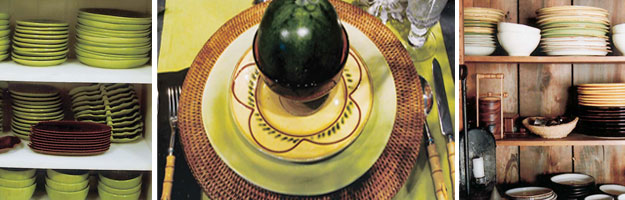
> Ten-and-a-half-inch dinner plates
> Eight-to-nine-inch dessert and salad plates. (I prefer a nine-inch plate, which is harder to find, because it is more generous for a salad or first-course plate.)
> Eleven-inch chargers or service plates for formal entertaining. (We sometimes use the larger plates if we are having a buffet, as John usually makes a number of different dishes.)
> Always purchase one or two extra plates in case there is an accident. I suggest having twelve of each set.
> Do not be afraid to use different styles of plates on the buffet for large groups. Matching plates should be used for a seated dinner, although a different pattern can be used for each course.
> Coffee cups and saucers
> Demitasse cups and saucers
GLASSES
> “All-purpose” wine glasses
> Water glasses
> White wine glasses
> Champagne glasses
> Brandy snifters
> Highballs or tall glasses
> Low tumblers (I prefer these for cocktails.)
SERVING PLATTERS
> At least four round or oval platters that will work together on a buffet table; they should all be the same color.
> At least four good serving dishes that can go from oven to table; they should work with the serving platters.
> Salad bowls—wood, glass or china
FLATWARE
> Dinner knives and forks
> Salad/dessert forks—double the quantity, as you may need one fork for salad or a first course and one for dessert.
> Small knives for first course or cheese course.
> Tablespoons—double the quantity, you may need one for soup and one for dessert after a meal.
> Teaspoons for coffee/tea
> Demitasse spoons for afternoon coffee (I always offer decaf coffee and herbal tea as well.)
> Salt and pepper holders: I prefer tiny open bowls with loose, coarse salt and pepper. I have them in glass, porcelain and lacquer. (Salt will corrode silver, so the holders must be emptied and cleaned after each meal.)
> Wine coasters, at least two per person.
> Pitchers—glass, silver or pottery for water, iced tea or lemonade.
> Votive candleholders (I have many sets of these, as I love the light they give to the dinner table. Clear glass works with everything, although I have them in amber glass, mercury glass, porcelain, silver and red glass for Christmas.)
TABLE LINENS
> Nothing can change the look of your table more than a new tablecloth, napkins or place mats. By having table linens in a variety of contrasting colors, complementary patterns and interesting textures, you can transform your table setting from everyday to party-ready.
> Simple cotton place mats can make a setting more casual, whereas beautiful Belgian linen mats are more elegant. We often place our blue and white china on a hot pink linen tablecloth, and our brown pottery looks fabulous on apple green.
> Place mats—straw, linen, cotton, lacquer, leather or cork.
> Tablecloths—solid colors from white to any colors you like that work with your china.
> Indian bedspreads make wonderful, inexpensive tablecloths. Buy a twin size if you have a narrow table, and buy two if one is not long enough and simply overlap in the middle.
> It is hard to find large, square cloths for round tables. A king-size bedspread makes a perfect tablecloth for a sixty- to sixty-six-inch round table. I like square cloths on round tables as I think it looks like a tablecloth, not a skirted table.
> You can never have too many plain white napkins. I especially love extra-large damask napkins, for a buffet when people are eating off their laps. I often find lovely cloth napkins in antique malls or thrift shops.
BAR
In whatever room you use the most—your living room, family room or library—I suggest having a bar that can be used freely. If you want a drink, it is nice to have something nearby; it is so much easier than running to the kitchen each time a glass is empty.
Mahogany, three-tiered trolleys make great bars. The top can have a tray with glasses and ice bucket, and lower shelves can hold mixers and bottled water. Narrow cabinets are another good option, with storage in the bottom cupboards.
FALL OR WINTER LUNCH
Casserole fish chowder
Green salad with pear, soft cheese (Brie, St. André) and French bread
Fresh fruit with cookies
(Tate’s cookies are especially delicious) or coconut cake
Casserole Fish Chowder
This chowder is very, very easy, and makes a delicious lunch.
- 2 pounds, fresh fish, boned, skinned and cut in chunks (use haddock, whitefish, halibut or cod)
- 4 potatoes, thinly sliced
- 3 onions, thinly sliced
- A few celery leaves, finely chopped
- 1 bay leaf
- 1 garlic clove, minced
- 4 whole cloves
- 1/4 teaspoon dill seed
- 2 1/2 teaspoons salt
- 1/4 teaspoon white pepper
- 1/4 cup butter
- 1/2 cup dry white wine
- 2 cups heavy cream
- Combine all the ingredients, except for the cream, with two cups of water in a 3-quart casserole.
- Cover the casserole and bake for 1 hour at 350F.
- Heat the cream to scalding and stir into the chowder.
- Garnish with fresh parsley or dill and serve. Makes ten cups or eight servings
