



ART VILLAGE revival
PUTTING THE “REAL” BACK IN REAL ESTATE
Realism first put the Hamptons on the art map in the late 1800s. Southampton became the destination of choice for aspiring artists, thanks to William Merritt Chase and the Shinnecock Hills Summer School of Art, for which Chase created the Art Village, an enclave that survives to this day. Mrs. William S. Hoyt convinced the well-known artist and instructor to take charge of the school, which evolved into a prominent institution for American landscape painters. According to a New York Times report from 1897, Southampton owed its “fashionable position and reputation which promises to be lasting” to the golf ball, an association the Art Village was determined to undo.
Upon completion in 1890, the Art Village included a McKim, Mead & White house built for Chase, his wife, and their nine children, plus dozens of surrounding cottages for housing students. One of these, 8 Studio Lane, was restored in recent years by Andy and Kate Spade and just sold this spring to art-collecting clients from London. The three-acre property with five buildings was listed at $5.45 million.
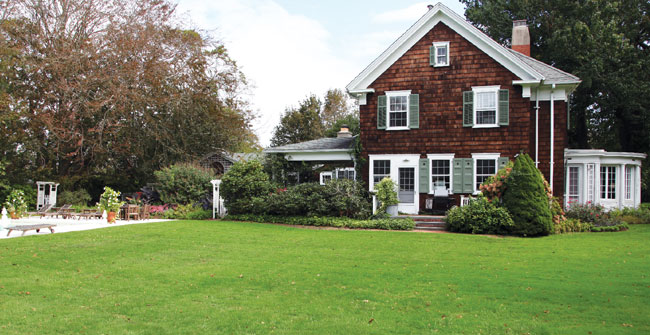
While the famous “Tableau” parties—where Art Village residents would gather dressed in full costume as their favorite portrait figures—are a thing of the past, the local passion for great art remains. The Art Village was the ideal locale for collector and arts patron Beth Rudin DeWoody, who runs her family’s Rudin Foundation and sits on the board of the Whitney Museum of American Art. Newly engaged to photographer Firooz Zahedi, she has listed her historic home for $5,995,000.
The 4,347-square-foot, six-bedroom, five-and-a-half-bathroom house sits on 2.1 private park-like acres with majestic old trees and a Romanesque pool. The home has beautiful millwork, paneling, moldings, and leaded glass, which DeWoody has meticulously preserved, adding a grand summer dining room with a bay window providing views of the grounds. It has the feel of a beloved family home, albeit with children’s pictures taken by Richard Avedon.
Listing agent Gabriel Falco of the Corcoran Group notes, “This is a grand house that’s hugely appealing for someone who wants the real deal. It’s not a new 10,000-square-foot home with iPod-controlled everything.” If the walls could talk, they would boast of displaying masterworks by such artists as Andy Warhol and Ed Ruscha.
DeWoody, who is a contributing editor to HC&G, says, “There is a great history of art in the Hamptons, starting with the 19th-century Tile Club. The Art Village was begun by artists who wanted to learn plein air painting, and even though the school begun by Chase closed in 1903, the village remained incorporated, with its own mayor for many years. My house was built not much later, in 1911, designed by Grosvenor Atterbury.” Should a buyer want to acquire part of DeWoody’s collection as well as her home, she says she will “sell certain pieces of furniture—most, in fact—except the mid-century pieces.” Also up for grabs are outdoor sculptures by Chris Astley and neighbor Immi C. Storrs.
Dewoody: Image Collect
ARTS COLLECTIVE
Artist Joseph La Piana has decided to apply his creative vision to other media, namely houses. “I find places no one wants and then restore them to their period splendor,” says La Piana, who relies on light and movement as a central component of his artwork—and his homes.
When he bought the former residence of artist Hedda Sterne—the only woman included in the famous 1951 Life photograph of Abstract Expressionism’s leading lights—one stipulation was that it had to be passed down to another artist. La Piana renovated the old dairy barn and fire station in the Springs and then sold it to a musician, following Sterne’s wishes (she passed away last year at age 100).
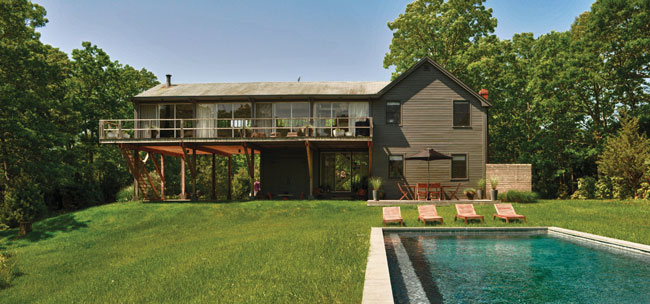
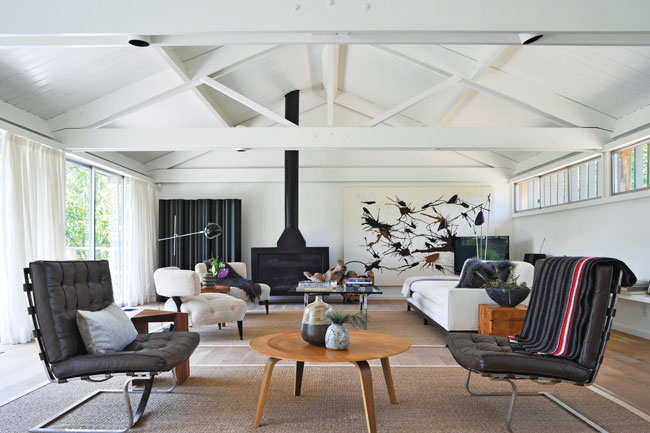
His newest venture, listed for $1,550,000 with Rylan Jacka of Sotheby’s International Realty in East Hampton, is a redone 1,600-square-foot modern on 1.6 acres. Previous owners had moved a farmhouse to the site in the 1940s, then hired architect Robert Rosenberg to build an addition—a 40-foot floating rectangle—in the ’60s. La Piana was drawn to the house’s period lines and restored original elements such as wooden built-ins; he also added a pool. This time around, there are no restrictions on who can buy the property.
SPACE EXPLORATION
Madoo Conservancy founder Robert Dash told one reporter in 2000, “I think we have more painters in this area than all Italy had in the Quattrocento.” As Hamptons real estate started its more recent meteoric rise, however, those numbers have greatly diminished. Whether it’s Brooklyn or Bridgehampton, as home prices increase, there is an inverse ratio of artists to real estate agents. And now Bobby Van’s is filled with dieting agents worried about calories instead of starving artists worried about cash.
“This is no longer the place artists come to find light or inspiration,” notes Karen Boltax, owner of Boltax Gallery on Shelter Island. She describes a tale of two Hamptons, with successful artists of a certain age who came out 20 years ago and are still part of the local community, like Ross Bleckner (see page 106), and emerging artists who can’t find large, affordable spaces to work in, though she is excited to be representing photographer John Messinger, who grew up here and has returned to his roots.
When it comes to exhibition space, there are two ends of the spectrum. You have 19 artists banding together to rent Ashawagh Hall for $250 a day for an exhibit versus the new $26 million Parrish Art Museum, set to open this fall in Water Mill. Even the latter number was slashed from the original proposed budget for the Herzog & de Meuron–designed building. Parrish director Terrie Sultan notes, “We worked closely with the architects to bring the scope and design in line with the economic reality” and cites the generosity of the philanthropic community and Parrish board members for making the project happen during an era when most arts organizations have been struggling.
The new building is on time and on budget, reports Sultan. “The landscaping has softened it up, and it now looks less like a construction site and more like a museum.” Fundraising continues with a “buy a tree campaign,” where you can purchase a tree at price points from $40 to $2,000. “You can be a part of this at every level. You don’t have to have millions of dollars.”
LEGS AT THE LONG ARM OF THE LAW
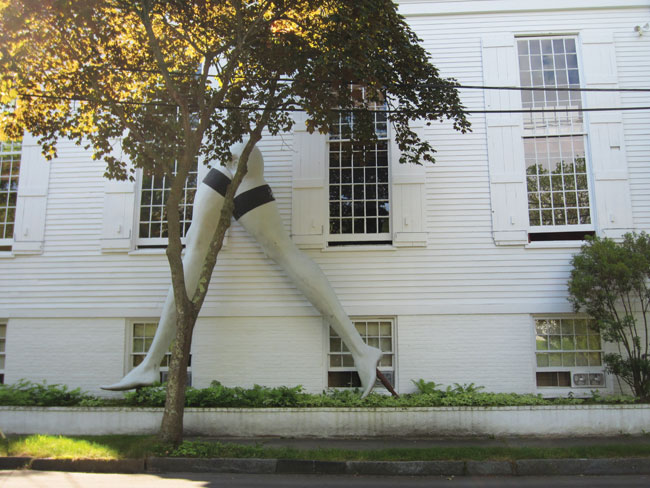
In Sag Harbor Village, the debate about what constitutes art hits below the belt—the garter belt, that is. The Larry Rivers sculpture that stands outside gallery owner Ruth Vered’s home in Sag Harbor has been the subject of ongoing controversy. The Sag Harbor Village Zoning Board of Appeals ruled that Legs, created by Rivers in 1969, has to be taken down by September 15. Apparently sculpture is considered both art and a structure: These legs ran afoul of the zoning regulations due to their proximity to the property line (only one foot where a 35-foot setback is required) and height (only 15 feet is allowed). To paraphrase ZZ Top, “She’s got legs,” but in this case the question is how she uses them.
Apparently sculpture is considered both art and a structure:
These legs ran afoul of zoning regulations

May the Best House Win!
Hamptons homeowners compete on TLC’s Four Houses
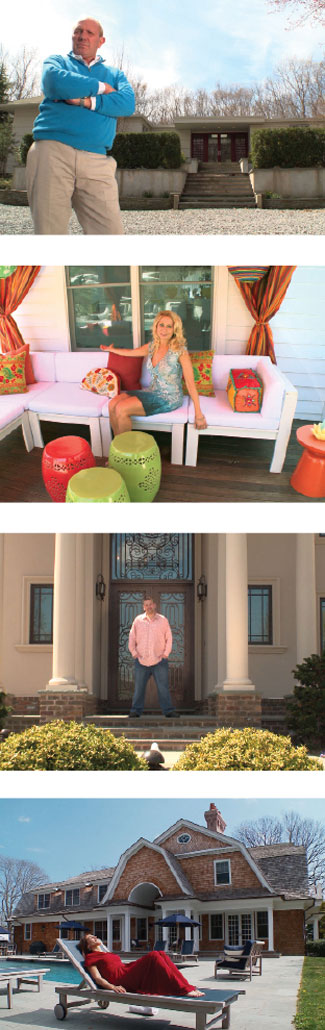
If you’re a fan of the TLC show Four Weddings, you know that brides can be fiercely competitive. Now the same producers are launching Four Houses, which proves that judging your biggest day has nothing on judging home sweet home. In the new series, four homeowners are invited to preview, critique, and score each other’s homes for the chance to win $10,000 and be featured in a home design magazine.
TLC promises that each episode peeks through the keyhole of homes that are as weird and wonderful as their occupants. The second episode of the series is set in the Hamptons and pits collectibles entrepreneur Matt and his Mediterranean-style Vegas villa against writer Anastasia’s classic Hamptons home, food businessman Monte’s contemporary, and single mom Ruth’s party-ready abode. Which Hamptons house would you vote for? Check out the results on Four Houses at 10 p.m. on Monday, July 9.
Chris Foster
HIDDEN RETREAT
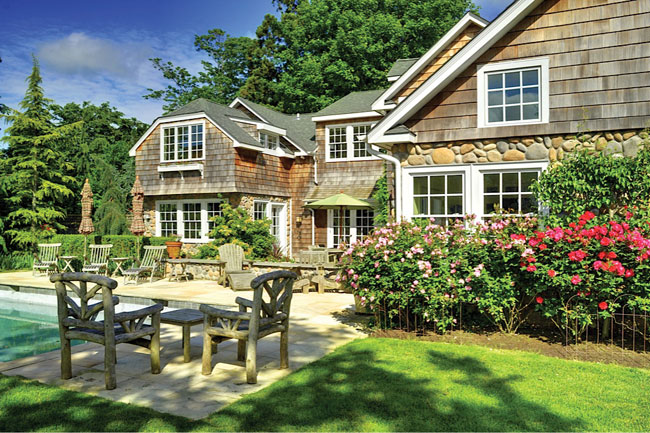
At the end of a private road off Newtown Lane in East Hampton, a historic artist’s retreat complete with studio space, gardens, and pastoral views of a neighboring tree farm is listed with Jen Wilson and Bill Stoecker of Town & Country Real Estate for $3,395,000. The traditional cottage entrance opens onto a surprisingly large 5,000-square-foot home. The 1900s house has been completely renovated, with five en suite bedrooms and a courtyard with pool and pool house/studio, all with southern and western views.
Whether you want to create a family compound or just keep your gardener nearby à la Lady Chatterley, an adjoining historic property with six bedrooms, five bathrooms, and heated gunite pool is available for $2,795,000. “It’s all within walking distance to East Hampton Village, but it feels far away and private,” says Wilson. “You feel like you could be in Napa.”
Owner Patrick Meehan, who traded working at Christie’s for the technology business, searched for the perfect hidden pastoral location for four years. Even third-generation Bonacker contractors who worked on the restoration during the past 15 years would ask, “Where is that?” Meehan says of his best-kept village secret. “The greatest compliment I have ever had was when an architect friend said, ‘You can’t tell where the old ends and the new begins.’ This has been my artistic and creative outlet.
“Houses like these speak to arts-minded people and entertainers in a very distinct way,” continues Meehan, who describes the overall look as “Next Millennium shingle style.” When she was making her Soldier of Love album, the singer Sade and her band spent a summer at the smaller house, and she still stops by to visit. Painter and illustrator Frank Sofo, whose projects include book covers for the Nancy Drew and Hardy Boys series, owned the larger house for more than 40 years. For any artist, “The good energy is undeniable,” says Meehan.

THE FIFTH BEATLE
Stuart Sutcliffe, the legendary “fifth Beatle” who passed away at age 21, actually preferred art over being part of what became the world’s most famous band. He lives on through his sister Pauline Sutcliffe, whose new book with partner Diane Vitale is In Conversation with Stuart Sutcliffe. The women have lovingly preserved Sutcliffe’s original abstract artwork and early photos of the Beatles in their East Hampton home, which is currently for rent. “You get very attached to his art,” says Pauline. “It goes into repose and comes alive again.” Of the Beatles in their early incarnation, she says, “They were so self-assured. They didn’t take prisoners.”
The four-bedroom, three-and-a-half-bath home with heated pool and pool house on one acre is available for $49,000 for July and August or $29,000 for August. “For someone who loves art and music,” says listing agent Priscilla Garston of Prudential Douglas Elliman Real Estate, “it has that extra element.”
SAG HARBOR: ROCK AROUND THE CLOCK
With a number of buildings—from the Bulova Watchcase Factory to the John Jermain Memorial Library to Village Hall—sheathed in scaffolding and protective netting, locals are likening Sag Harbor to “a poor man’s Christo.”
Luckily, the 120-year-old Bulova Watchcase Factory building on Division Street, vacant since 1980, is seeing new life, with Cape Advisors moving full speed ahead on the luxury condominium project. Even die-hard Sag Harbor boosters can hardly believe the reno is finally happening. Graffiti artists with spray cans have been replaced by construction workers using a special walnut-shell blast to gently clean the brick walls.
The building has a history of revival. The original Fahys Watch Case Company closed in 1931, a victim of the Depression. Sag Harbor’s private citizens and local businesses paid for the renovation and new machinery in order to reincarnate the factory in 1936, attracting Bulova for an almost-50-year run.
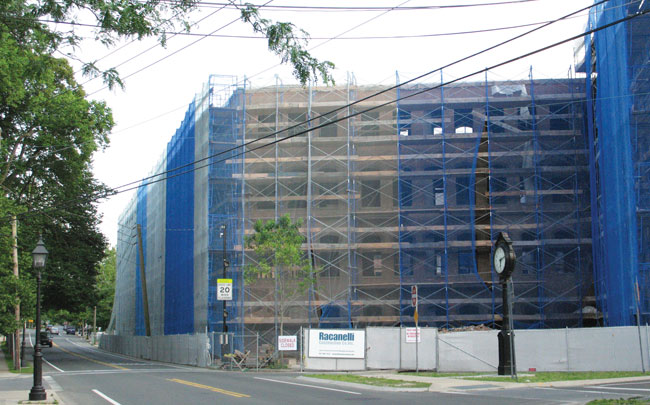
The Watchcase Factory (bought by Cape Advisors for $16 million in 2006) was also a victim of the economy when the development hit the recession head-on in 2008. Cape Advisors co-founder Craig Wood says, “We had a fairly long, arduous process to get our approvals, which we managed to obtain in late August 2008, before the economy went into a real tailspin. It didn’t seem the best time to start.” Deutsche Bank stepped in last fall to infuse $60 million into the project, fast-tracking the renovations.
The property will encompass 47 condominium residences ranging from studios to four-bedrooms, including penthouses and 17 new-construction townhouses. Manicured gardens and lawns, a swimming pool, fitness center, and underground parking are also in the works, according to the Corcoran Sunshine Marketing Group, which will be handling sales.
“We’re anticipating a sales launch in early 2013 for presales, and building completion in late 2013,” says Wood. “If we keep to our schedule, we’ll be putting landscaping in next summer.”

Of the design, Wood explains, “We’ve spent an enormous amount of time and effort to retain the essence of the building, such as the arched windows, exposed beams, and granite vaults. We’ve saved 20,000 bricks from the original structure. You just can’t match that patina. The townhouses were designed to look like unique Sag Harbor homes.” There’s already a waitlist, even though the prices have yet to be published.
Cape Advisors has tapped New York– and Sag Harbor–based designer Steven Gambrel to do the interior design of the residences and common areas. Quennelle Rothschild will complete the landscaping using all native plants. The exterior will be done by Beyer Blinder Belle, the preeminent American architectural firm behind such restoration projects as Grand Central Terminal, the Ellis Island Museum, and the United States Capitol.
Another stalled Sag Harbor condominium development is showing signs of life again. East End Ventures is reportedly working on securing financing to complete the 21 West Water Street Condos next to Baron’s Cove, which have been sitting dormant at about 75 percent completion, though the company needs to deal with a reported $3 million in liens from unpaid contractors recorded with the Suffolk County Clerk’s office. The listing for 21 West Water indicates 19 units ranging from approximately 1,500 to 2,000 square feet with prices ranging from $1.6 million to $3 million.
East End Ventures is also behind the proposed condominium complex on Ferry Road next to the bridge to North Haven. Recently, the firm’s $30 million lawsuit against the Village of Sag Harbor and its trustees was dismissed in federal court. It had alleged discrimination because the developers of the (then 65-unit)Bulova project were given exemption from the new village code, while their proposed 18-unit luxury condominiums at Ferry Road were subject to the code’s units-per-acre limitation. East End Ventures is reportedly seeking to find a way forward on both projects.
Village codes notwithstanding, what remains to be seen is if there’s a demand for a large number of expensive condominium units hitting the Sag Harbor market. Not mowing the lawn is nice, but for $3 million you can have a beautiful house with a pool and tennis court and not have to listen to your neighbor’s best “Poker Face” rendition.
SURFSIDE’S UP
While ever-popular Meadow Lane in Southampton recently celebrated a top sale of $28.5 million, Surfside Drive in Bridgehampton is running a close second, with a reported trade of 43 Surfside Drive for $27,253,000 from the Pamela Schein Trust to 43 Surfside LLC. Not only can Surfside residents count Donny Deutsch as a neighbor (he bought in 2011 for a reported $20.5 million), but the street is also known as the wealthy Hamptons oceanfront setting of the TV series Royal Pains.
Corcoran Group Senior Vice President Susan Breitenbach has sold many properties on Surfside Drive, some of them multiple times. “Buyers like the fact that Bridgehampton oceanfront is less formal than Meadow Lane and closer to everything,” she notes. “There’s also not much inventory. Everyone is out here looking, including financiers and international families, plus many renters who now want to own. Even on Memorial Day weekend, I was out showing $30 million properties.”
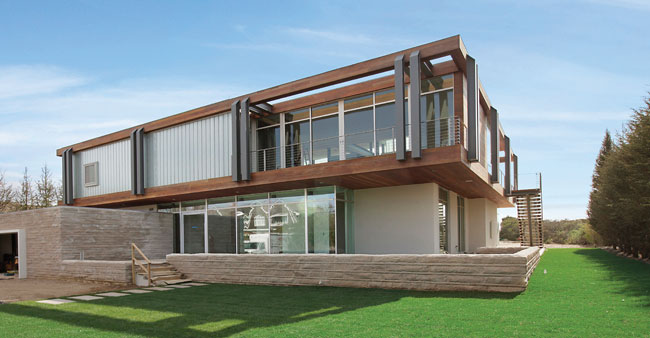
Breitenbach is seeing lots of activity on her listing at 263 Surfside Drive, a brand-new, Barnes Coy–designed 9,500-square-foot oceanfront with views of the Atlantic Ocean and Sagaponack Pond listed at $29,950,000. The seven-bedroom, 10-bath open modern not only has all the interior bells and whistles, including a full gym with steam and plunge pools, but also expansive outdoor living areas. The 6,000 feet of deck space includes two outdoor kitchens, an infinity-edge pool and spa, and a rooftop terrace and fireplace. “A number of top-end buyers who visit the best places in the world and stay in places like Aman resorts want a stunning house like this,” says Breitenbach. “There isn’t anything like it in terms of new modern on the ocean, especially with these ceiling heights. Now that FEMA has just changed the regulations, you can’t build something like this again.”