


BRING IN ‘DA FUNK
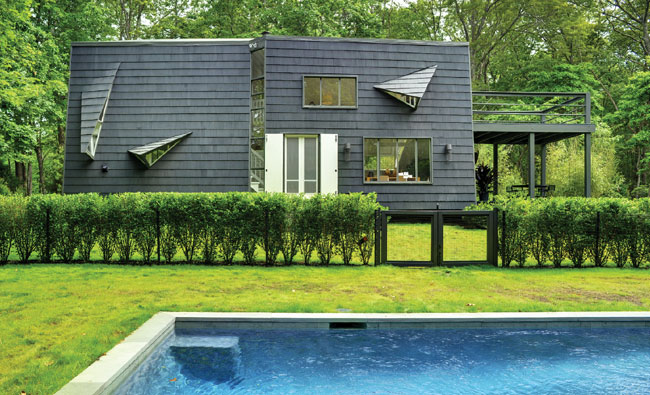
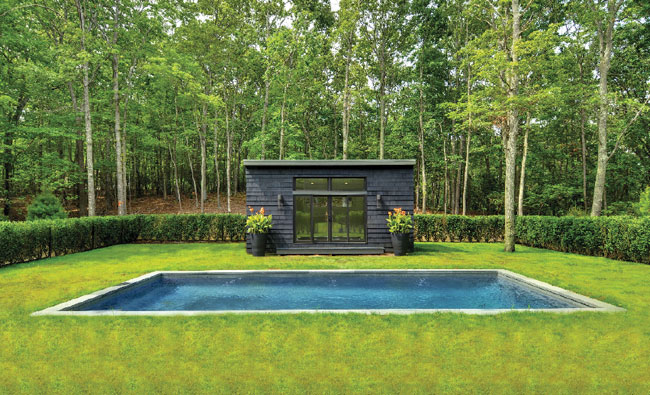
Among the ranks of such celebrated architectural adventurers as Julian and Barbara Neski and Charles Gwathmey is the lesser known modernist architect Andrew Geller, whose projects ranged from the Windows on the World restaurant atop the World Trade Center to the logo for Lord & Taylor. Geller created this 1960s weekend cottage in Bridgehampton (above) for Elizabeth Reese, head of public relations for Raymond Loewy, the industrial and design firm where Geller worked. The New York Times noted upon his death in 2011 that “Geller helped bring modernism to the masses” with his distinctive but modest vacation homes. The trapezoidal windows on the flat-topped A-frame were a nod to the abstract. They look like gills on a fish swimming on the five-acre property, where privacy was paramount, especially for nude sunbathing on the top deck. Listed for $1,595,000 with Corcoran Group Senior Vice President Cee Brown, this is the third home transformation by designer John Bjørnen and landscape designer Joseph Cornetta, who created a bright, open feel around a whitewashed stone hearth with a fully renovated kitchen, bathrooms, fixtures, and systems. “I’d loved this property and house for a long time,” says Bjørnen. “We wanted to breathe new life into the building and bring it up to date.” They also put in a heated gunite pool and a pool house with full bathroom and storage rooms. “You can fall in love with it as is or use this as a guest compound and create a new main residence elsewhere on the grounds,” Bjørnen says.
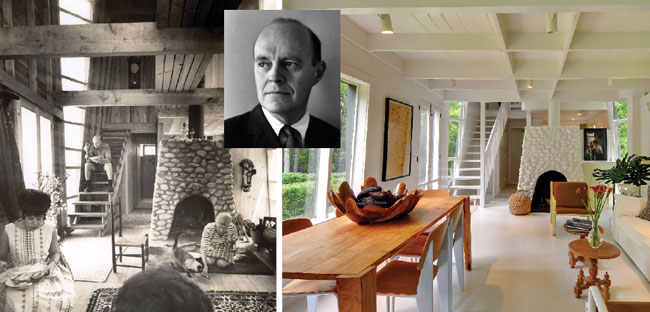
the Andrew Geller Architectural Archive
Notable Hamptons homeowners have always been passionate about their personal residences—from Andy Warhol’s clutch of cliff-top cottages in Montauk to industrialist Ira Rennert’s crowning glory, the 100,000-square-foot Fairfield on the ocean in Sagaponack. While shingle style has dominated East End architecture for centuries, a number of individualists have created unique structures that embody their own vision.
The six-story Montauk Improvement Building (now deluxe condos fetching up to $2 million) on the circle in Montauk is an ode to developer Carl Fisher, who purchased the entire 10,000-acre peninsula of Montauk for $2.5 million in 1925 with a goal of “Miami in the winter and Montauk in the summer.” Although he completed some of his vision (including Montauk Manor, which was the most luxurious hotel on Long Island), other plans, such as a deepwater dock to accommodate transatlantic steamers, sank when the stock market collapse put an end to a high-rise Miami Beach of the North.
The Hamptons has seen buildings become the canvases
for individual expression
And if a man’s house is his castle, Dragon’s Head on Meadow Lane in Southampton became the poster child for Camelot gone wrong. What started as Chestertown, a Georgian Colonial built in 1926 by Henry Francis du Pont, evolved into a playground for Baby Jane Holzer in 1970, then was later dubbed Dragon’s Head as financier Barry Trupin expanded it to the 55,000 square feet that neighbors called the “garish gargoyle” in the 1980s. The gothic castle was so large that even Trupin’s medieval armor collection, shark tank, and 16th-century Norman pub imported from France didn’t make a dent in the space. When Trupin went bankrupt in 1992, Worldcom’s Francesco Galesi bought and repaired the home, renaming it Elysium. Calvin Klein finally purchased the property and put the house out if its medieval misery, razing it in 2009 to make way for a
yet-to-be-completed modernist glass house.
With a long history of attracting artists, the Hamptons has seen buildings become the canvases for individual expression. Late sculptor and philosopher Mihai “Nova” Popa created the barrel-shaped Elliptical House in 1986 on Millstone Road in Water Mill as part of his “integral art” movement. “We like the archaic spirit and new forms of the house—old powerful wood beams and steel to give you a sense of timelessness; you may be in a galleon 500 years ago or a spaceship of the future,” explained Popa in a 2007 Newsday article.
Life force is also behind the Bioscleave House in East Hampton. International artists and architects Arakawa and Madeline Gins created the Life Extending Villa in 2007 on the notion that how you interact with your environment keeps you young. The bumpy moonscape-like surface of the interior keeps you on your toes, literally, supposedly stimulating your immune system.

Hello Hamptons!
What would living in an entirely pink house do for your health? On Bravo TV’s The Millionaire Matchmaker, Haute PR CEO Robin Kassner discussed her plans to build America’s first Hello Kitty house in the Hamptons, complete with Hello Kitty refrigerators and dishwashers from Italy. Needless to say, matchmaker Patti Stanger felt the all-pink house would seriously deter Kassner’s search for Mr. Right.
JOHN STEINBECK: THE WRITE RENTAL
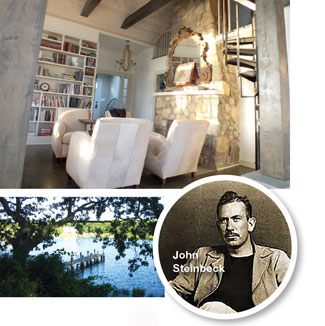
For the literary minded, a treasured piece of local history is John Steinbeck’s Sag Harbor home, “The Point,” which was recently listed for rent from July through Labor Day for $125,000. “It’s not just one writer’s dream, but a summer renter’s dream as well—a perfect Hamptons cottage surrounded with water on three sides with a dock,” says exclusive agent Doreen Atkins of Sotheby’s International Realty. “The interior is chic, down-to-earth comfort.”
The 1.8-acre waterfront property perches on a point with inspirational vistas, especially from Steinbeck’s writing studio, which was designed with the same dimensions of a riverboat captain’s quarters, a nod to his favorite writer, Mark Twain. The room, dubbed Joyous Guard, the name of Lancelot’s castle, still retains Steinbeck’s original writing table and chairs and the pencils he was famous for using in lieu of a typewriter for creating his literary classics.
The main two-bedroom cottage and sleep loft includes pictures of John and Elaine Steinbeck with presidents, celebrities, and world leaders. The original door frame still has marks measuring the height of extended family members and distinguished guests. And a portrait of Charley—Steinbeck’s beloved canine companion in Travels with Charley—remains above the hearth.
A cabin with its own story also graces the property. When the Cozy Cabins in Wainscott were being carted away, Steinbeck bought one on the spot to be moved to his homestead to accommodate his expanding family. Surprises were a Steinbeck specialty, it turns out, notably the pool that he built to surprise his wife as a birthday present upon their return from a European trip.