


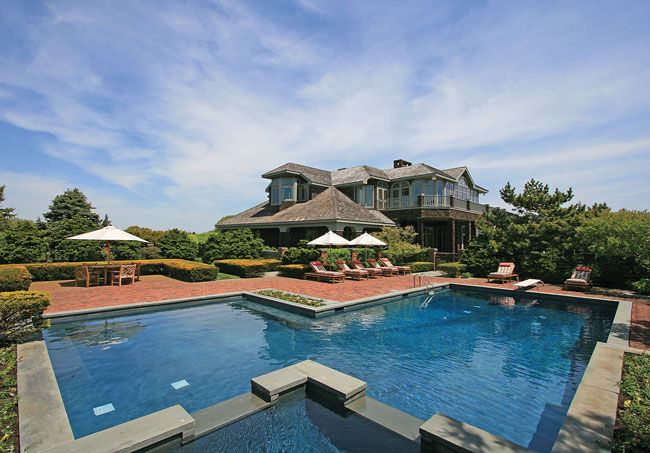
As 2010 comes to a close, many Hamptons brokers are reflecting on the year in real estate with a level of optimism that hasn’t been seen along Montauk Highway in years. “I think the 2010 market was 100 percent better than it was in 2009,” says Corcoran broker Susan Breitenbach, who in 2009 was ranked by The Wall Street Journal as the No. 6 broker in the nation for sales volume: $126.88 million, to be exact. “I’ve just recently closed $100 million in deals over the last 90 days, although other brokers haven’t been as lucky.”
When Bear Stearns and Lehman Bros. took a tumble earlier this year, transactions came to a halt. For Breitenbach, rebuilding a business when clients with $68 million listings were suddenly spending their Saturdays clipping coupons meant she had to take a different sales tack. “I remember saying to my son, ‘Don’t spend a dollar on anything!’” she recalls. “But now lots of people are making money again. They’re not grabbing things for $60 million without giving it a thought, but they’re spending.”
Most notably, billionaire hedge-fund manager David Tepper picked up Joanne Corzine’s oceanfront residence in Sagaponack for $43.5 million at the beginning of the summer. “It was definitely a record-breaking transaction,” says Breitenbach, noting that she had previously listed the property as a $900,000 summer rental, although no brokers were paid on the sale. “I don’t think there has been a trade anywhere near that price in the last two or three years.”
At Sotheby’s International Realty in Bridgehampton, 2010 sales for January 1 through August 31 were up 88 percent from last year. “There are people who are thinking we’re at the bottom, and then there are people who are thinking that there’s going to be another dip,” says Senior Vice President Dana Trotter. “Interest rates are at all-time lows, so it’s cheaper to finance. If you have good credit, it’s a great time to buy.”
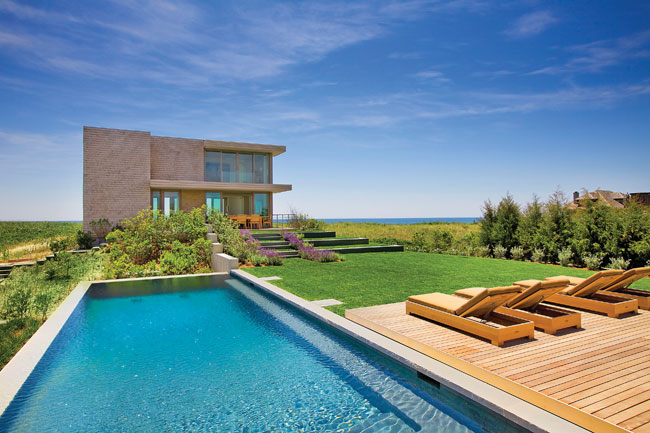
Ultimately, the market will recover when prices have adjusted to realistic levels and buyers begin to grab available inventory before inflation inevitably sets in. Sotheby’s recently worked with the Topping family in Wainscott to reduce the asking price of their 18-acre, sub-divided Arrowhead Farm from $72 million to $57 million. The four lots are still on the market and can be purchased in any configuration. “People don’t necessarily require such a large property,” she says. “It’s currently set up as a horse farm, but a buyer could easily have an estate on 14 or 12 acres or even less. So far the feedback is very good. And it’s a magical spot—one of a kind. You don’t see pieces like this on the market very often.”
Land sales have also picked up, as builders sell off existing spec homes and move on to new projects. “A spec house on a busy street north of the highway just sold recently, and it was listed at $4 million and change,” says Christopher Burnside of Brown Harris Stevens. “It got close to the asking price, which gave me confidence to start my own spec project on a property I bought awhile back for $1.6 million. I’ve held off for two years, but now I’m building a 6,000-square-foot modern farmhouse overlooking the Bridgehampton polo fields, and I’ve got it listed at $4.3 million pre-construction.”
Burnside, who adds that 2010 was the best year he’s had in a 12-year real-estate career, says properties in the $5 to $7 million range are selling like taffy at Dylan’s Candy Bar. “You can now get a new house south of the highway for $6 million, whereas previously that same house would have been listed for $8 million. The properties sell when they’re realistically priced and appear to be a good value, not when they’re overpriced.”
For some agents, summer 2010 was difficult, although the market typically doesn’t perform well when everyone would rather be at the beach. “It was better than summer 2009, but the rental market was not nearly what we had hoped for given a promising January and February,” says Susan F. McGraw Keber of Town & Country Real Estate. “Customers were predictably wary because of the instability of the economy, an uncertainty that had a considerable effect on the market.” Would-be Hamptonites, whether potentially renting or buying, were also in a pre-election holding pattern, she adds. “Fear over what the future holds is the key element directing people’s investment decisions. They just will not part with funds saved in case of job loss or illness.” Baby boomers in particular are putting their dreams of a second home on hold, sitting tight as their children complete college.