


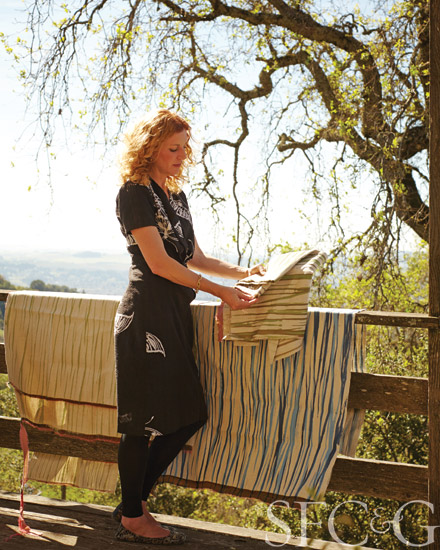
Anyone who insists that there’s an absence of seasons in the Bay Area should talk to Michelle Pereira. “It’s a myth,” says the textile designer, whose palette is heavily influenced by her pastoral environs and their seasonal imagery. “One of my staple colors is metallic umber, which was inspired by the rolling, grassy hills of late Sonoma summer.”
For the past 12 years, Pereira has called the small wine-country town of Penngrove home. Her 10-acre property includes a converted barn that she shares with her two young children as well as a cottage studio that sits on the crest of a ridge, affording her sweeping vistas. “I’m often graced by a natural event of some kind that will spur my creativity,” she says. “Like catching a glimpse of a lizard slithering under a rock or a Great Horned Owl cooing with its mate.” Her Cumulous pattern, for instance, was inspired by the cloud formations seen from her studio’s perch.

In 1997, she launched her firm, Michelle Pereira Studio, with an assortment of apparel and accessories including scarves, totes, wrap skirts and aprons. A decade later, Avner Lapovsky of Sloan Miyasato recognized that her fabrics would be well suited for the interiors market. His San Francisco showroom debuted her home line, and continues to represent her collection.
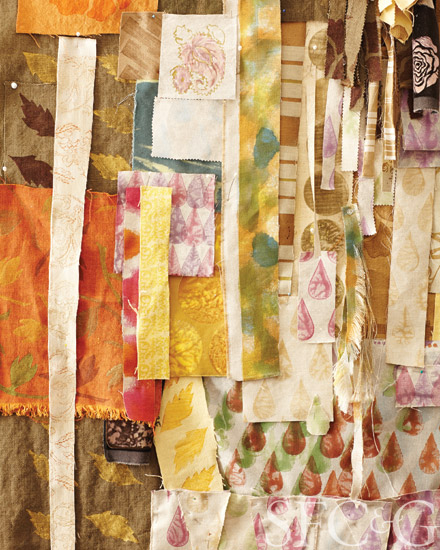
Today, Pereira focuses primarily on designing and meticulously hand-printing textiles. She releases two or three collections every year, with a total of about 20 to date. Her process generally starts with a pencil drawing of a motif, which is later cut out of a woodblock using a scroll saw. The magic, as she puts it, happens when the block is painted with one of her formulated colors and then pressed onto linen or velvet. “I work to create rhythmic patterns that, when examined, are full of slight imperfections that make the eye want to go further and explore,” she notes.
In addition to the block-printed fabrics, some of her designs employ Shibori techniques. The Japanese method of dying cloth dates back to around the eighth century and entails stitching, folding, twisting or tying to create a more refined tie-dye look.
By focusing on yardage rather than products, Pereira is able to devote her time to developing patterns while “someone else has the vision for what to do with it and how to transform it,” she says, recounting a closet that interior designer Paul Wiseman outfitted in Peony. He covered the walls and even the padded hangers in a saffron-hued version of the floral. Pereira continues, “It’s exciting to see a designer take what I do to the next level.”
