


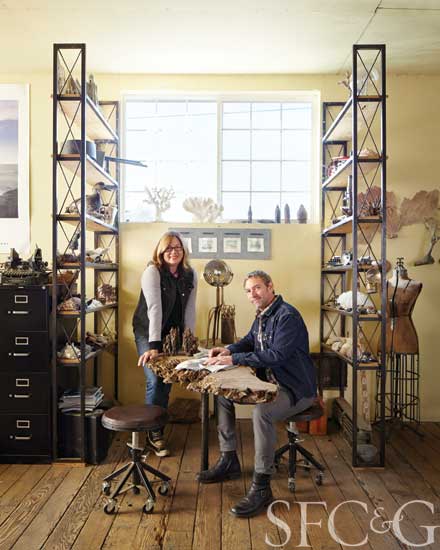
For 15 years, Randy Tuell and Victoria Reynolds have been crafting furnishings one might call “rough-luxe.” In their eponymous Cloverdale metal-arts studio, the pair forms bronze, iron and natural elements such as petrified wood and agate into lighting, case goods and accessories that are equal parts sculptural and organic. The duo’s new Sequoia tray table, for example, is solid cast bronze, but features textural wood rings whose verisimilitude belies their hand-carved origins. Here, the artists give us insight into their creative process, which, while rooted in nature, always yields something luxurious.
SFC&G: Natural texture paired with industrial sleekness is one example of the striking tensions in your work. Tell us, what are some other opposing forces that you employ?
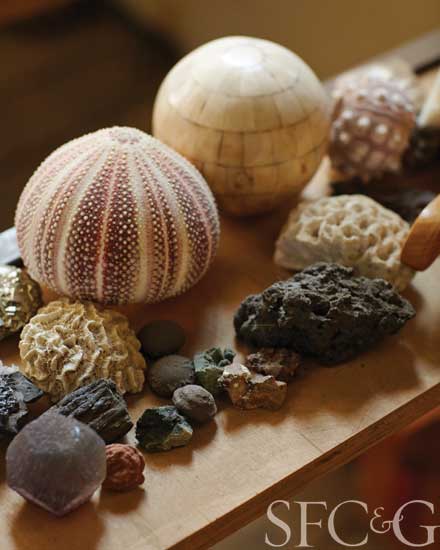
Randy Tuell: We’re starting to incorporate more natural materials into our metal art—natural stone, petrified wood from the northern Cascade Range, Brazilian agate. We’re inlaying our mirrors with lizard skin and buffalo horn, too.
Victoria Reynolds: Now that we’re gravitating toward these earthy elements, our work is feeling more organic, but in the most dramatic way.
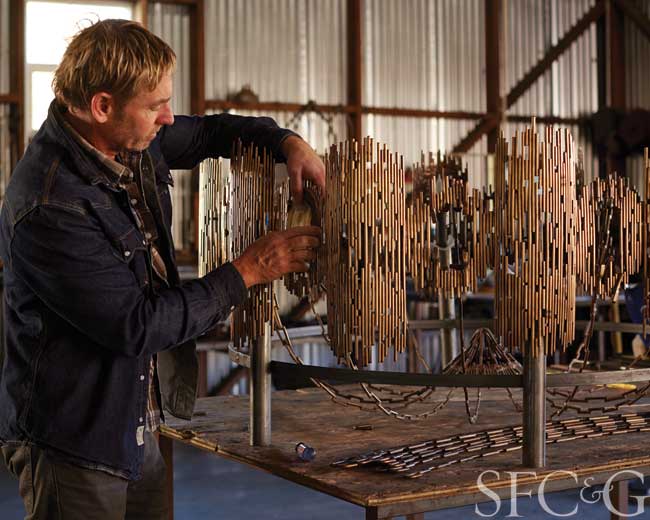
What’s the allure of an original hand-wrought piece?
RT: Well, there are always the inherent irregularities to appreciate as part of the beauty.
VR: The materials themselves are quite beautiful, so we don’t coat or paint our work. A lot of it looks like something you might find in a really special antiques store. They embody a timeworn gravitas. A lot of times, it can be hard to believe that they are actually modern works.
Is that the Tuell & Reynolds calling card?
VR: We also have this signature texture that’s created by carving wood with a chisel and then using the piece as a mold for sand casting. It’s linear, yet has some irregularity
RT: Above all else, durability is our trademark. Everything we make has a really long lifespan. And everything we do has value, even if we’re just talking about its weight in metal.
What in your environment inspires your objects?
VR: Randy and I both love old scientific equipment, antiques, vintage typewriters. We are literally surrounded by these things at the studio. You can probably also spot influences from [fellow Northern California metalworkers] Ned Kahn and Richard Serra in our work.
What parts of the artistic process do you enjoy, or even dread?
RT: We don’t always know how something is going to turn out. We really enjoy letting the process evolve. Sometimes you reach a point where you’re like, “I’ve put a lot of work into this. I hope it turns out okay!”
VR: You definitely need a certain amount of faith and vision. There are times when our creations are not looking their best, especially when we’re pushing design boundaries. But in those moments, we remind ourselves that things are actually pretty interesting when they’re verging on ugly.