


she unfolds a map of the
Eastern seaboard on which she’s drawn a bold red line from Connecticut to Prince Edward Island. “I’m trying to figure out if it’s cheaper to drive them up or ship them,” she states, tracing the route with her finger. “I’ll have to take the truck—they won’t fit in my car. Fourteen hours. It would be a nice trip, and I think I’d save some money bringing them myself.” That’s what Annie Farrell usually decides: to do it herself. In this case, it means hauling several hundred pounds of sheared sheep’s wool to a maker of artisanal blankets in Canada. Dozens of pillowy black plastic bags are scattered about, making her office look like a Goodwill depot. Each bag contains the wool of a single sheep; one is a misty gray, another the color of dirt streaked with charcoal, a third a deep, inky midnight black. The wool begs to be touched and inhaled, and gives off a musky perfume of dry hay and lanolin.
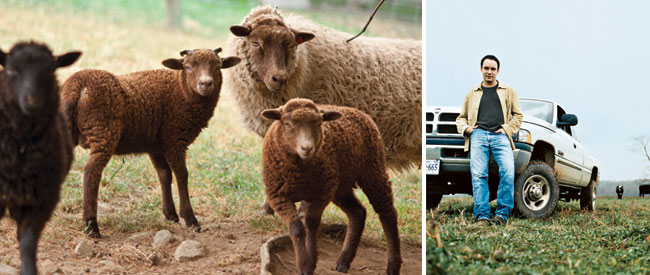
It’s a midwinter day in Wilton, and there are several feet of snow on the ground at Millstone Farm, where Farrell earns her living as a Master Farmer. In 2006, family foundation managers Jesse Fink and his wife, Betsy, a long-term board member of the American Farmland Trust, hired Farrell to turn their newly purchased 75-acre property into a working farm. Today, Millstone supplies its succulent produce to such top chefs as Michel Nischan (Dressing Room), John Holzwarth (The Boathouse at Saugatuck), Bill Taibe (LeFarm) and Tim LaBant (The Schoolhouse at Cannondale). Millstone also operates a small Community Supported Agriculture program (CSA) and makes weekly deliveries to Wilton’s Village Market. Farrell often makes those deliveries herself. She oversees Millstone’s operations, from its greenhouses to its mobile chicken coops to its livestock. In warmer weather, grazing sheep, free-ranging chickens, happy pigs and graceful horses dot the rolling hills, separated by pre-Revolutionary stone fences. But in the winter, Farrell brings the hatching inside. Electrical cords snake around the bags of wool, tethered to incubators filled with multicolored hens’ eggs. Farrell started this batch of hens early, “so they’ll be laying by fall,” she explains. In the spring, Millstone lends the incubators to a local school where the kids hatch the eggs as a science project. Among the school’s students are the children of singer Harry Connick, Jr. The previous year, she says, “They fell in love with the chicks and ended up bringing them home, so we taught the family how to care for them. Now they’re good friends of the farm.”
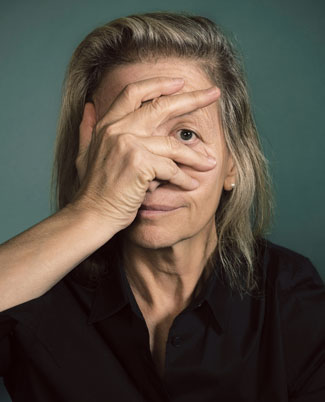
As more eager and often high-profile landholders adopt the gospel of sustainable farming, they need an expert to help them. Enter Annie Farrell, farming consultant. Bringing four decades of agricultural wisdom to bear, she’s designed and resurrected dozens of organic farms and gardens on the East Coast, harvesting a bumper crop of famous friends along the way. She freely shares stories of fabulous dinners with celebrity chefs; of catching roosters with legendary photographer Annie Leibovitz, of rubbing elbows with Paul Newman and his daughter Nell. At the 2007 Global Environmental Citizen Awards ceremony, she met HRH Prince Charles—and afterwards apologized for the roughness of her hands.
“Two years ago, Nell Newman did a photo shoot for Vogue at Millstone, and that’s how I met Annie Leibovitz,” she says, as she folds up her map. “She asked me to take a look at her place and help her with her gardens.” That’s how it usually goes with Annie Farrell: Everything is connected, and everyone is drawn in by her humility and humor. Yet she’s anything but starstruck: “I’m really only comfortable and grounded when I have both hands in the dirt.”
joe erario (sheep), courtesy millstone farm (2), and jake chessum (dave matthews)
Star chef and sustainable food pioneer Michel Nischan is one of her many fans. “Annie is one of the most dedicated cultivators of soil and relationships,” he says. “She’s part farmer, matchmaker, visionary and chatterbox—all rolled into one beautiful package. Makes damned good pickles, too.”
Farrell also makes public appearances at events devoted to the sustainable use of land and resources. Her overarching mission is to teach Americans why and how to produce their own food in their backyards and urban homesteads. Ironically, she was once an urbanite herself. Born and raised in New York City, where she attended Music and Arts High School, Farrell describes her upbringing as “classically Manhattan.”
“Dad was a New York City police detective, Mom was a Lord & Taylor lady, and among the freaks at my high school I was more Lord & Taylor than freak,” she explains. Yet as far back as she can remember, she longed to nurture nature. “As a little kid in the city, I would sit on the stoop, and there was a cherry tree right next to the stoop. The cherries would hang down and I could pick a cherry and eat it. That blew my mind—that I could pick cherries right off the tree.” During summer visits to her uncle’s cabin in northernmost Westchester County, she’d ride her tricycle to the dairy farm down the road. “I wanted a horse. Farmers had horses, so I wanted to be a farmer.”
In the 1970s she bought a piece of land in Bovina, New York, for her farm, living in a house built by hand from native stone and salvaged barn boards. Her neighboring farmers, a group of independent and thrifty old-timers, showed her the basics. “Nothing I learned in school was relevant to what I’m doing now except that I wanted it to be artistic and beautiful. I had zero academic training for this.” She began cultivating baby lettuces, mache, chervil and edible flowers in her fields and greenhouses—the kind of specialty crops that chefs like Alice Waters were touting on the West Coast, but that were practically unheard of in the Northeast. Undeterred, she launched Annie’s Elegant Vegetables in the early 1980s. She found a market for her fancy produce in the gourmet groceries and restaurants of New York City. “The guys from Balducci’s saw me pull up and would say, ‘Hey the veg lady’s here!’ So that’s how I became known.” The moniker is now her license plate and e-mail address.
Farrell’s unconventional lifestyle attracted attention from Ms. Magazine and Gourmet. Yet, while her business thrived, dairy farms in the Northeast were going under, and she began consulting with other farmers on how to grow and market specialty crops. “The downfall of farming was monoculture,” she says. “The dairy model was hybrid corn or grain from outside, with inputted fuels and big combines requiring lots of fossil fuels. My goal was to get them to diversify.”
In 1986, when an opportunity arose to help develop Cabbage Hill Farm in Westchester County, Farrell eagerly joined forces with owners Jerry Kohlberg, the Wall Street legend (and the first “K” in KKR), and his wife Nancy. “We had so much synergy and big ideas about sustainability and small farms and growing food in closed-loop systems,” she recalls. “Jerry asked me to help them create what he called ‘the big rocket ship’”—meaning a model of sustainable farming that included the preservation of rare breeds of farm animals. “Within a few years, we had opened a slaughterhouse and a restaurant showcasing regional foods.” That restaurant, Flying Pig on Lexington, in Mount Kisco, was one of the first local-food restaurants. She also spent years developing and refining a revolutionary aquaponics system “until it worked just right.”
This creativity and tenacity landed Farrell other gigs in the area and some farther afield. Westchester County hired her to write a master plan for a sustainable agriculture education center at the 175-acre Hilltop Hanover Farm. In 2003 she got a call “from somebody who said we need consulting help with a large farm in Virginia, the Best of What’s Around Farm. I looked it up. It was Dave Matthews’ place.” The musician and his wife had purchased the 1,200- acre farm and placed it under a protective land easement to ensure it would never be developed. Their next step was to create a certified organic farm. The farm already had a CSA and a vineyard, and Farrell drew up plans for a goat dairy. With her input, they developed a strategy that would make the farm more efficient, productive and easier to operate.
Over time, Farrell took on an activist role as a defender of farmer and field. She lives in Yorktown Heights in Westchester, and when some suburbanites harassed her farmer friends over the sights, sounds and smells of their operations, Farrell drew on her political capital and pushed the county to create its Agriculture and Farmland Protection Act. She enlisted the gentry of Bedford Hills and environs—families that had been farming there for eight generations—and invited newcomers like Martha Stewart and David Rockefeller to sign on. “That’s how Mr. Rockefeller got to know me,” she says.
It turned out that Mr. Rockefeller needed help turning his Westchester estate, Stone Barns, into a working organic farm and restaurant. Farrell pulls out a worn blue folder containing her original computer-generated design. Looping dotted arrows point out the linkages from field to fork and back to the fields. That master plan, covered with her chicken scrawl notes, was the inspiration for the now-celebrated Stone Barns Center for Food and Agriculture.
Farrell’s farm-design process, from planning to execution, is meticulously plotted and recorded. “Whether it’s one-sixteenth of an acre or two hundred acres, I map it. If it’s a tiny little plot, I map it on Excel by the square foot. For a large farm, I’ll use an aerial photograph and overlay a grid of where the various components are going to be. Then I do a micro-map of each component: where the gardens should be, where to pasture chicken or sheep.”
In 2006, the Finks sought her services. Like Farrell, Betsy Fink, a native of Ithaca, New York, dreamed of becoming a farmer. In 2005, her dream came true when she founded Millstone. “I studied forest ecology and soil science, geology, hydrology and did my graduate work in land reclamation. I felt a huge need to have hands-on experience,” Fink says. “Annie learned from the old-timers. In my mind it’s really a perfect combination because the intersection of all these areas really creates a more sustainable, healthier farm.”
Fink and Farrell have developed a deep and symbiotic partnership. Millstone is their vehicle for developing best practices that integrate wisdom from the past with new technologies and innovations, which they then bring to the community. “Annie understands how all the systems come together, and she executes on my vision,” Fink says.

Farrell works year-round with a marked sense of urgency, not so much to complete the task at hand, but to get ahead of her fear of impending regional and global shortfalls. She speaks of food security, peak oil and climate change in both pragmatic and apocalyptic terms. To her, adopting organic and sustainable practices isn’t merely fashionable; it’s imperative. “There has to be some incentive to get people to hire a NOFA-certified landscaper,” she says, referring to the Northeast Organic Farming Association. “Towns should give a tax break. Sooner or later there won’t be any choice. They won’t be able to get the chemicals, and all the things that go along with the chemicals. We won’t be able to get gasoline.”
“Annie’s felt this urgency since the day she started farming,” says Fink. “She had great insight into seeing what bad farming did for the land and what good farming did for the land. She understands our plan. She’s a great networker. And she’s so inspirational to everyone, and especially great with the kids.”
Entrepreneur Nell Newman, president of Newman’s Own Organics, concurs. “Annie Farrell is one of those people whose breadth and depth of knowledge takes your breath away. The little time I’ve spent with her was a learning experience I will never forget.”
Now that Millstone is “humming along,” Farrell and Fink are focused on building community. They support new organic farms and gardens in suburban backyards and urban “food deserts” around the region. They teach teachers, host school groups and workshops, and employ a handful of summer interns on the farm. They’ve helped build a 200-plus family community garden at Fodor Farm in Norwalk, and Farrell is working on plans for an edible garden at Stepping Stones Museum for Children. Part of what they’re teaching is economics. “We try to look at the cost of inputs and minimize all that and show that you can grow this much on a square foot and do it all by hand.”
This grass-roots component is part and parcel of Millstone’s mission of building a healthy local food system that enhances the natural and social environment: “It’s the anti-precious; that’s what turns us on,” she says. While she continues to design sustainable “rocket ships” for the future, Farrell’s advice for now is simple: “If you can’t do it yourself, join a CSA or neighborhood garden. It’s best if it’s in walking distance.”