


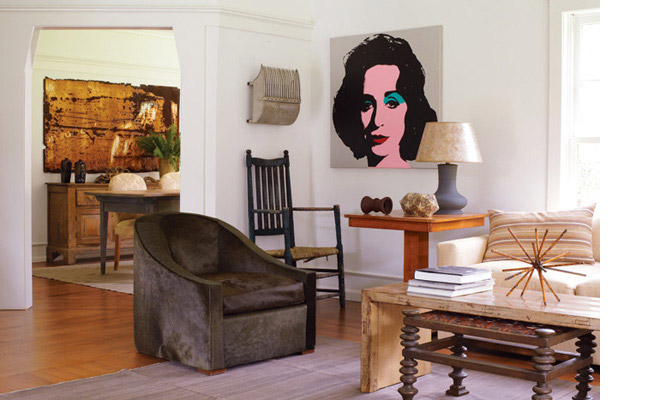
Susan and Steven Jacobson’s shingled East Hampton house sits quite happily on its adequate land—not at all as intrusively as the many shingled dinosaurs that invaded the South Fork of Long Island in the 1980s and ’90s. The interior is comfortably scaled, with an open floor plan and numerous windows and small terraces on its three floors that continuously invite the outside in. The airy, playful interior, designed by James Huniford, incorporates art that the Jacobsons have collected in the last decade. Like a number of the artists’ works on view, Huniford mixed genres, incorporating antique industrial and architectural elements into his design. High and low, art and non-art artifacts enliven the space and exist in cheery symbiosis. “Working with a client who has an art collection like this really brings out the passion I have for interesting, artful objects,” says Huniford. “It challenges me to find one-of-a-kind pieces that complement the art.”
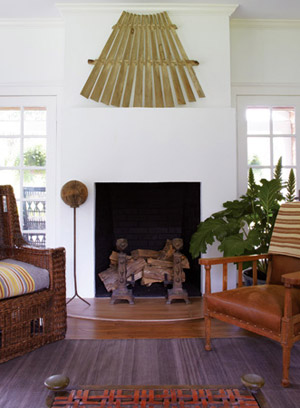
A jubilant painting by Deborah Kass, in which she appropriates Andy Warhol’s silkscreen portrait of Elizabeth Taylor to create a portrait of herself, hangs at one end of the living room. A rare cranberry rake from the early 20th century hangs on the wall perpendicular to this work. Its metallic shine mirrors the silver background of the Kass; its curved shape echoes Taylor-cum-Kass’s hairdo. Over the fireplace hangs a section of a 20th-century windmill. At the end of the living room, in front of glass windows and doors, sits a cylindrical wire armature buzzing with brightly colored, found ceramic and porcelain birds, bangles, beads and more to challenge their paler-feathered kin just outside closed doors. Nick Cave, the maker of this joyous aviary, is an Alvin Ailey–trained dancer, sculptor, master sewer and creator of what he calls “Soundsuits” that can be either exhibited on mannequins or worn for performance. The eclectic mix of furniture in a neutral mix of colors provides plentiful ease. “Ford has the uncanny ability to combine found objects with contemporary art, antique furniture and modernist pieces,” says Susan Jacobson.
Art and non-art artifacts enliven the space and exist in cheery symbiosis
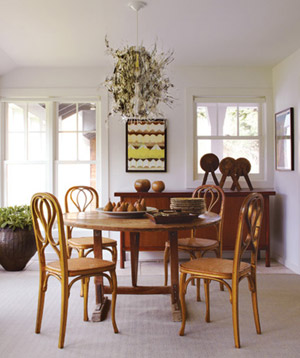
In the adjoining dining room, a large, gorgeously rusted advertising sign from the 1930s that was once on the side of a WPA truck hangs above the sideboard and dominates the room. On a shorter adjoining wall are two works by Vik Muniz, a wizard of visual puns. In the labor intensity typical of most of his works (in mediums that range from dust to soil to chocolate), Muniz painstakingly draped thread into 19th-century landscape configurations similar to those created by artists such as Camille Corot, and then photographed the outcome. What conventionally would be a documentary record of artistic process becomes the artwork. Two processes, corrosion and documentation, engage in stunning dialogue.
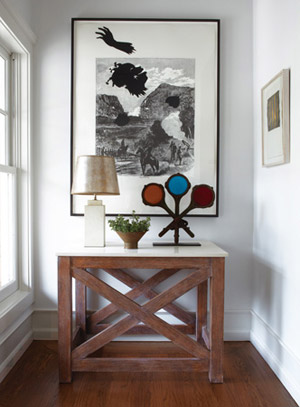
Throughout the house, this mix of art, design and industry continues to engage the eye. On the landing, a shallow, rippled, bowl-like piece of glass sits on a round tabletop—a lens from a disabled lighthouse, possibly, although to the non-trained, modern eye it could easily be a confection by Steuben. And also on that landing, a wonderful 18th-century American chest of drawers is covered with painted feathery bunches that happily mirror 20th-century abstract painting, just as in the master bedroom, a sleek conical shape, once a foundry mold, lies on the table in front of the bed and harkens back to the pure forms of some of the abstract sculpture from the last century. “There are visual surprises to be seen in every single room,” says Steve Jacobson, clearly enthralled with the matchless juxtaposition of art and objects. “We now have the perfect house to share with our family and friends.”

Like the artists’ works on view, Huniford mixed genres, incorporating antique industrial and architectural elements into his design

