


I have made no secret of my belief that if you can resolve a project’s architectural challenges rather than decorating around (or over) them, then the finished home will live, work, and look better. This house, beside Long Island Sound in Greenwich—a town stocked with prosperous folk with a taste for residential traditionalism—subjected my belief to a kind of stress test. I couldn’t “fix” the interior architecture because there was, in effect, no architecture to fix—to connect the house to the character, conditions, and customs of Fairfield County, I had to put it in. Rather than being burdensome, this proved to be a matchless opportunity, a lesson in the interconnections between space, connectivity, flow, and views; in the selection and deployment of classical mouldings and details; in the relationship between design and context; and, not least, in the braiding of a historic architectural style with decoration supportive of a modern way of life.

Great opportunities, of course, require generous clients. This couple—he is one of the more charming individuals I’ve met; she is surely the most organized; both are easygoing, family-oriented, and very funny—had decided to depart New York City and resettle in the country. These people were transitioning from a Manhattan townhouse, distinguished by a largely neutral color palette that served as a backdrop for a well-judged collection of blue-chip twentieth-century art. While the life they had in mind, exemplified by the spectacular water views from the windows, was different from the one they’d led, my clients still cared deeply about what they saw on the walls. A large part of our task, my partner, Mercedes Ganes, and I understood, involved integrating that collection into a less formal, more relaxed way of life, and this couple was entirely encouraging of our efforts.

I knew from our preliminary conversations that our clients had a dream, and when I first laid eyes on the house—a romantic white clapboard structure with inviting porches and decks—it seemed clearly on display. But it would be hard to overstate the shock I received upon entering—without, it was an elegant, traditional New England coastal residence; within, it was a SoHo loft. The developers had apparently assumed that the New Yorkers who were, at the time, fleeing Covid might wish to replicate the downtown “haute hipster” lifestyle, and so there were no rooms. I found stripped-down, undifferentiated spaces, utterly lacking in warmth, intimacy, and character.
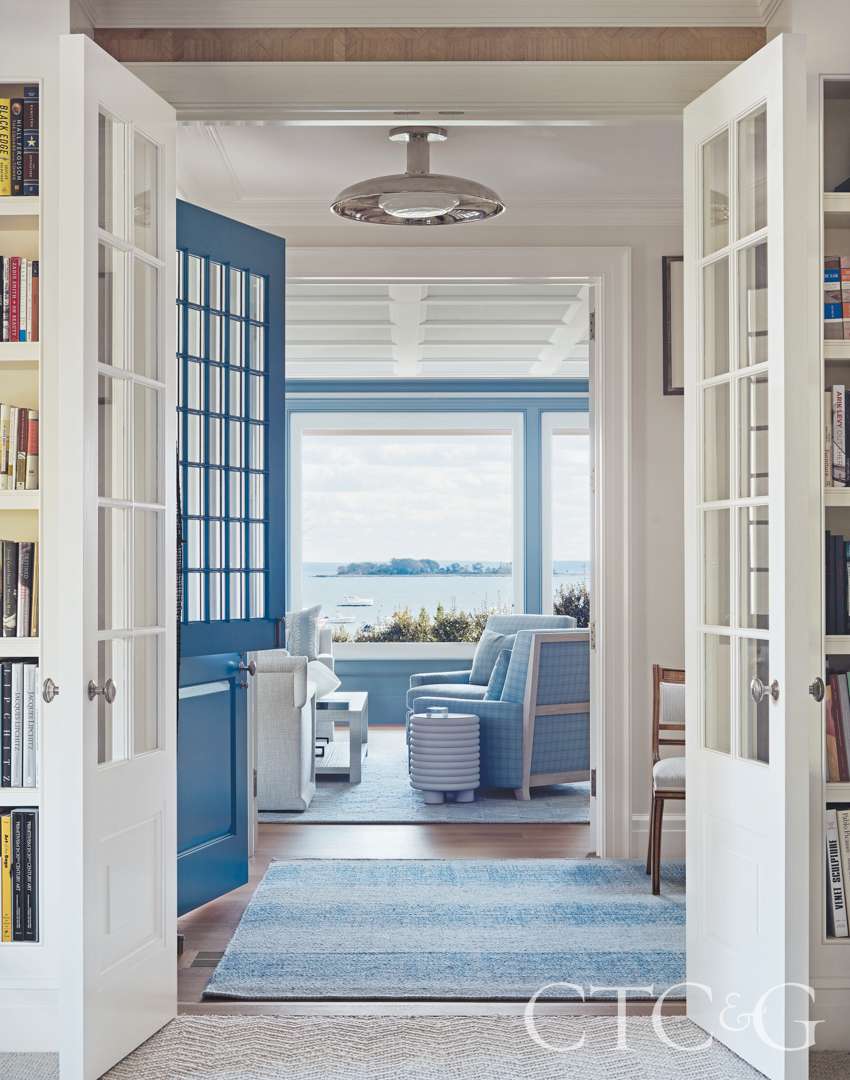
A view from the library through the entry hall to the living room and, beyond it, Long Island Sound—the inspiration for the layered shades of blue found throughout the house. My office supplied the entirety of the interior architectural articulation.

An archway lightly separates the living/dining room from the bar, exquisitely designed by my partner Mercedes Ganes. (I especially appreciate the overscale fluting—classical in style, surreal in character.) Sited to the left of the bar, the table’s banquette resides in a niche beneath its own arch, supported by a Rodin bronze and a pair of works by Mark Tobey.
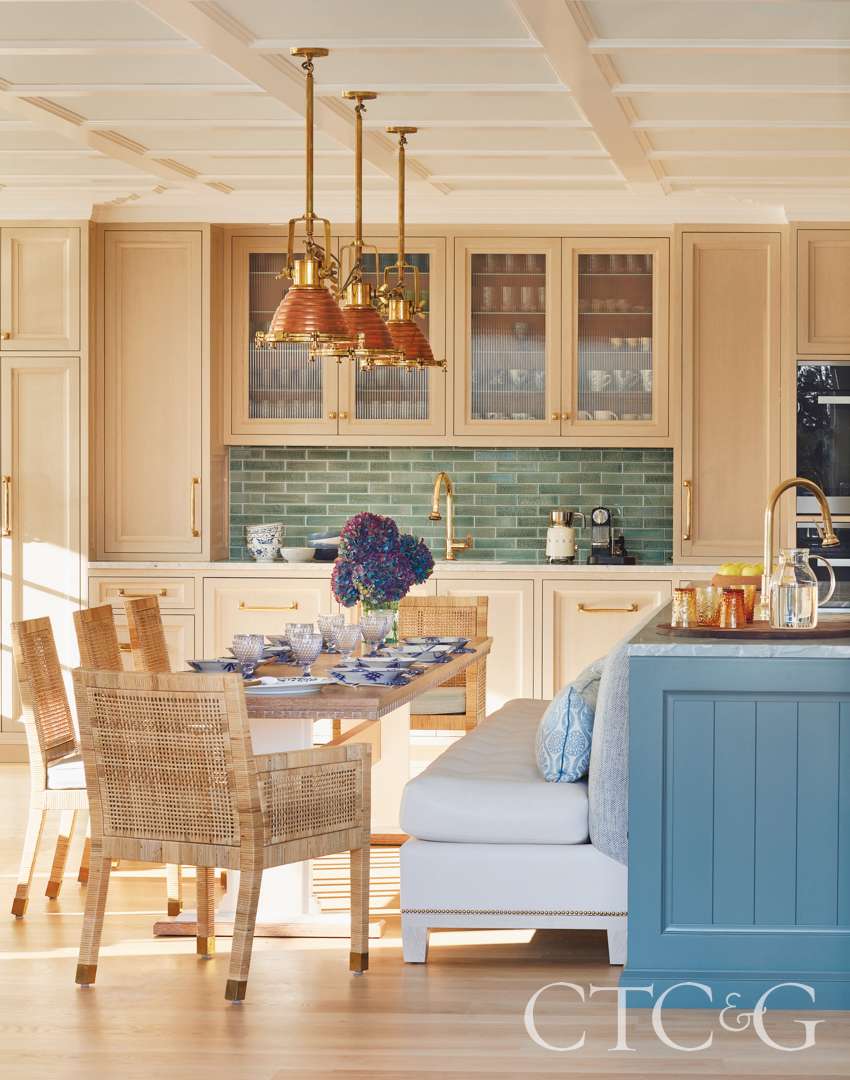
The graciously scaled kitchen/breakfast room boasts rattan chairs originally designed by Billy Baldwin in the 1960s. My office created the trestle table, the cabinetry, and all of the architectural detail, from floor to ceiling.
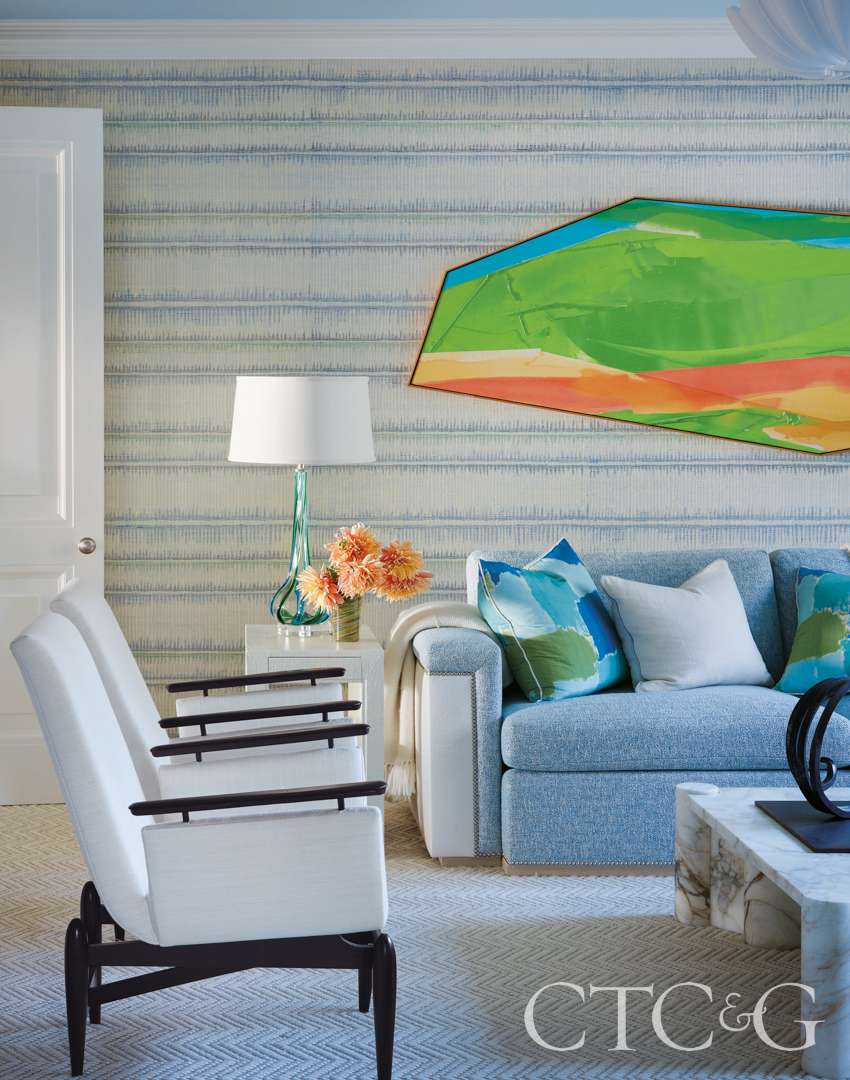
In the family room, we turned the wallpaper sideways, so that its lines would express the calm of the horizon beyond the windows. Decorative elements include a marble Gae Aulenti coffee table, Italian sling chairs from the 1940s, and a custom sofa—its end walls upholstered in leather, the cushions covered in chenille. A colorful work by Kenneth Noland hangs above.

A significant challenge: making my clients’ black-and- white Manhattan art comfortable in a Connecticut beach house. I discovered a sixteenth-century Italian bench that captures the flavor of the artwork above it; iron sconces complete the tableau.

In the primary bedroom, which adjoins the lady’s office, a magnificent Biedermeier chest from my clients’ previous home radiates warmth and vitality.
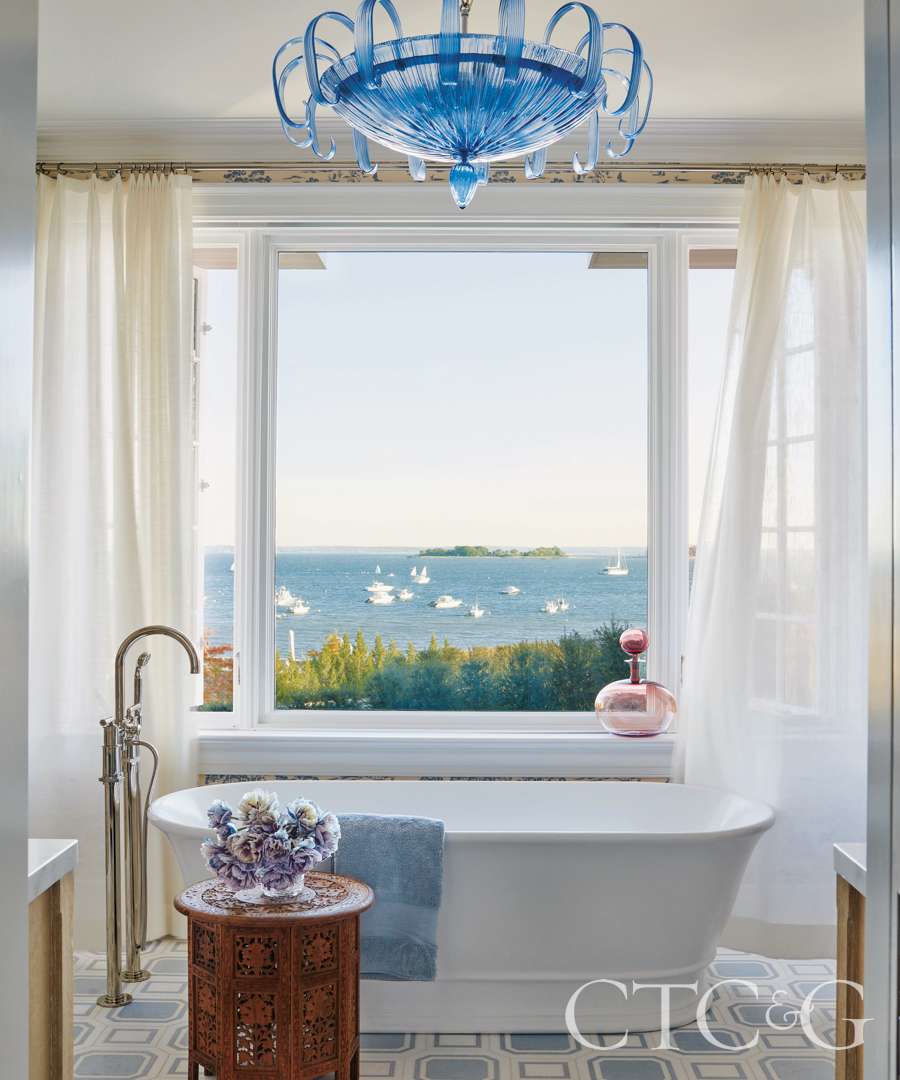
Exquisitely beautiful in its own right, peerlessly evocative of the water, a cerulean Murano chandelier in the bath expresses everything that is best about this home and its setting.

This guest room, with its layered patterns and textures, is at once the most traditional room in the house and also—thanks to the untraditional wallpaper—strikingly contemporary. That mix, of familiarity and modernity inextricably intertwined, remains one of my favorite definitions of elegance.
The house’s main, public floor conveys my response. As noted, my clients are relaxed individuals, comfortable in their own skin, and liked the idea of fluent, communicating rooms, especially as their family is a large one. My idea was to create interlocking experiences that were differentiated but conveyed a sense of unity—this was my objective even in multi-functional areas, notably the living room, in which a dining table loosely separates the formal sitting area from a fully equipped, carefully detailed bar. The rooms have definition, but they also flow, visually as well as actually. Onto these experiences we layered paneling (on the ceilings and walls) and a robust moulding program to counteract the acres of undifferentiated drywall that had initially greeted my eyes.

Having conformed the interior architecture to the house’s Edwardian exterior profile, Mercedes and I then integrated contemporary decorative flourishes into the largely traditional setting. My clients brought a selection of antiques with them from New York, but these are the exception. Rather than looking for inspiration to the classic English country house style of Nancy Lancaster or the lively American elegance of Sister Parish—decorative genres that predominate in the region—I created furnishings modern in flavor and casual in character. Many pieces were custom designed by my office—these were augmented by vintage (as opposed to antique) furnishings, notably the Italian sling chairs and Gae Aulenti coffee table in the den, and a set of classic Billy Baldwin–designed wicker chairs around the kitchen table. As for the palette, the presiding shade, on the walls and in the fabrics, is a rich, gentle blue. The color serves as an excellent foil for my clients’ astonishing art collection and the strongly silhouetted sculptures found throughout the house. Not least, it captures the experience of the mist-softened sky and ever-shifting, shimmering, omnipresent water views—which is why these former New Yorkers chose to live here in the first place.

As interior designers, when undertaking complicated projects, we get involved to a greater or lesser degree in changing a home’s structure. Sometimes this involves collaborating with an architect, other times we will give detailed drawings to a builder or contractor and draw on their expertise. Here, Mercedes and I were compelled to create a comprehensive architectural vision for what amounted to a blank slate. It continues to teach me about the value of knowledge gained from scholarship and personal experience, the creative opportunities that arise from connecting a client’s desires to their physical circumstances, and how complicated it can be to knit together one’s decorative and architectural impulses. I love what I do, and never tire of the challenges that each project presents. To be professionally creative—to make a living with one’s imagination—is a gift, for which I am endlessly grateful. How lucky can a guy get?

Excerpt from Defining Elegance (Rizzoli, 2025) by Marshall Watson, reprinted with permission.
