


The Basque region of Spain put on a spectacular Food and Wine Showroom this fall. They brought in their heavy guns: three-star chefs from San Sebastian, among them Chef Juan Mari Arzak (Restaurante Arzak).
At an intimate lunch for only about 30 people held at (appropriately enough) Bar Basque in Manhattan, the legendary three-star Michelin chef, Martin Berasategui, presented a multi-course tasting menu of his greatest hits over the years. Courses that dazzled the mind and the eye—from mille-feuille of smoked eel, foie-gras and green apple (1995) to oyster with cucumber, sour fruit and kafir (2011)—all served with regional wines from Rioja Alavesa (brilliant distinctive reds) and Txakoli (lightly effervescent wines).
I sat at a table with Mr. No Reservations himself, Anthony Bourdain, and he had a lot to say about the Basque region. Bourdain has a loving history with chef Berasategui. In 2000 he did an episode on Berasategui and Basque cuisine and he went back a few years ago to revisit his brilliant friend. “Chefs love him,” Bourdain said. “He can often be found at a local bar at 4 a.m. with adoring young chefs around him, debating the latest hot culinary topic—like, ‘is umami a taste or is it a sensation?’”
Bourdain went on rhapsodizing as we had one creative course after another—now now grilled sirloin over a bed of Swiss chard chlorophyll and cheese bonbons paired with Martin Cendoya Reserva Rioja 2007. “For me the Basque region is the most exciting culinary area in the world,” Bourdain said. “It’s the center of Western gastronomy.”
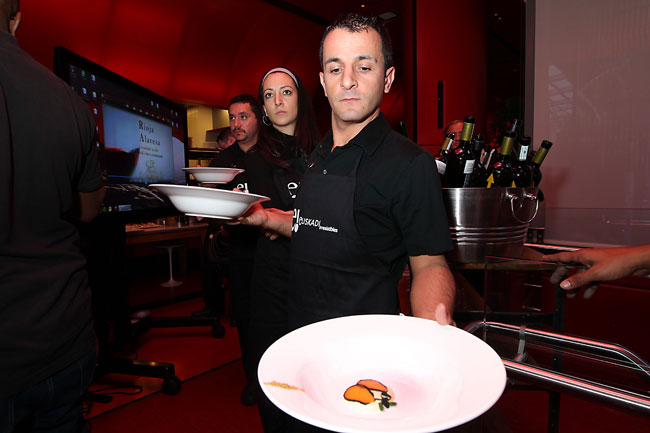
Chef Berasategui came out at the finish of the lunch and said, “Art, magic, and cuisine… that’s what I bring you here.” Indeed he did. What we were celebrating at this lunch was the new Basque Culinary Center, which opened this September in San Sebastian, Spain. Bourdain explained that he got a call that morning to see his friends from Basque country and wasn’t told that Martin was preparing an epic lunch. “It was like I stopped in for a beer and wound up at a Rolling Stones reunion,” he said, upon leaving.

At the Hamptons International Film Festival (HIFF) the Nicolas Feuillatte Champagne was once again flowing—this summer the brand had a big presence at Hamptons events—at a party for emerging talent at Wolffer Estate and one for Lauren Bush’s FEED charity at Nick & Toni’s in East Hampton.

On the deck at Nick and Toni’s I met a number of documentary filmmakers and later went to see their films. I spoke with Scottish producer Anthony Baxter of You’ve Been Trumped, a film in the style of Michael Moore, that follows the drama of Donald Trump bulldozing one of the most beautiful coastal dune lands of northeastern Scotland and rudely displaces the villagers to build the “world’s greatest golf course.” I also spoke with David Gelb of Jiro Dreams of Sushi, taking you into the world of octogenarian, Michelin three-star sushi master, Juri Ono, and his pursuit of culinary perfection. Mesmerizing!
Ciroc vodka was another presence at the parties and a sponsor of a HIFF series called Conversations. I caught the hot ticket “Conversations” where Matthew Broderick and Alec Baldwin bantered about the personalities of film directors in whose films they’ve appeared. Broderick did a hilarious imitation of Marlon Brando. During the Q&A, suddenly a normal-looking crazy woman started a line of questioning that turned into an appeal to save her from the FBI’s attempt to kill her. Baldwin’s mouth remained open wide with no immediate attempt at humor to deflect this. Later after the woman was escorted out by the guard, Broderick made reference to Lincoln’s assassination.

Sunday started with a viewing of an enormous circular trench-like sand sculpture by Jim Denevan done on windy Georgica Beach in East Hampton. Denevan created the world’s largest earth sculpture, spiral circles on the frozen surface of Lake Baikal in Siberia (photographed by satellite). The festival film, Anthropologist, documented his Siberian art piece.
Since HIFF is more about seeing films than drinking at parties, I took in two more movies of note: Oranges and Sunshine is based on the true story of a British social worker (played by Emily Watson) who uncovers an epic scandal in the United Kingdom where 130,000 children were deported from the country without the knowledge of their parents; and a highly engaging documentary, Pelotero, about Major League Baseball recruiting promises to 16-year-olds in the Dominican Republic. The film followed two promising teenagers in their lottery for the big bonus money of the majors caught up in the dirty maneuvers of some unscrupulous baseball recruiters.

With the number of wines on the market reaching critical mass, publicists are outdoing themselves to find interesting angles to promote their brands. Wine producers hire artists, designers and perfumers and become sponsors of all sorts of sporting events (Moet & Chandon created special bottles for the US Open). Of all things, Piper-Heidsieck has associated itself with S&M, which resulted in one of the most unusual tasting sessions I’ve experienced in my nine years of wine writing.
I received an invitation to come to a secret location where I would have a private taste of “the forbidden.” When I arrived at the West 30’s address and entered the dingy lobby, a woman dressed in dominatrix garb greeted me and brought me one flight up a staircase. There in a dark room, another bustier-clad woman (publicist) directed me to take a seat and poured me a flute of Champagne. As I looked around at the studio’s décor in bewilderment—there was a wall of hanging objects with whips, chains, and mysterious gear—the woman said that this room was the actual working den of a dominatrix. Suddenly music went on and a pole dancer dressed in a black sequenced bikini appeared and performed an extremely acrobatic pole dance for my pleasure alone. This apparently was the taste of the forbidden.

Then came the unveiling. Piper-Heidsieck had linked up with designer Jean-Paul Gaultier to create a fantasy. In the long tradition of Champagne houses dressing bottles in little outfits (Pucci wardrobed Veuve Clicquot a few years back) Gaultier had dressed two Piper-Heidsieck bottles in S&M gear. The bottles come in gift boxes and will be out just in time for Christmas. The houses are hoping to hit a chord with that little girl in all of us who loved to dress and undress our Barbie dolls.
Sporting a tiny red mask on its neck, Piper-Heidsieck French Cancan ($55) is a brut cuvee wrapped in black latex with fishnet stocking material over it. Upping the ante, Piper-Heidsieck Black Cancan Millesime 2000 ($630 in a limited edition of 100) is covered by Swarovski crystallized fishnets and a collar studded with diamond-cut crystals. It comes in a cushioned red case and has two curvaceously shaped flutes. Add a pole dancing class with Seraphine (sfactor.com) and it’s a great holiday gift.
It’s seems all the sparkling wine houses are out and about, showing off their new vintages. I gladly attend these tastings. If I could take one style of wine with me to that swept-away tropical island … it would be a shipload of sparkling.

The season kicked off with a vertical tasting of Le Reve (“The Dream”), Domaine Carneros Taittinger Blanc de Blancs that is made in the champagne method and aged six years. Although only the new vintage is available, we tasted the years 1992 through 2005 with Le Reve’s founding winemaker, Eileen Crane. “With the Carneros terroir with grapes coming from a coastal region, with its consistent climate, there are only good years and exceptional years,” she said.
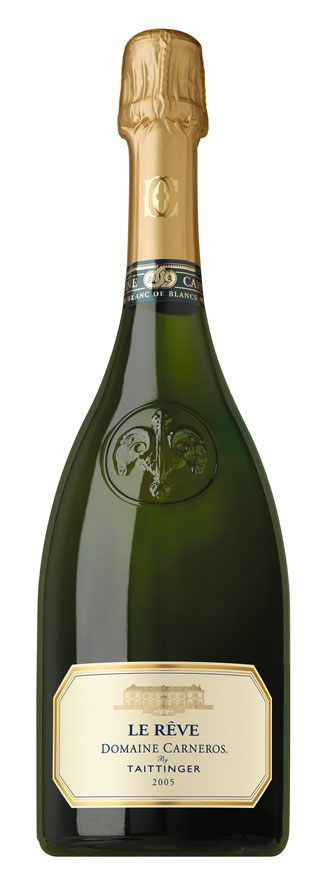
Our little tasting group decided that the 1999 was the exceptional vintage for its density and tension, its three dimensionality and tremendous length. I liked the current 2005 vintage, which was full and round with tiny bubbles and a creamy sensation on the palate, though Crane claimed it is still a young child and could age for a long time. I always prefer younger wines to older wines—so too with my men.
Le Reve came about when Claude Taittinger wanted a California answer to his French flagship, Taittinger Comtes de Champagne. He called Crane (then winemaker at Gloria Ferrer Champagne Caves) and said, “Eileen, I have a dream.” He wanted her to someday make America’s finest Blanc de Blancs. He asked her a test question: which ages longer Chardonnay or Pinot Noir? She responded, “Chardonnay.” It was the right answer because Chardonnay-based sparkling has structure and backbone and lives longer. She got the job and is making wine from certified organic grapes from the Domaine Carneros’ 300 acres. We tried the just launched Le Reve 2005 with the first course, delicate lobster claws. “Le Reve and lobster…that’s the ideal pair,” Crane said confidently.

Chandon and caviar is a mighty fine pairing as well, I discovered. Chandon, another celebrated sparkling wine of California, matched up with Pointy Snout Caviar, a sustainable farmed wild sturgeon raised on a special diet in a farm in Elverta, California. One of the key rules of food and wine pairing is to pair the country or wine region’s local grapes with locally grown food or wildlife—or, in this case, sea-life from the area’s waters.
Pointy Snout Caviar comes in Caviar Nouveau, which is aged only three days, or Caviar Avance, which is aged for 90 days. Both have firm-textured eggs and are wonderfully balanced with just the right saline flavor.
There are few greater pleasures than being given a tiny pearl caviar spoon and a big open can of caviar and being told to indulge. After sufficiently indulging, I could pronounce Pointy Snout Caviar and Chandon a perfect pair, a marriage of California locals.
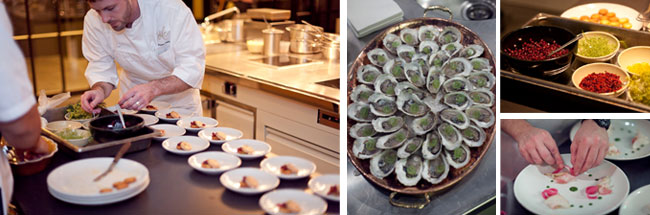
Chandon didn’t stop there with demonstrating how well sparkling pairs with so many foods. At another event, Chandon brought in its head sparkling winemaker, Tom Tiburzi, and executive chef Perry Hoffman from the Michelin-star Etoile restaurant at their winery in Napa, and the two gave a cooking demo and pouring of great matches. Wine journalists can’t get enough of these sessions … indeed someone has to judge whether the wines really go with the food. I am always ready for the challenge.
We started with a smoked quail egg with a dollop of the now familiar Pointy Snout Caviar, this time topped with crème fraiche. Cured bay scallops with fresh yuzu (which I found out was a Japanese fruit, a cross between a tangerine and a lime) came next along with Chandon Brut Classic. Now a bite of yellowfin tuna carpaccio from the Marshall Islands (the best) made with stonefruit, red shiso and basil. Tiburzi brought out the Blanc de Noir, which matches well stonefruit. Finally foie gras torchon with pomegranate and peppercorn flowers, for which Tiburzi poured the Chandon Rose.
“All great choices,” I assured them as I exited the Andaz party space on Fifth Avenue and then floated a few blocks east back to my East Fifties apartment. Upon my return certain doormen automatically ask, “Good wine tonight, Baroness?”

KRUG is a four letter word that drives aficionados of Champagne crazy. It is the ultimate. The heights of the Champagne world. Krug has been very active lately in trying to alter its image. It doesn’t want to be on that untouchable pedestal for only the top occasions or uttered in hush tones by Krug cultists—regardless that it costs upward of $170 a bottle for the multi-vintage Grande Cuvee. It wants to be like Dom Perignon or Cristal, something we’d drink more often when we are merely celebrating the high life. And it wants a younger, aspirational audience.
Hence, this summer Krug took over a fabulous art-laden townhouse with inner courtyard with stained-glass skylights and wraparound penthouse terrace, called it the Krug House and threw a series of “influencer” young and hip parties. At Krug House on Hudson and Horatio Streets they poured the Grande Cuvee like it was Perrier and everyone partied and danced to a series of bands. The handsome Olivier Krug came in for the celebration (and danced with me, which was a thrill). Next they sponsored a big party at Burning Man festival in Black Rock City, Nevada (I wasn’t there but read about it in pre-released November issue of Town & Country) where all the celebrants in the Zoo Camp dressed like animals and again drained the Krug, reputedly 60 bottles of Grande Cuvee with barbecued ribeye.
A few Sundays ago, I had a chance to get my fix when the Krug was poured in torrents at a dinner at Restaurant Marc Forgione honoring a Master Sommelier, Roger Dagorn (one of only 180 Master Sommeliers worldwide!) We started during the cocktail hour with Krug Grande Cuvee, the king of multi-vintages. Again, I did what I do best: judge the pairings of wine and food. During the tasting menu, different cuvees of Krug were presented: Hiramasa tartare and Krug Rose (elegant and lovely); tortellini with truffles and vintage 1998 (wow); halibut en croute took on the vintage 2000 (again wow) and finally dessert brought back the Grande Cuvee. Yes, it all paired flawlessly. It doesn’t get better than that.
