


It was the lot nobody thought buildable, even speculative developers hungry for any unoccupied land on the East End. So unsure about the site even was the then prospective homeowner, that he brought landscape architect Chris LaGuardia to walk the sloping site with him.
“The owner asked me if he should buy it or not,” recalls LaGuardia. “The lot was considered the worst lot in the subdivision because of the steep topography. However, we discovered that the long building envelope, which architects James [Merrell] and Steve [Soule] took full advantage of, offered opportunity in terms of both views and level changes. Suddenly, the realization came that this was, in fact, the best lot in the entire subdivision.”

And now it’s the best house in the neighborhood, too, so admired that, rumor has it, the homeowner has been repeatedly approached to sell. “The fact that he’s outright refused tells us yet again that they’re the perfect clients who appreciate the design we created,” says architect James Merrell. The house appears to have grown naturally on the hilly property, with its glassy elevations reflecting its embrace of a scenic pond and the treetops that appear to vault into infinity.
As Merrell and Soule are wont to do, they asked these first-time clients to write out a wish list of what they wanted their house to be. While the responses they usually get from prospective clients are brief, in this case, according to Merrell, “The husband wrote five single-spaced pages, a list that was less emotional than practical.” The architects responded to the directives, all doable, and drew up a structure that, as Soule says, “Creates a dialogue between vernacular and what might be called contemporary.” As Merrell adds, “The couple really understand design and they had an intuitive feeling that what we came up with would be appropriate.”
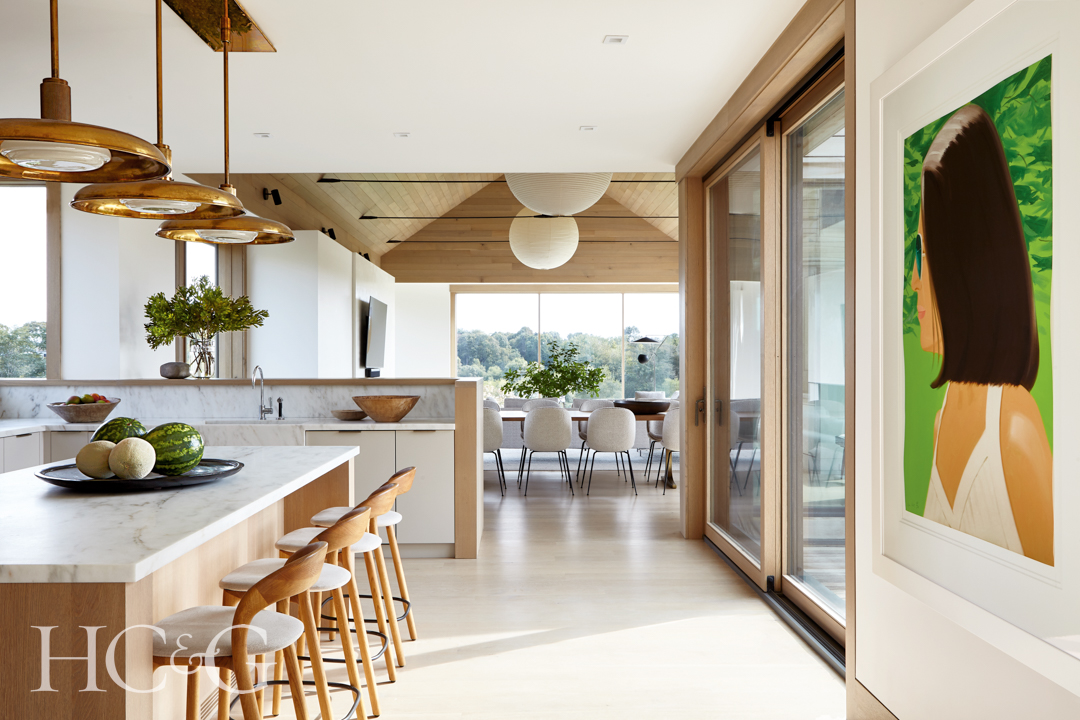
Artisan bar stools surround a custom island designed by Merrell Soule Architects.
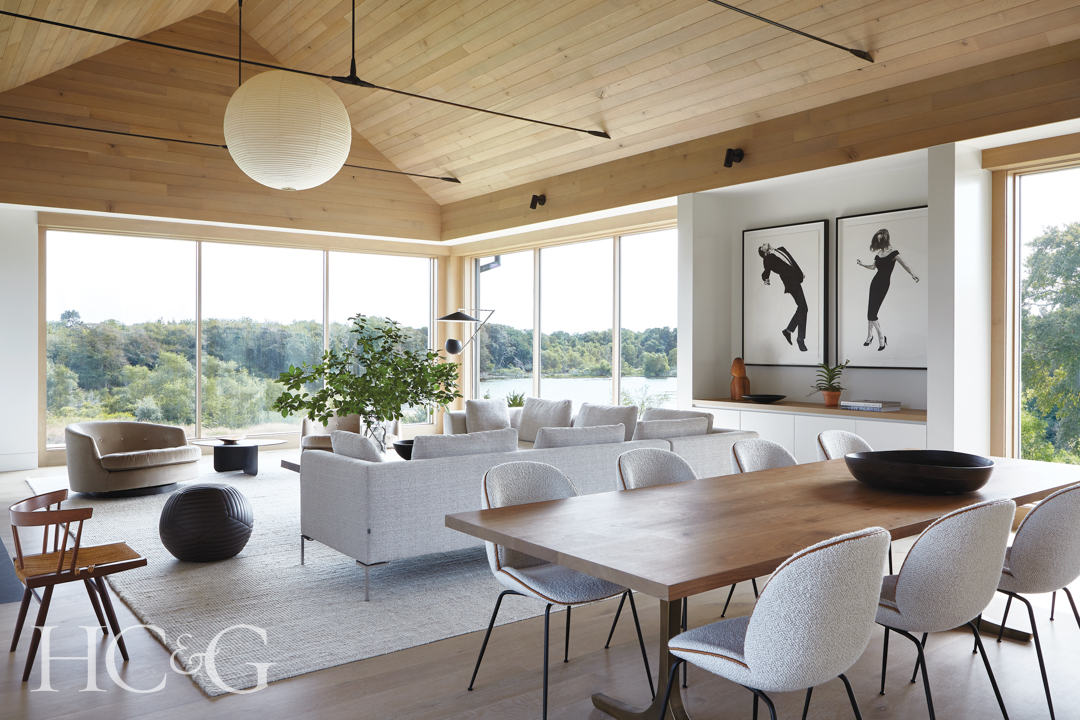
In the family room, a ceiling fixture by Noguchi hangs above a sectional from B&B Italia.
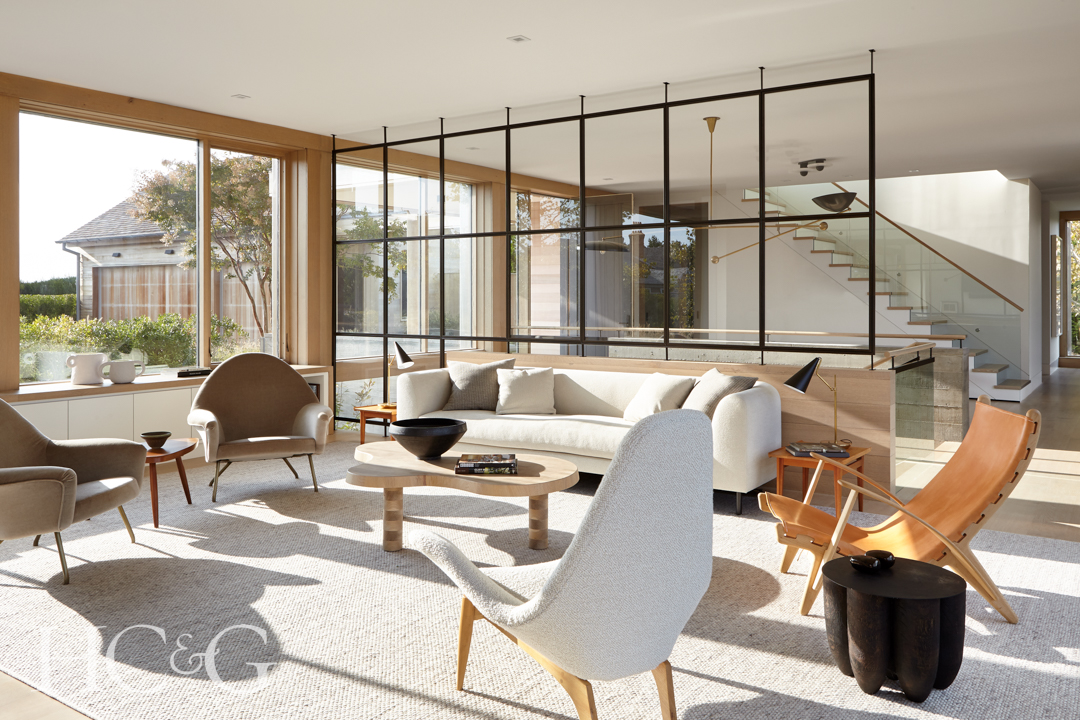
In the living room, a sofa from Dune is upholstered in a Holly Hunt fabric.
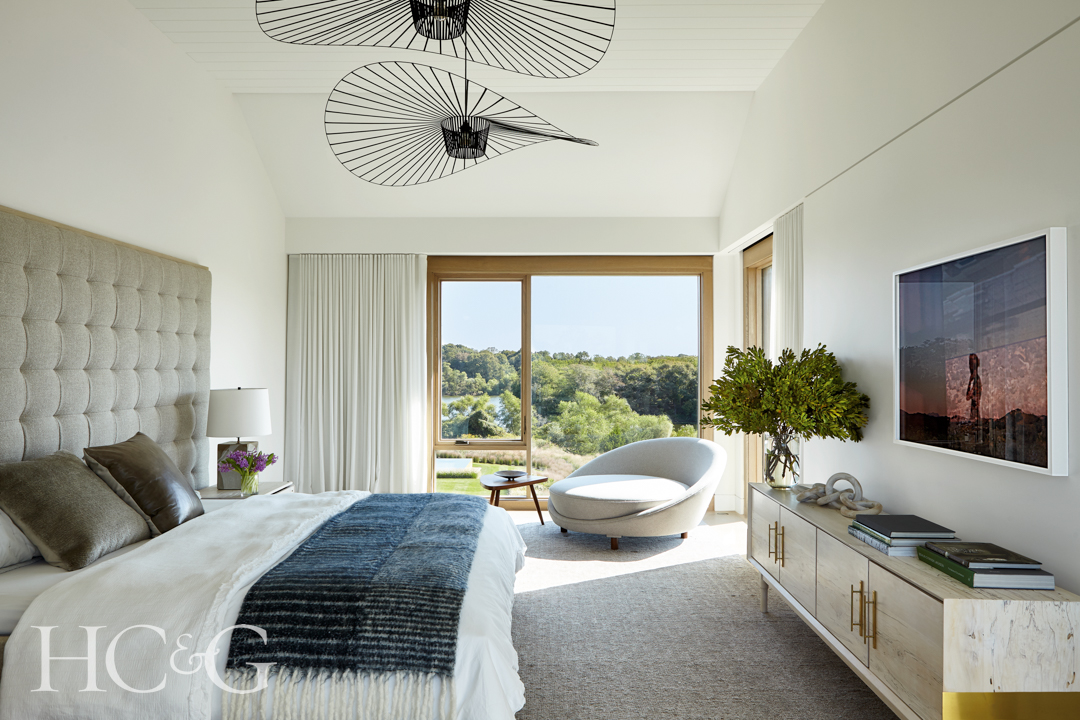
In the primary bedroom, the bed is dressed in linens by Frette. The sculptural pendants are from Petite Friture, and the curtains are by The Shade Store.
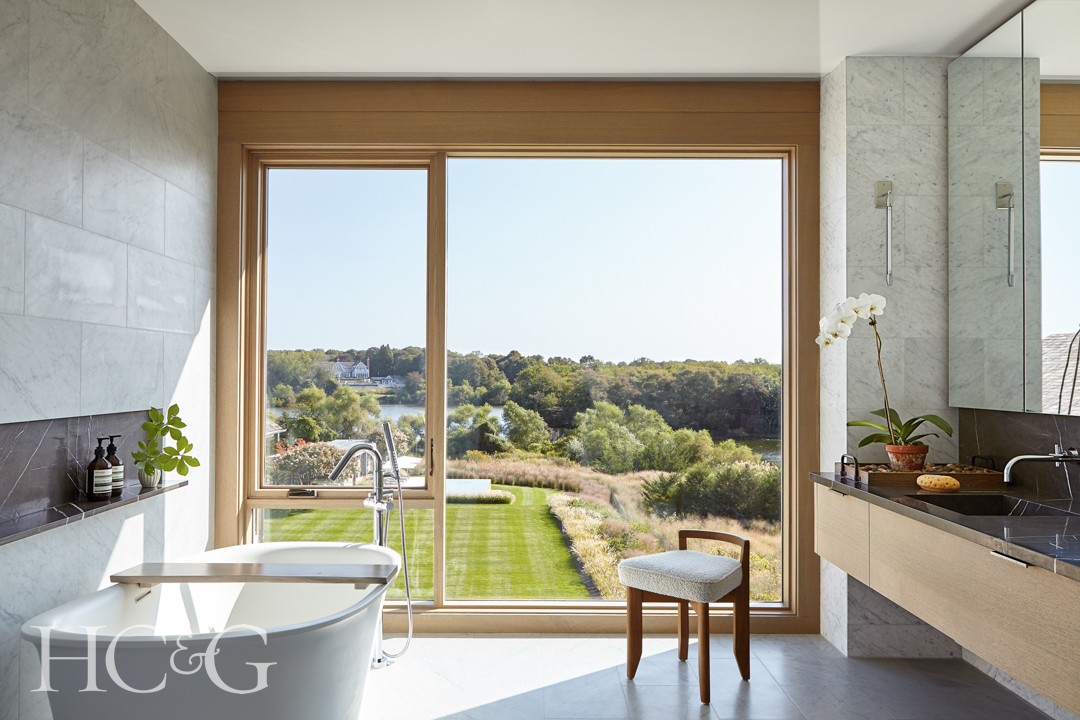

Floor-to-ceiling windows frame views of the natural surroundings and allow for an abundance of sunlight to stream throughout the residence.
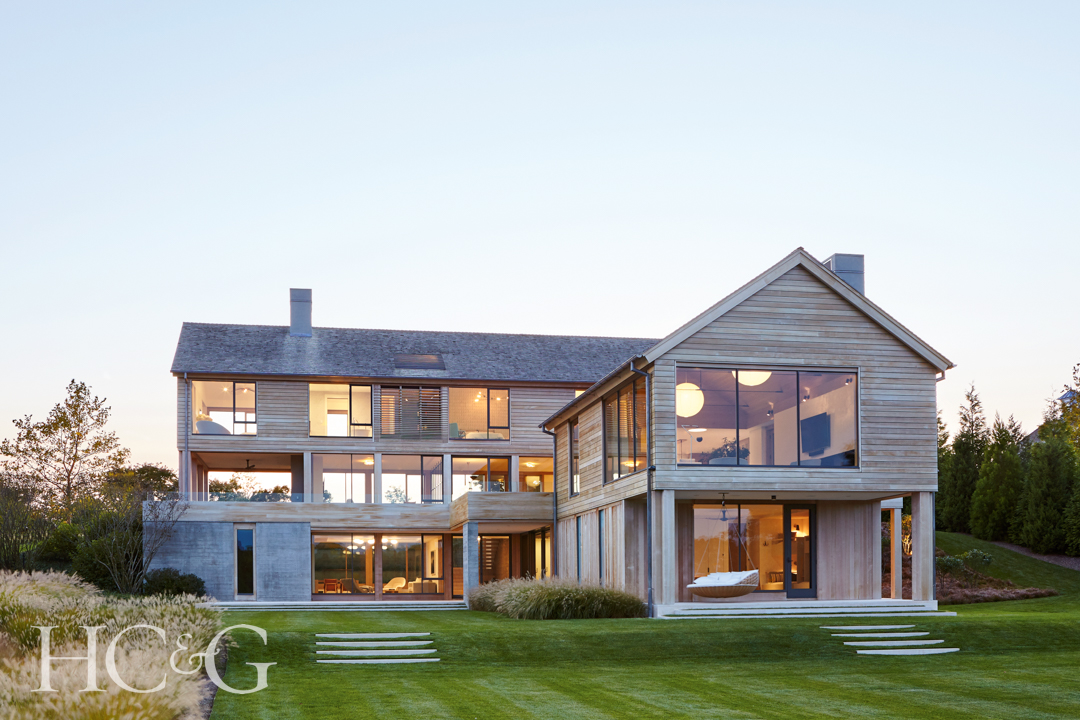
The house is clad in a Weathered Western Red Cedar Rainscreen.
In answer to the steep slope, which drops at the rear, LaGuardia and his team, notably, his design partner, Dan Thorp, filled the front yard with a sunken tennis court and swimming pool, allowing the east-facing back area to remain open. With Cardel Development as the home’s builder, Merrell and Soule fashioned a three-story structure in such a way that the home’s entry appears to be two stories, while at the rear a third, ground-level area is revealed.
“Style comes last for us,” declares Merrell. “We never start with an idea, but, rather a plan, a floor plan for how a house is to function and operate.” The house, inside and out, responds directly to the site and needs of the family, taking advantage of the most abundant resources on the East End, sunlight and air. With the house pulled back on the lot, the architects were able to focus solely on how the site would determine the architecture. “We wanted people who arrive at the house to be able to see right through it to the pond on the east side,” says Merrell. He and Soule created a floorplan whereby the main living areas have exposures on all sides, while the top-level family quarters are linked by a windowed hallway that runs flush against the west side of the house.

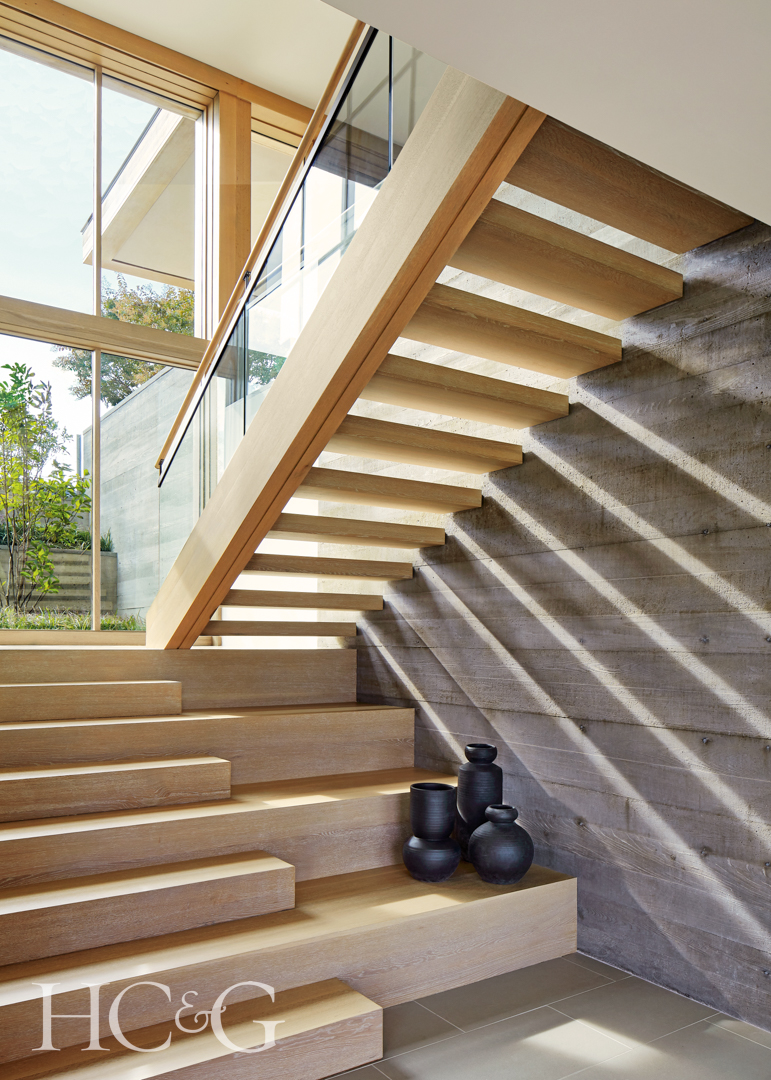
As for décor, every bedroom is infused with views of the water and landscape. Ceilings throughout are clad in a handsome, neat red cedar boarding, while the textures and hues of the board-formed concrete foundation walls are visible on the exterior. The team cleverly separated the entry area from the liv- ing room with a steel-framed glass screen, serving as a visual cue to enhance a sense of privacy. Vast expanses of glass keep the views a priority while still resulting in a house that has volume, a defined architecture and a unique presence in the area.
Interior designer Brad Ford, who has worked with the clients on prior homes, was commissioned to configure the interiors. “I’m such a fan of Jim’s and Steve’s work that I knew I needed to keep the interiors understated. They understand how to design a modern house that respects that fine line between simplicity and steeliness.”

“Brad ‘got it’ right away,” says Soule. Merrell adds, “Brad enhanced the experience of this home rather than competing with its architecture. There is a design logic embedded in this house.” Indeed, Ford is particularly sensitive to the role that everyone in the development of a home plays—architect, interior designer, clients. “As was exactly the case with this house,” Ford says, “I always say that we approach a project with curation in mind as opposed to decoration, meaning that we’re all creating something together.”
