


Chalk It Up
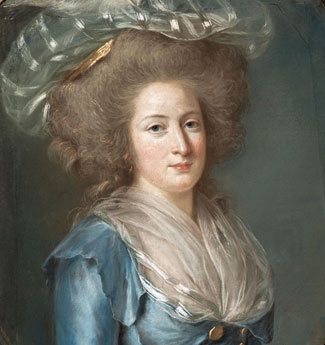
Two charming sisters on a hobby horse, a graceful woman with pearl earrings, earnest merchant John Collins with a sheep, wistful Elizabeth Vigee Le Brun, Marie Antoinette’s brooding sister-in-law, Elisabeth of France, coy actress Mme. Royer with a drama mask … these are some of the irresistible characters you encounter in the new exhibit of 18th-century pastel portraits at the Metropolitan Museum of Art.
Rendered in powdery crayons, easily susceptible to damage from too much light or vibration, the pictures are rarely exhibited; they offer irresistible insights into the personality and character of fascinating historical figures.
The exhibit runs through August 14.
http://www.metmuseum.org/special/se_event.asp?OccurrenceId={E6FD2DDB-6A6A-44FA-8298-5D44E5827B46}
Pastel portrait of Elisabeth of France, ill-fated sister of Louis XVI

Arty All Over
If you remember the famous post-9/11 New Yorker cover of “New Yorkistan,” if you wear a 10-One-4 wristwatch, if you’ve read The Principles of Uncertainty, you know the quirky work of artist/designer/illustrator Maira Kalman. Her cheerfully off-kilter creations are on display at the Jewish Museum where her self-portrait with a dog, Isaac Mizrahi printed raincoats, four-part Goethe embroidery, and collection of (actual!) onion rings share the gallery with chairs and ladders and gouaches of a Le Corbusier sink and of a green pickle tag.
The hodge-podge of charmingly unexpected delights in “Maira Kalman: Various Illuminations (Of a Crazy World)” includes the video of her 2007 TED Conference lecture, Kalman on tape describing herself as “An Illustrated Woman.”
The exhibit runs through July 31
http://www.thejewishmuseum.org/exhibitions/mkalman.
Maira Kalman, Self-Portrait (with Pete), 2004-5, gouache on paper. Courtesy of the artist.

Geneviève Receiving King Mark’s Letter, by the Master of the Vienna Mamerot. Romance of Tristan; France, Bourges?, dated 1468. The Morgan Library & Museum
Fashion First
Who would have thought that the knights and ladies of old cared about what they were wearing? Welcome to the medieval world of courtly fashion where advances in tailoring and the use of buttons in the mid 1300s introduced features such as the man’s button-front “cote hardy” and the woman’s “surcot” with peek-a-boo slits revealing the “kirtle” underneath. Illuminated medieval manuscripts picture in detail “tippets” ribbons hanging from the elbow, “pouleine” shoes with long pointy toes, and “chaperon” capes with hoods and tails.
It’s all displayed in the Morgan Museum’s exhibit, “Illuminating Fashion: Dress in the Art of Medieval France and the Netherlands,” with manuscripts shown in the context of an historical timeline circling the room. Mannequins wear four actual ensembles recreated from the ancient pictures, and captions reveal the garments’ symbolism. That towering headpiece on the Whore of Babylon, for instance, is 20 years out of date—an indication to readers that she was not only old-fashioned, but decadent as well.
The exhibit runs through September 4
www.themorgan.org

Fashion Twenty-First Century
Back uptown, the Metropolitan Museum of Art, which once exhibited the courtly costume Vanessa Redgrave wore as Lady Guinevere in Camelot, has leaped into the 21st century with its highly publicized retrospective of the work of the late fashion designer Alexander McQueen.
Nature, technology, death, and dereliction are themes in the elaborately constructed garments built up out of feathers, medical slides, chiffon, Scottish plaids. A “Cavern of Curiosities” includes the famous hovering butterfly hat and the now iconic “armadillo” shoes.
Mixed in among the bumsters and ruffles are headpieces reminiscent of the double horned “temples” and tubular “burlets” which supported the veils of medieval fashion plates. What goes around comes around.
The exhibit runs through July 31.
http://blog.metmuseum.org/alexandermcqueen/
pictured: Gown and headdress from Alexander McQueen Widows Collection 2006-07
