


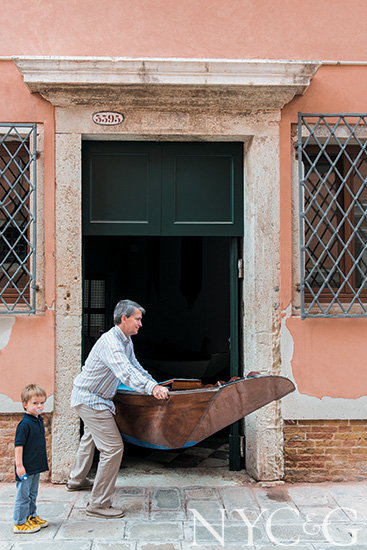
Andrea Rubelli and his son, Leonardo, photographed at the entrance to their 14th-century Venetian palazzo, prepare to launch a puparin racing boat in a nearby canal.
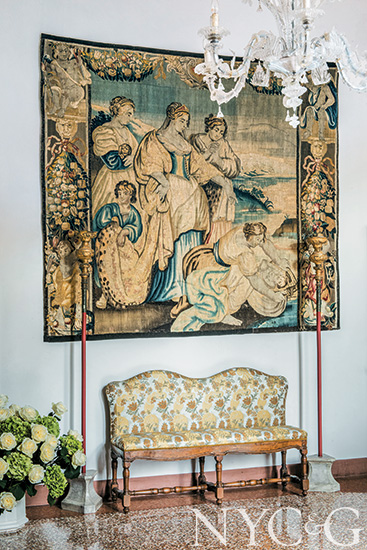
In the main hall of the home’s state apartment, an 18th-century tapestry, possibly Flemish, hangs above a 17th-century Italian bench covered in Rubelli Venezia’s San Stae lampas; the 16th-century torches are mounted on contemporary bases of wood and stone.
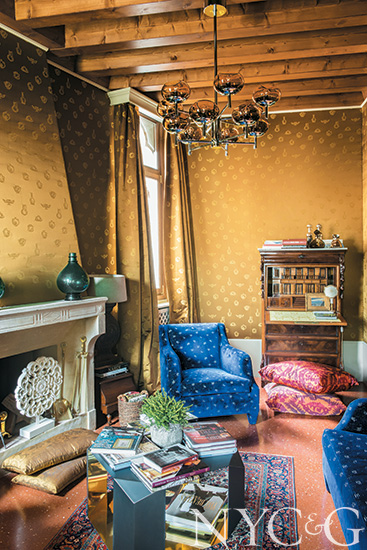
The reading room features Rubelli’s Alchimia silk on the walls and Rubelli Venezia’s Rattoppato velvet on the club chair and sofa, patterns designed by Giò Ponti; the 18th-century secretary is Tuscan.
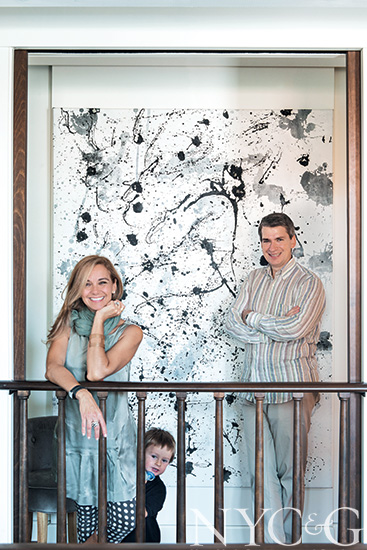
Sandrina, Leonardo, and Andrea Rubelli stand on a landing in front of a painting by Friedericke Raaf.
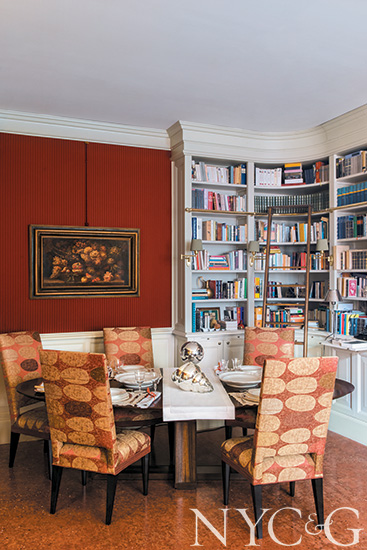
The dining library’s Raleigh table and Di Lorenzo chairs (in Story Stones silk lampas) are from Donghia. The original red terrazzo floor is exceedingly rare today.
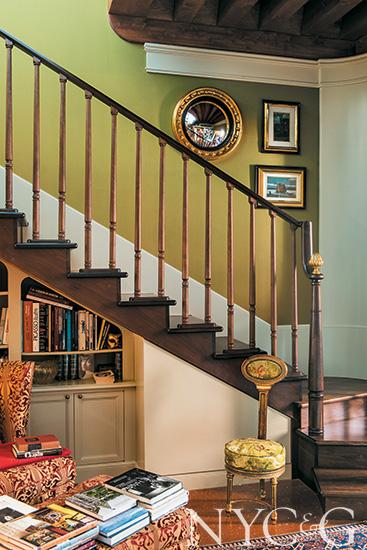
An 18th-century Portuguese cellist’s chair sits at the bottom of a stairway.
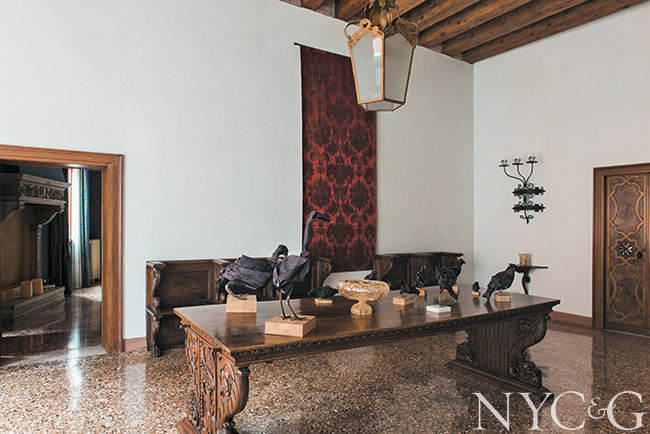
The state apartments on the piano nobile are used to entertain guests and for business meetings. The portego, or receiving room, features an Italian Renaissance table topped with bird figurines wrapped in a black Rubelli silk, designed by Li Edelkoort for the 2012 Salone del Mobile in Milan.

The sitting room includes a 17th-century Venetian armoire and stools; covering the table is a fragment from a hand-woven silk and gold-thread curtain created by Rubelli for the Bolshoi Theatre in Moscow.
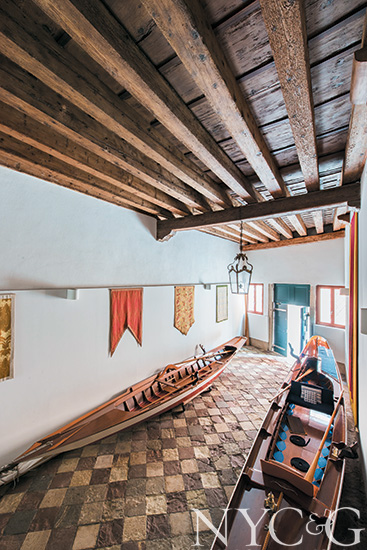
The family’s puparin is stored inside the entry on the ground floor.
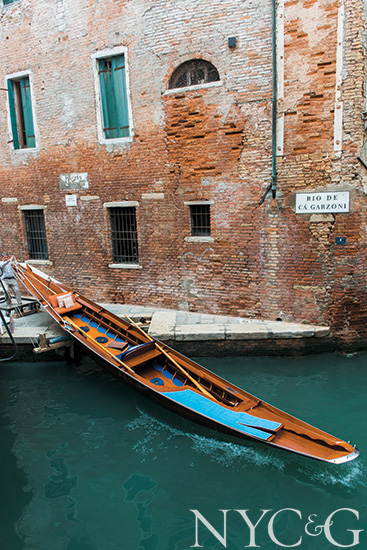
A smaller racing boat called a mascareta.
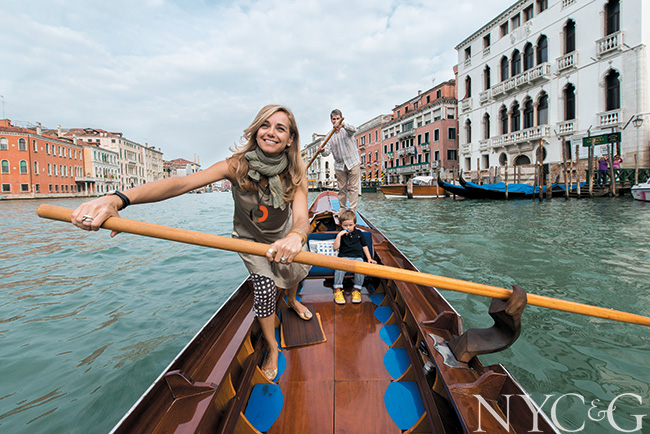
Sandrina, Leonardo, and Andrea Rubelli take the puparin for a spin on the Grand Canal.
