


No one wanted to forget this apartment’s past. Not only is its history a noble one, but it’s also an apartment that continues to make history. Interior designer Sarah Magness, architect Gordon Kahn, and the enlightened homeowners all concurred that the best way to remake this apartment, to seamlessly combine two two-bedroom apartments into one, was to honor the Art Deco lineage of The El Dorado, the famous Upper West Side building, an actual designated landmark.

In keeping with its name, The El Dorado, completed in 1931, continues to represent a gold standard of what the best of Deco embodies—strong geometric forms and lines, restrained decorative embellishments, and an aesthetic that marries the machine-made with the artisanal. “How do you make a modern apartment in a modern way, but still remember the apartment’s past,” Kahn asks rhetorically. “That’s always a really important matter for me,” he adds, citing the many other Art Deco–era apartments he has redesigned, including one in the same building with the identical footprint. As Magness says of the gut renovation/reconfiguration she and Kahn undertook, “We did a magic act.”

The homeowner couple had been living for years in an adjacent two-bedroom apartment, and when the one next door became available, they purchased it, knowing they could take even better advantage of their perspective just over the tree line of Central Park. “They cherished the views and the level of light in the apartment,” says Magness. Among the most effective layout changes executed by Kahn was to position a den/study in a southeast corner, a room that Magness calls the “crème de la crème of the entire apartment.” Kahn further “pushed” the bedrooms to the west side, reserving the best southern and eastern views for the public rooms.
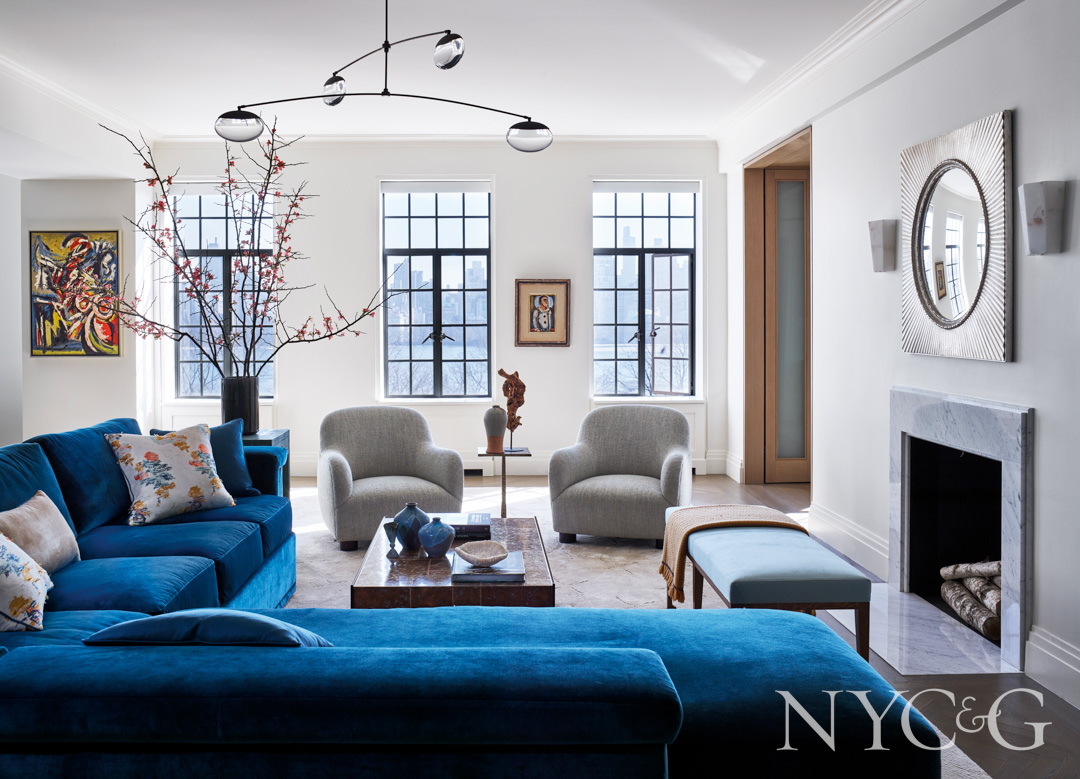
In the living room, a sectional from The Bright Group is covered in a Zoffany fabric. Armchairs from Roman Thomas feature a Larsen fabric.
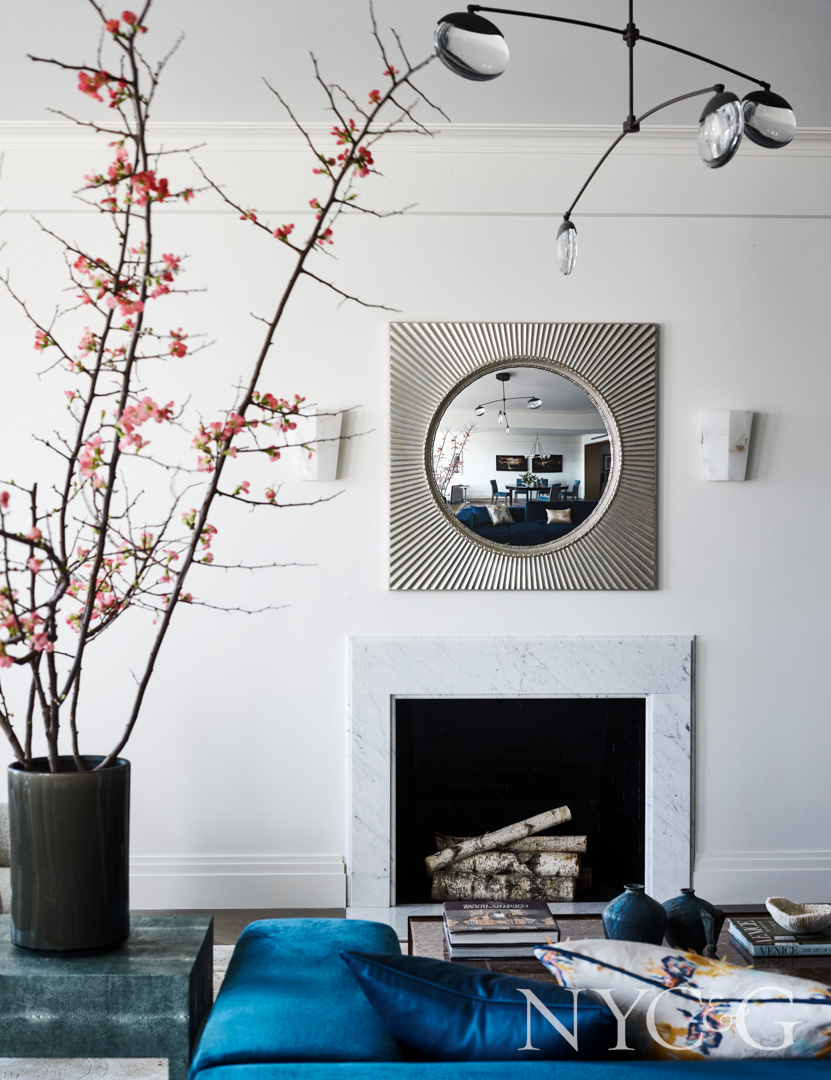
The fireplace surround in the living room is by Jamb, and the ceiling fixture is by Ochre.
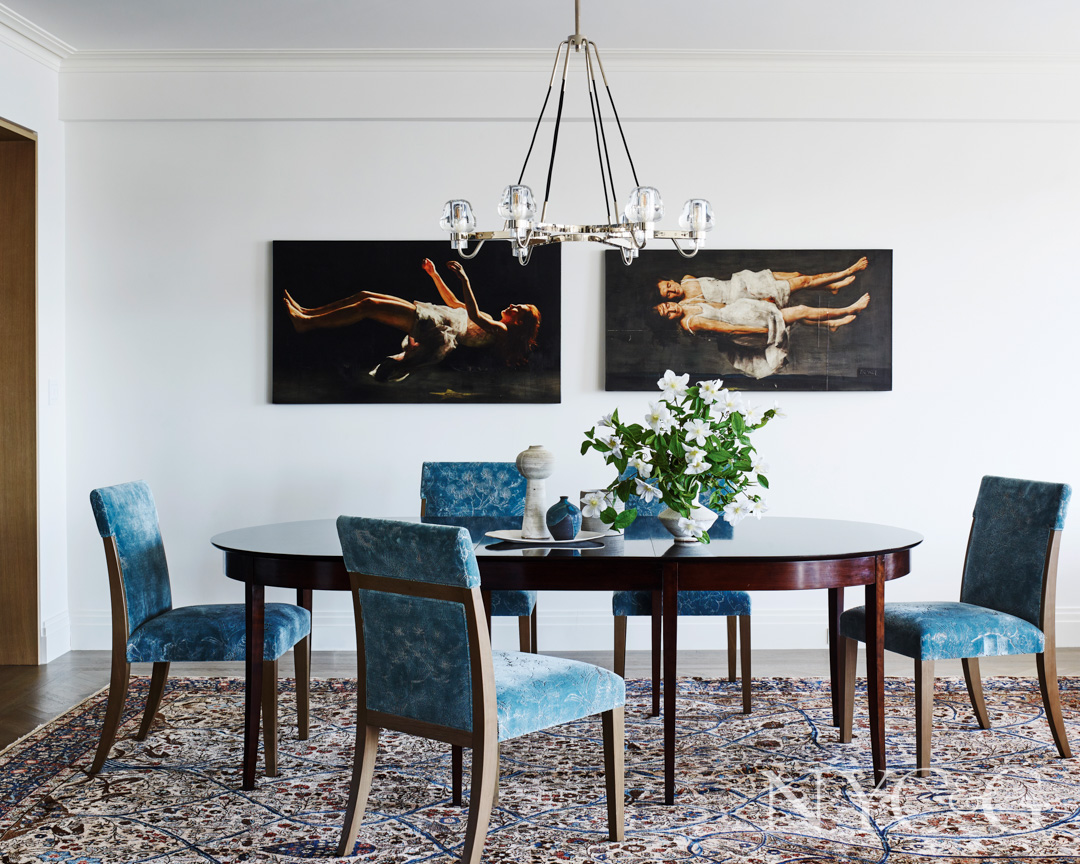

In a sitting area overlooking Central Park, a Dmitriy & Co sofa is covered in an Edelman Leather.
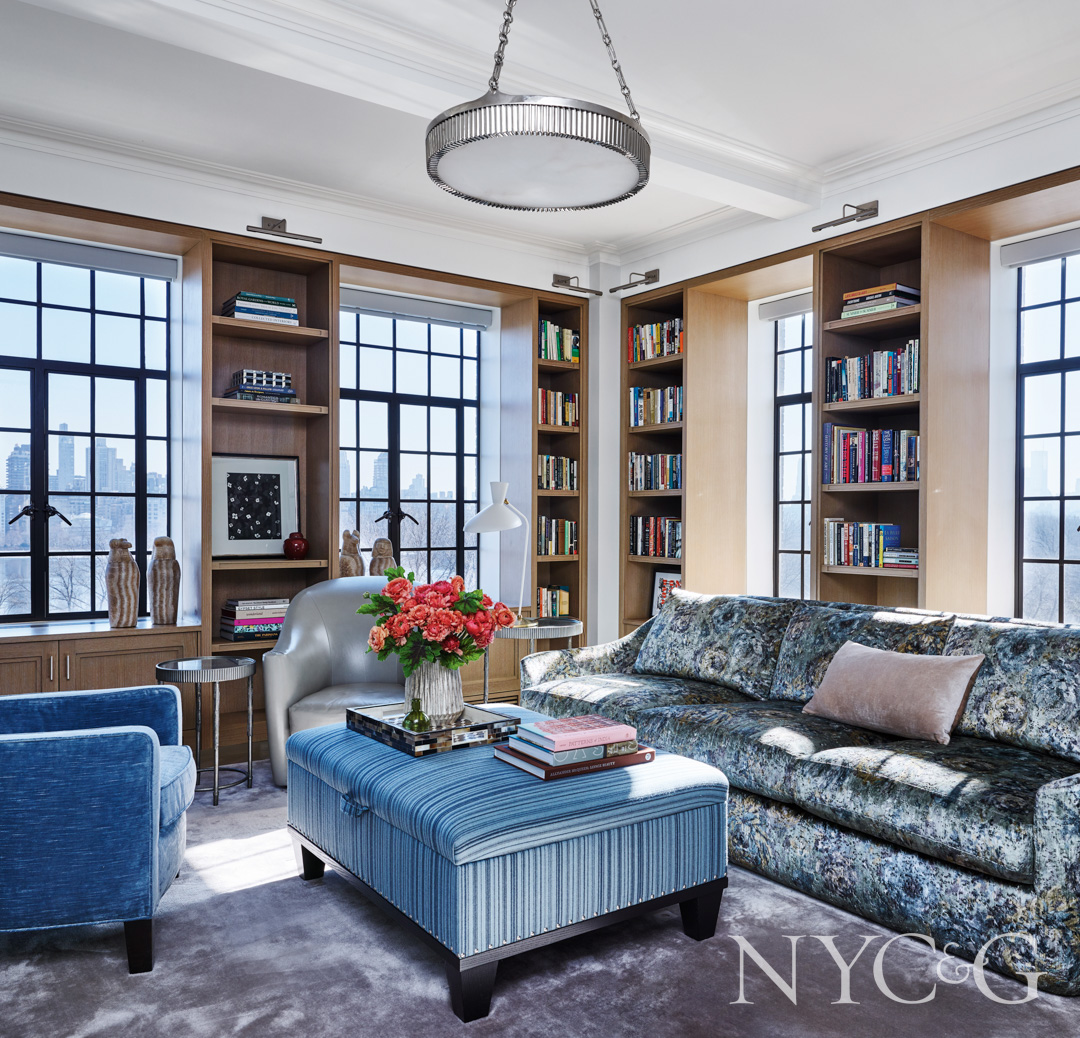
The study’s George Smith ottoman complements a Dmitriy & Co sofa covered in a Alhambra fabric. The rug is from Sacco Carpet.
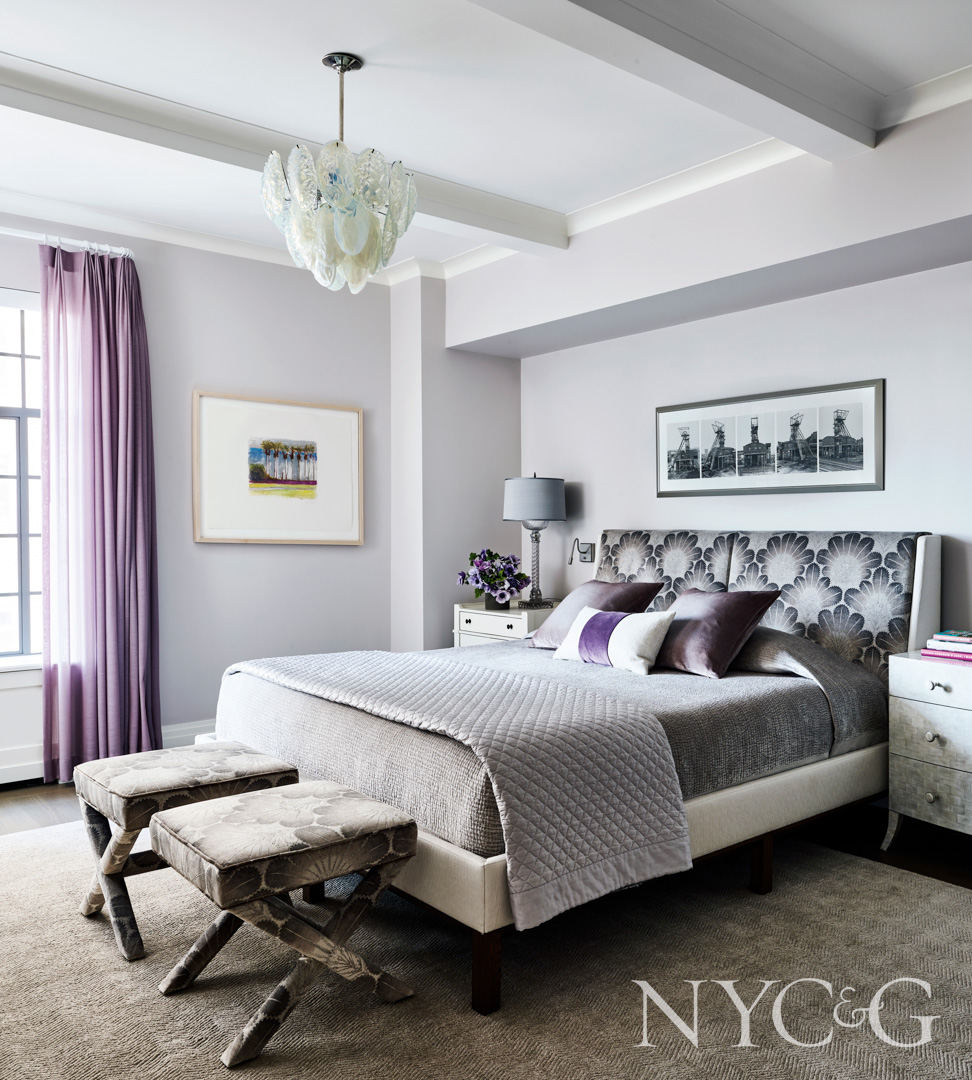
In the primary bedroom, a ceiling fixture from Venfield hangs above a bed covered in fabric from Misia. The upholstered bed frame is from Dmitriy & Co, and the ottomans are from Lee Industries.
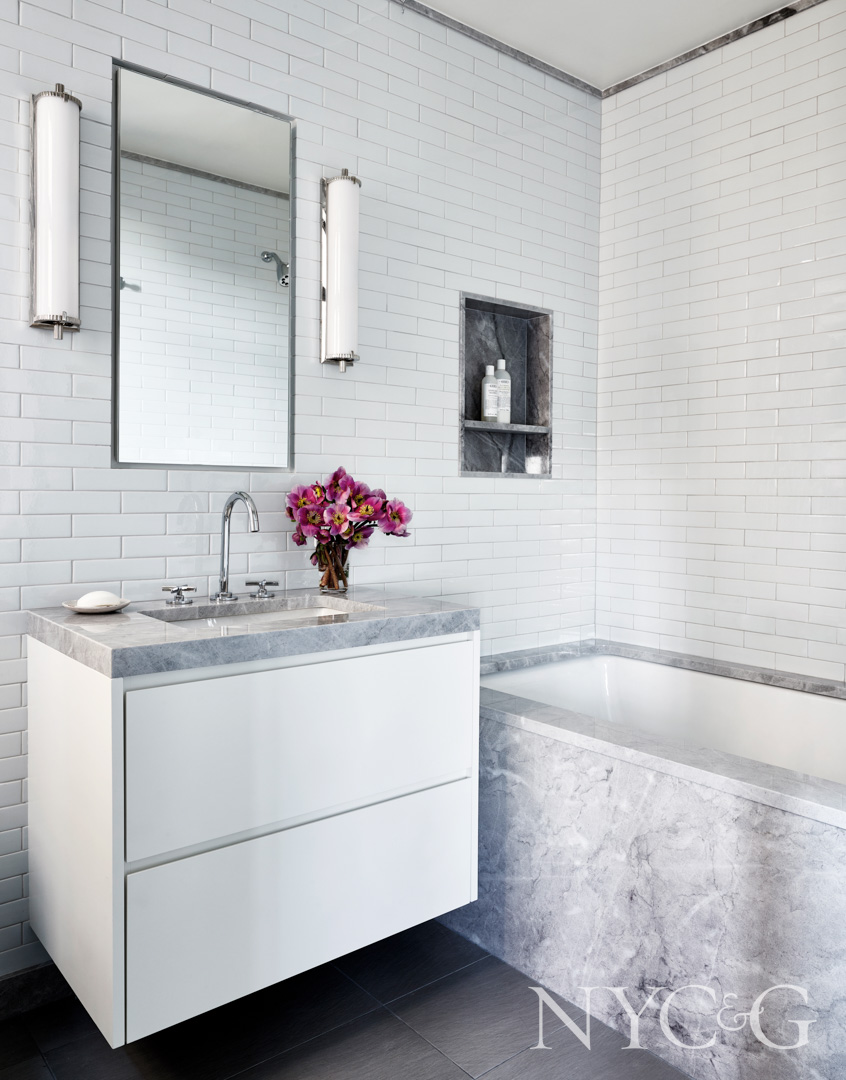
In the primary bath, the stone is from ABC Stone, and the tile is from Ann Sacks. The sconces are from Visual Comfort.
While a rhapsody of blues works their way throughout the apartment, Magness features varieties of patterns of the hue in the den. She expertly combines a silk-and-velvet floral pattern for a Dimitriy sofa with a Fortuny stripe on an oversized ottoman with monochromatic blues and mauves defining a chair and rug. As is evidenced in every room, too, Magness and Kahn were both determined to make lighting sources as much practical elements as statement pieces. For the den, a modestly scaled room with an oversized role in the apartment, she selected a circular brass fixture, coated in polished nickel from Urban Archaeology. “We designers have objects and materials that we’ve held onto for decades, waiting for just the right project and the right client” she says. “This was one in my ‘cabinet of curiosities’. It’s so exciting when you have the right accessory for the right client.”

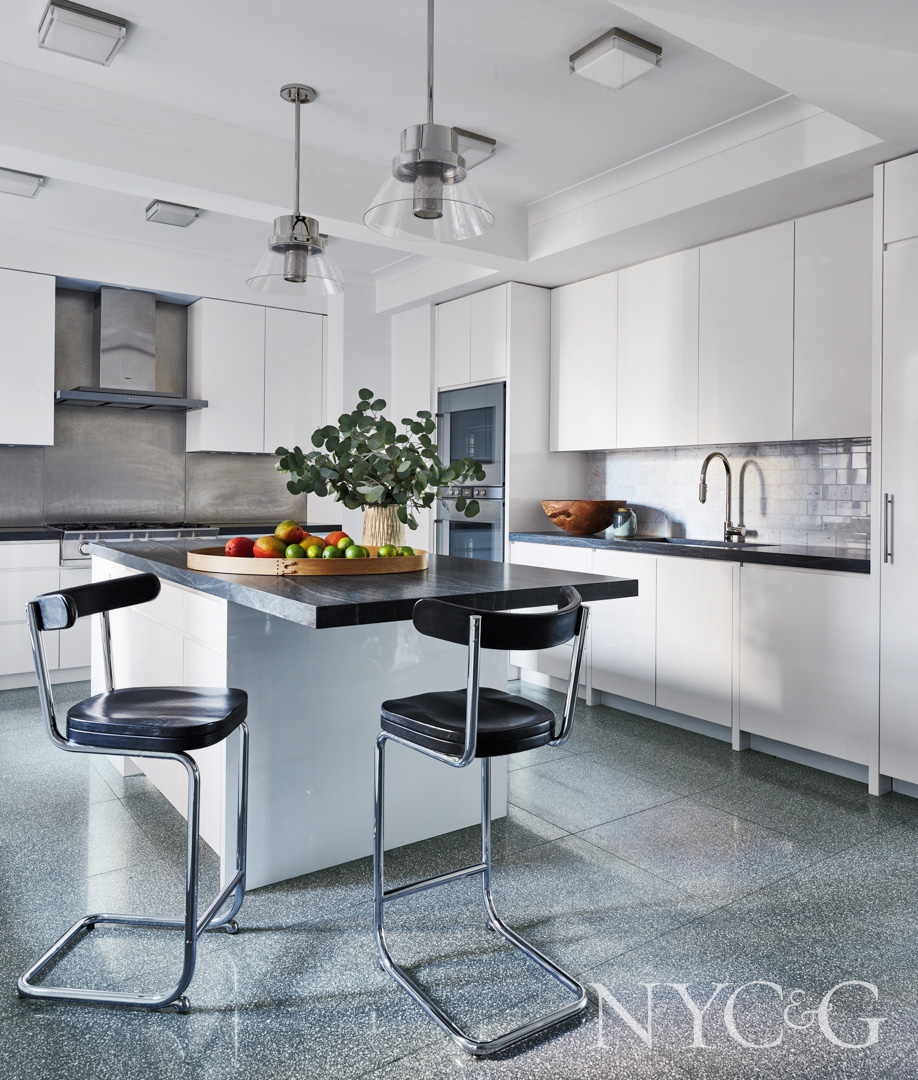
Kahn, too, was constantly aware of materials to employ, with one of the most arresting choices being a hammered stainless steel for the kitchen backsplash. “It has a wonderful texture, it ties into the appliances, it adds reflective light to the room, and it won’t stain with age,” he says. That particular material choice also reflects his and Magness’s propensity for favoring local artisans (though the metal artisan has since retired). “We really try to use our favorite specified artisans and craftspeople,” she says, “especially family-heritage companies. The stools, for instance, come from a favorite Connecticut company, York Street Studio.”

Apart from the den, there are multiple places for the couple and guests to gather. A well-articulated seating area that is part of the dining room is furnished with a sofa and pair of club chairs, making the nook function, essentially, as an alternate living room. The true living room is, at once, a subtle study in Deco references, including the clever use of a convex mirror set over a handsomely articulated fireplace that visually expands the room, combined with decidedly contemporary elements, notably an Ochre lighting fixture whose arms swing like a mobile. “The clients particularly liked this piece. They’re careful collectors of all kinds of fine objects, from antiquity to contemporary art to photography,” says Magness.

“I’m so proud that we were able to reference Art Deco but still make this a home of today,” says Kahn. Adds Magness, “It was a thrill for me to work in The El Dorado. The clients love it because of its heritage and its stamp on New York City history. This is a building you have to listen to when working there.”
