


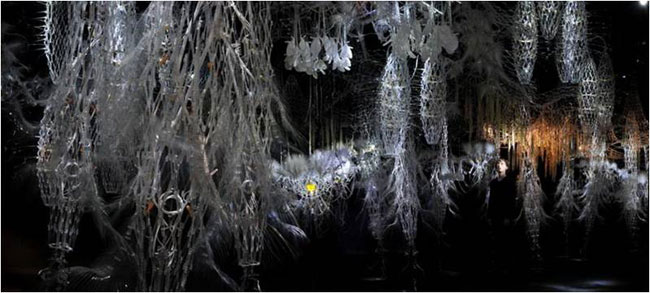
Photos courtesy of Philip Beesley
I recently wrote to Philip Beesley, a professor at my alma mater, to congratulate him on his breathtaking entry at the 12th International Architecture Exhibition for the Venice Biennale. He has combined an expansive study of architectural textiles and landscape-size installations with chemical, computer and fabrication technologies to produce a wondrous artificial landscape that interacts with those who enter it.

The collaboration between architect and sculptor Philip Beesley, a professor at the University of Waterloo’s School of Architecture, U of W electrical engineer Dr. Rob Gorbet, and British professor Dr. Rachel Armstrong resulted in an installation that explores qualities of contemporary wilderness.
The structure resembles a wintry version of a tropical forest with its layers of ecosystems. The names of the components are from the worlds of nature, poetry and science – clouds, fronds, breathing columns, kissing pores, implant matrices, reflexive membranes.
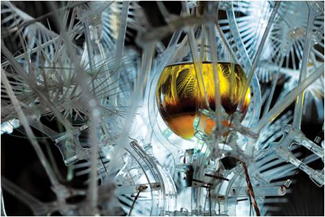
Beesley explains, ‘Tens of thousands of lightweight digitally-fabricated components are fitted with microprocessors and proximity sensors that react to human presence. This responsive environment functions like a giant lung that breathes in and out around its occupants.
Arrays of touch sensors and shape-memory alloy actuators (a type of non-motorized kinetic mechanism) create waves of empathic motion, luring visitors into the eerie shimmering depths of a mythical landscape, a fragile forest of light.’
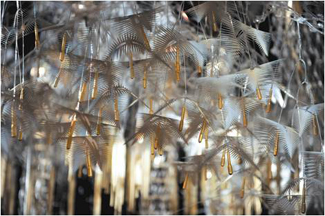
This year’s Biennale, themed “People Meet in Architecture”, was a chance for architects to take a global perspective, designing an environment that would truly resonate with all who entered their exhibition space. In the case of Hylozoic Ground, the theme was taken one step further, as people not only met in the space, but became a part of its system. As visitors moved around the various forms, the fronds, feathers and whiskers reacted, seemingly reaching out, breathing deeply or quietly swaying.
As Eric Haldenby, director at University of Waterloo School of Architecture, describes, “This wonderful piece refreshes, or, even, restores the fundamental relationship between the built and natural environments. The work holds out the promise that there will one day be an architecture this deep, vivid and alive.”
all images copyright pierre charron
