


A real designer, like Michael Halpern, can look at a single detail and be sufficiently inspired to make a whole house from it. When Halpern, a prolific interior designer, wanted to build a house on a 25-acre parcel of land he purchased in Litchfield County, he “interviewed” a potential architect, Nate Dalesio, in the architect’s house that Dalesio had significantly renovated and rebuilt. As Halpern recounts, “I went inside Nate’s house and immediately realized that this guy knows where to put a window.” Something about the positioning of a certain window—and others—in a living room wall convinced Halpern to commission the young architect for what would turn out to be a 4,200-square-foot house.

Despite the fact that Dalesio, newly on his own as an architect after working at an established firm, hadn’t yet designed a house from foundation to roof, Halpern knew he was right for the job. “Nate really had a vision,” Halpern notes. “His exuberance at taking on the project made for a fun, great collaboration.” As Dalesio adds, “It was my first full project, and I learned early on that Michael is very open to ideas—but also able to say when he didn’t want something, and that’s good. Now that I’ve designed other houses, I’ve learned that a client who’s maybe too open to ideas is sometimes harder to work with than someone who makes decisions.”

Halpern—who has been designing interiors for years—drew up a floorplan for the two-bedroom house that he envisioned for himself. “I wanted something modern but that would reflect the local architectural vernacular. And, so, the idea of two barns linked with a glass connector made sense, establishing a “public” barn of living areas and a “private” barn with bedrooms.” What he admits to not knowing how to do with confidence is how to scale a house and establish proper proportions. “I had a vision for the house as a whole, but I left it to Nate to execute it,” he notes.

When interior designer Michael Halpern found the right hillside site for a new home, he wanted it to be evocative of local vernacular forms, while also being a new, modern house.

At the foyer, Halpern designed a white-washed floating shelf made of plywood across from the Lucha Libre photograph by Lourdes Grobet; the bronze disc light fixture is through RT Facts.
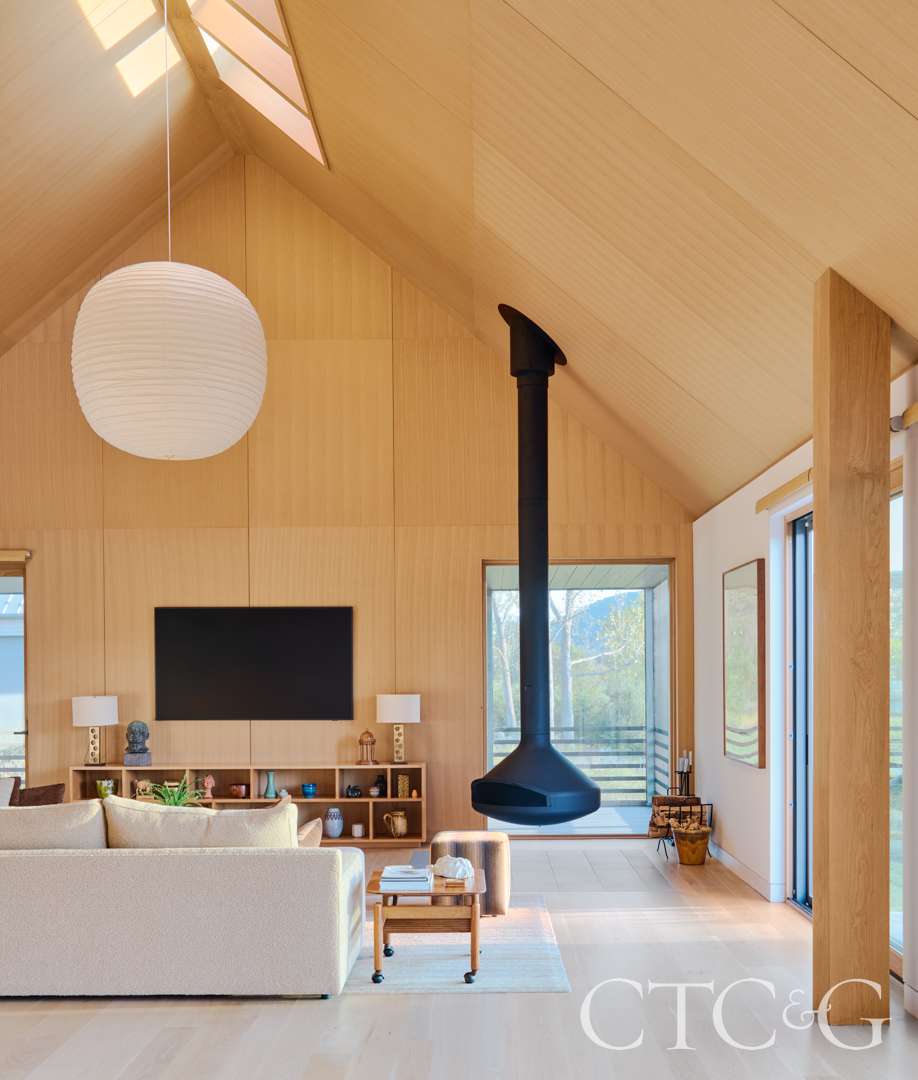
The expansive great room is discreetly lit with natural light by day via a series of skylights, while a giant Akari paper lamp glows like a moon at night. A suspended Focus fireplace works also as a bold piece of minimalist sculpture.
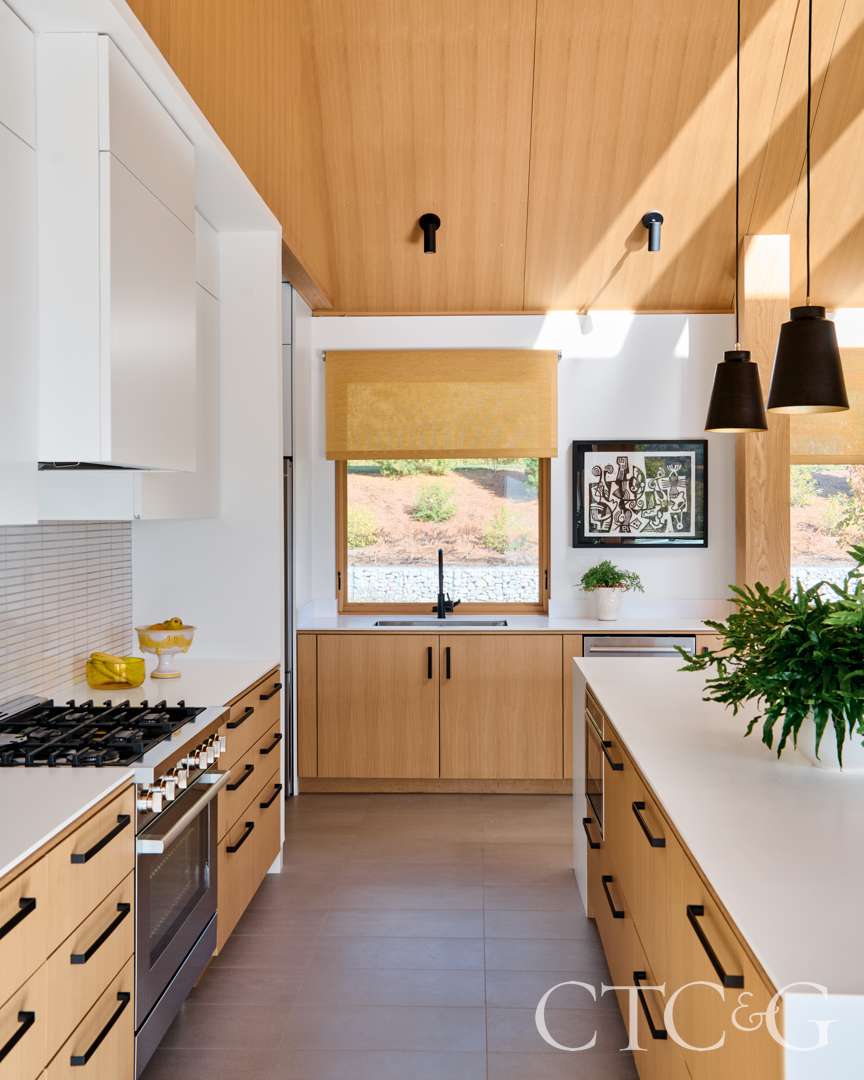
In the kitchen, backsplash tile is from Fireclay Tile, and Brendan Ravenhill’s Grain Barrel pendants provide light over the island.

An Artemide desk lamp tops a custom desk crafted of Baltic birch, and the artwork is a puzzle portrait by Tyler Hays through BDDW.

The painting under the stairs is by Pat Roberts.
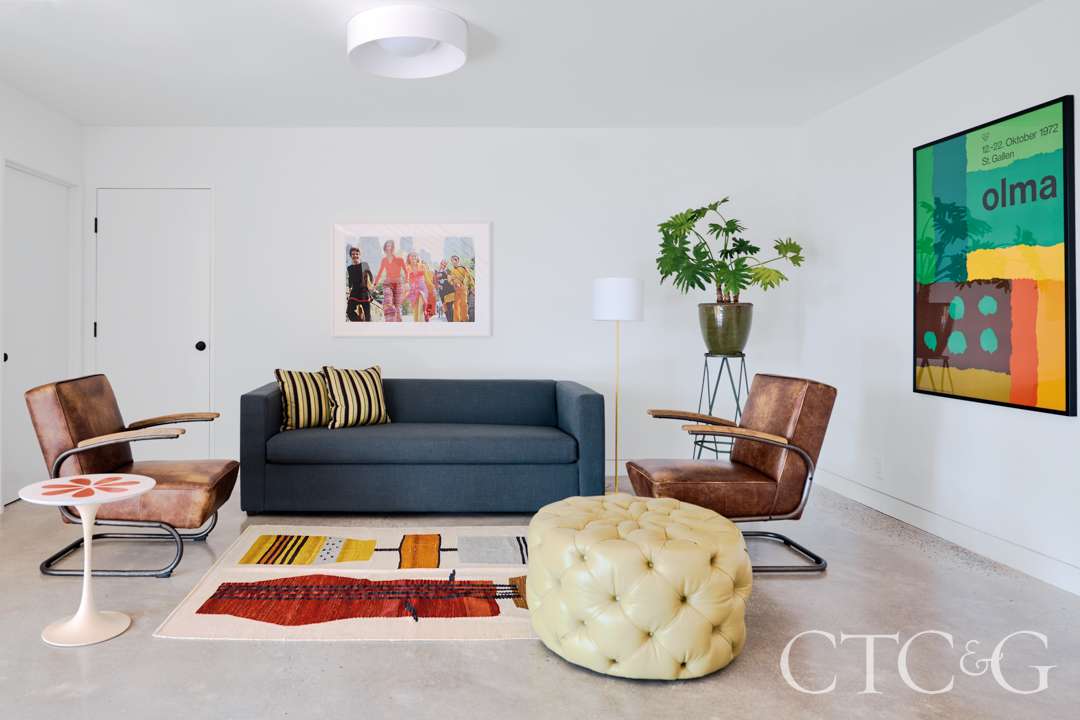
The guest sitting room is furnished with a Blu Dot sleeper sofa, Mitchell Gold side chairs through J. Seitz & Co., and a vintage flat-weave Persian rug from J&D Oriental Rugs.

In the primary bedroom, Halpern designed the bed, nightstands and headboard, which were built by SJP & Sons Construction. The painting over the bed is by Norman Bluhm through Miles McEnery Gallery.

The wood-paneled closet is illuminated by a vintage Italian pendant through InCollect.


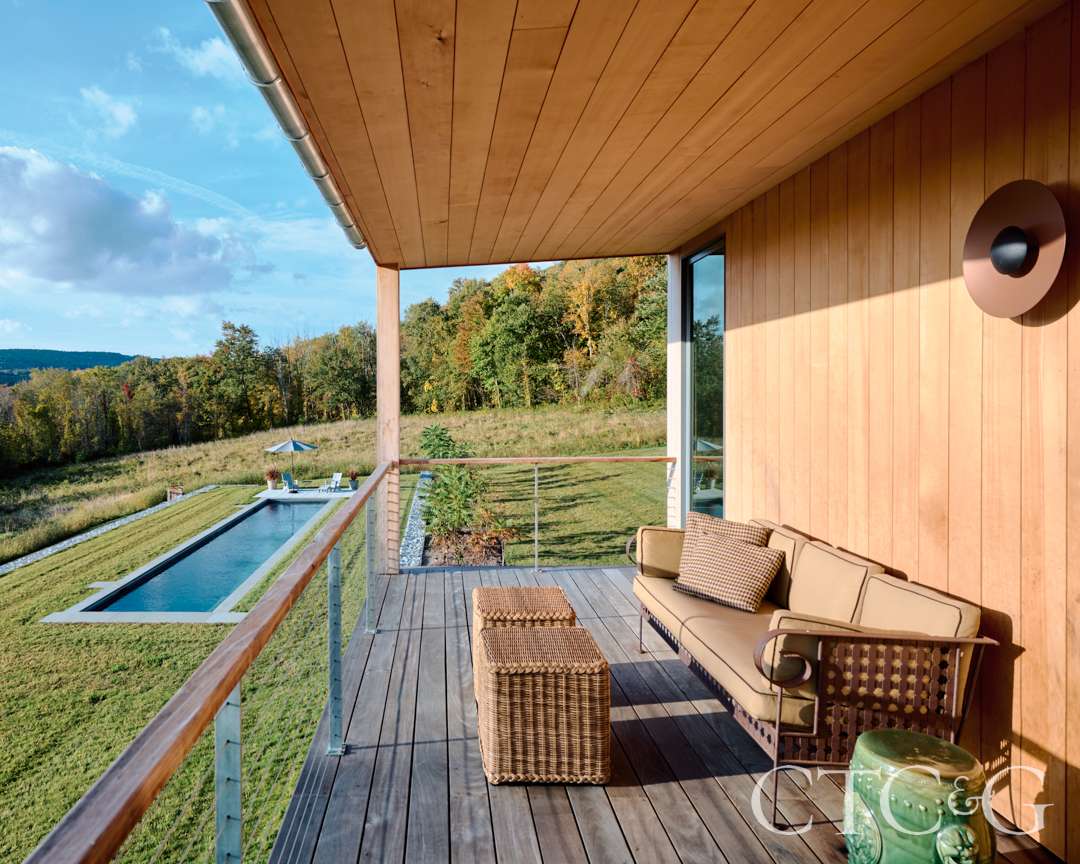
The homeowner found a vintage metal sofa at the Rose Bowl Flea Market in Pasadena, California, and had it shipped for use on the balcony off the primary bedroom.
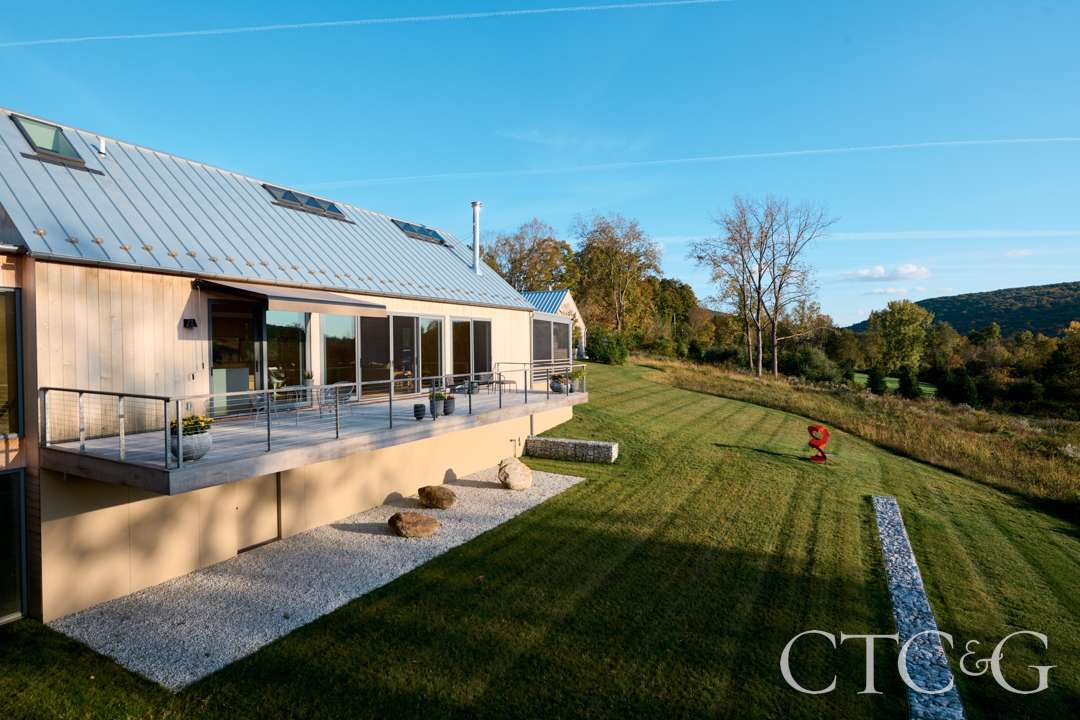
A masterful landscape design by Peter Eckert Landscape Design anchors the house on its site.
Among the very first decisions made was to use yellow Alaskan cedar as the primary exterior material. “I’ve used it a number of times,” explains Dalesio, “mostly with shingle-style houses. The wood silvers nicely as the sun bleaches it, turning it a light gray with some shine.”

As sited on the sloping property, the house is, essentially, two levels, with a downstairs bedroom, bath and home office serving as guest quarters—accessed via a staircase from the main floor, as well as through an entry near the lap pool. All the rooms are large, but knowing how to furnish them is where Halpern does understand scale and proportion. “I’m a designer who always starts with the function of a room. What’s the room for? What’s needed inside and what’s the simplest version of each element that needs to be there?”

For his bedroom, Halpern responded by designing a singular oak unit that contains a king-sized bed, along with a complementing headboard and floating nightstands. A 1970s Brutalist wood credenza serves as a dresser—with little else needed in the room, apart from art. Halpern has a penchant for works both figurative and abstract. Over the bed, he positioned a work on paper by Norman Bluhm—a composition that appears to be an amalgam of the abstract and semi-figurative. Elsewhere, including his walk-in closet, Halpern has hung vintage portraits, as well as decidedly minimalist canvases. “It’s easy, I only buy what appeals to me.”

The expansive, volumetric living room, which melds with an eating area and the kitchen, is furnished with a sectional and a fireplace that hovers mid-air. “What works about that fireplace,” he says, “is that it makes the space intimate. When you’re on the sofa, you’re eye level with the flames.”

Late in the building process, upon seeing a landmark Marcel Breuer house in New Canaan, Halpern had the builder, Stephen Pelletier, fashion a cantilevered porch. “Stephen was the dream contractor—on site everyday—and as obsessive about detail as I am,” Halpern emphasizes. Another detail that continues to matter are the windows, designed and positioned by Dalesio, and through which Halpern sees the meadows, hills and woodlands.
