


Architect Mark Hutker says that the garden is a room itself, with “a floor made of stone and low plantings, walls made of hedges, and a ceiling made from the sky.”

An Apparatus fixture hangs in the foyer. The floors are antique bluestone.

The kitchen looks out to the sculpture garden.
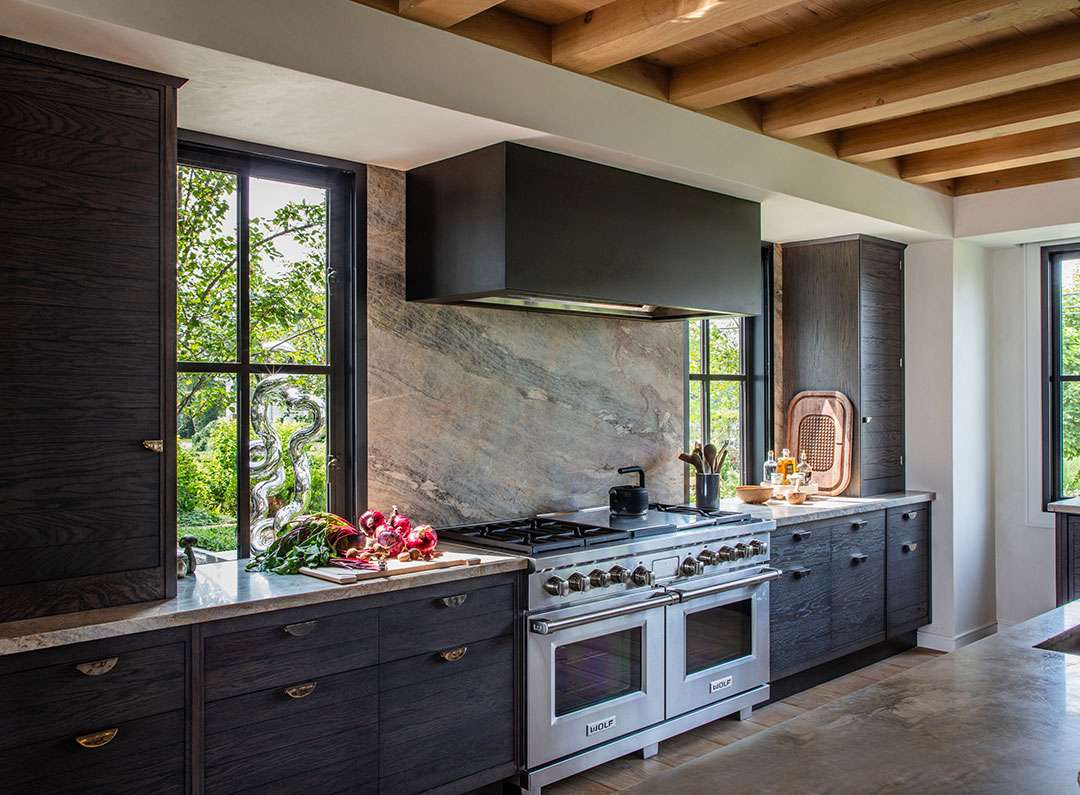
Kitchen countertops are Taj Mahal Quartzite. “I think it’s the best stone for kitchen countertops because it’s just the most impervious stone,” Filicia says. Hardware is from Smallbone.
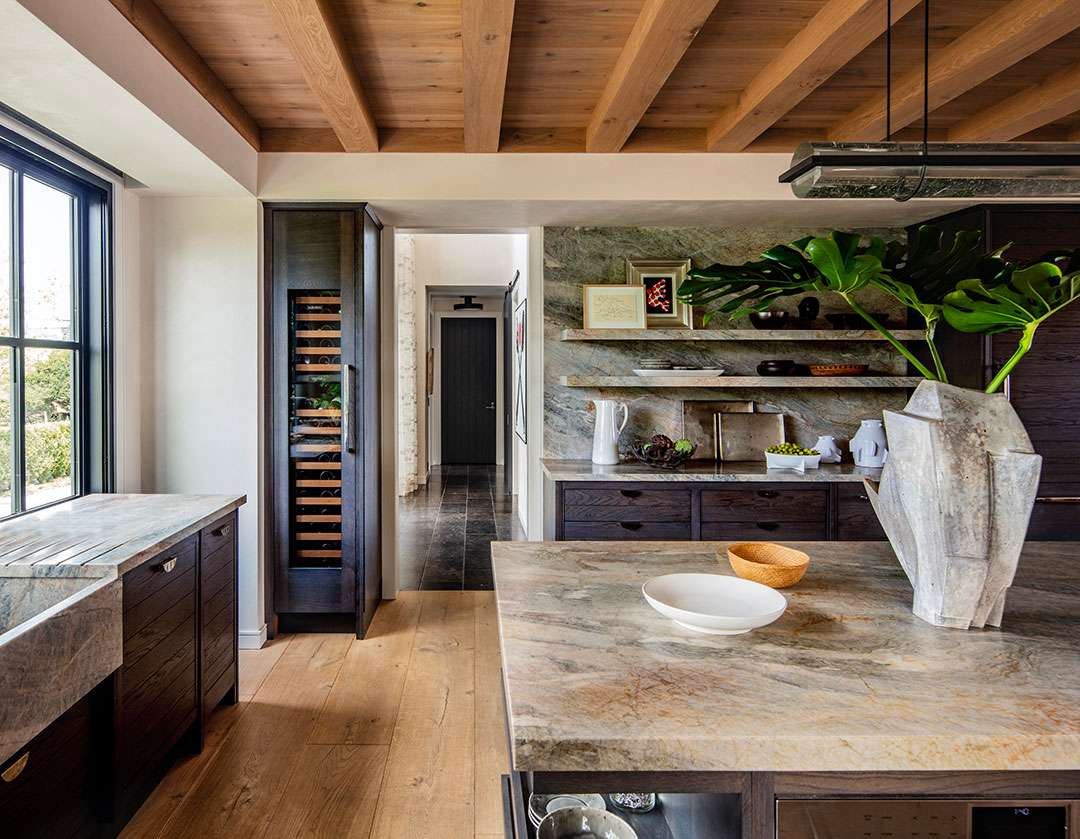
The architect designed a kitchen that is easily accessible for both those cooking and those not cooking, alike.
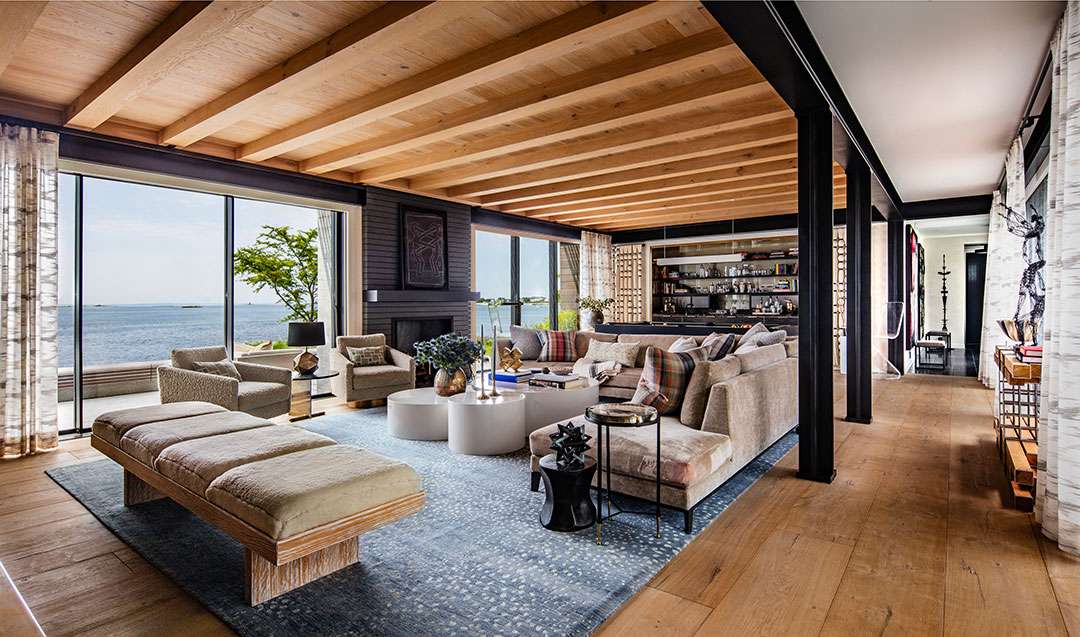
“You can look through glass to the ocean and you can look through glass to the inside,” Hutker says. “But the light quality during any time of the day is exquisite.”

The wet bar is complete with heavily raked wood cabinets framed in brass with integrated handles, an unlacquered brass side panel, textured woven leather, and an antique glass mirror.
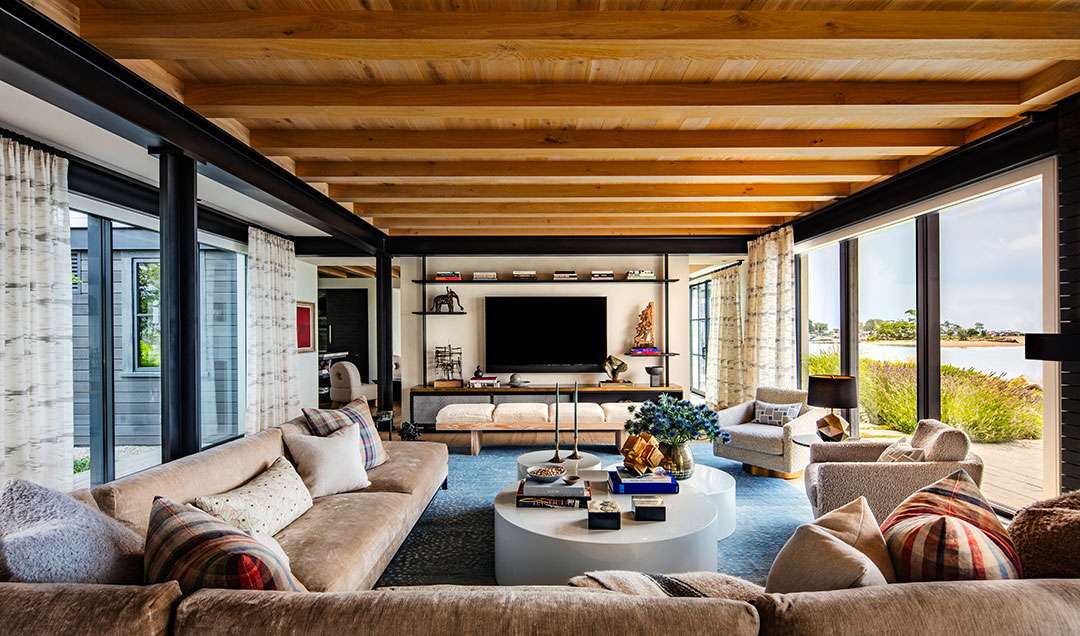
“Our goal is to get two exposures to the sun in every room, at a minimum,” Hutker says.
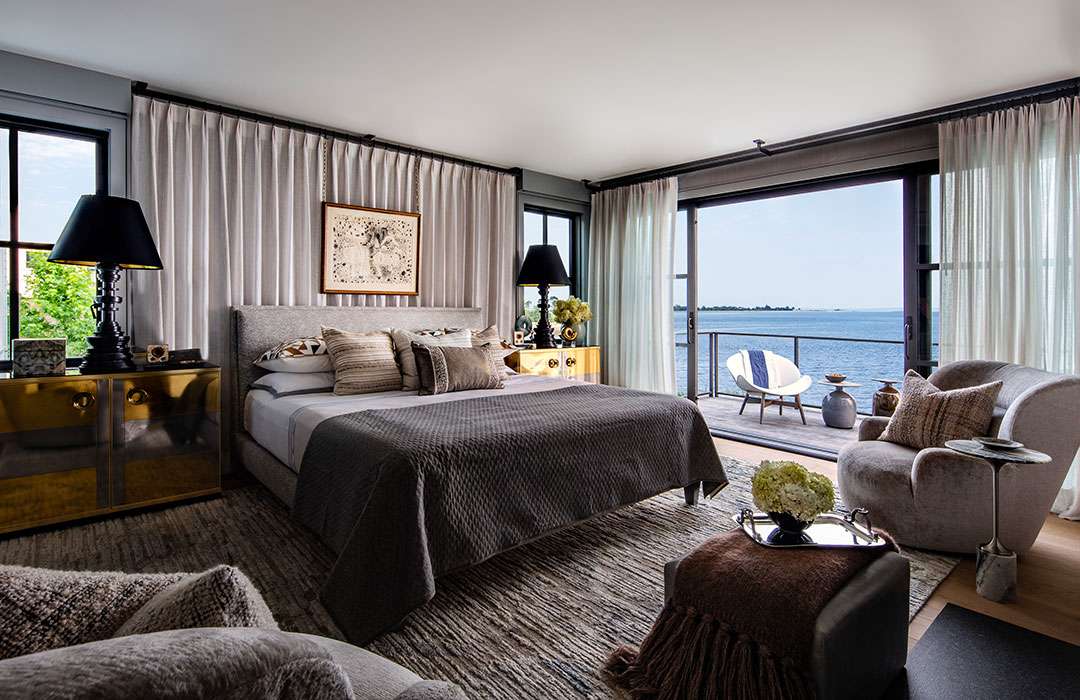
Designer Thom Filicia says there are “little hints of formality” throughout this home. In the primary bedroom, there are nightstands complete with black glass, brass, and nickel detailing.

The primary bathroom is outfitted with a Waterworks tub and fixtures. There is a fog light on the bottom half of the windows, shielding bathers from seafaring spectators.
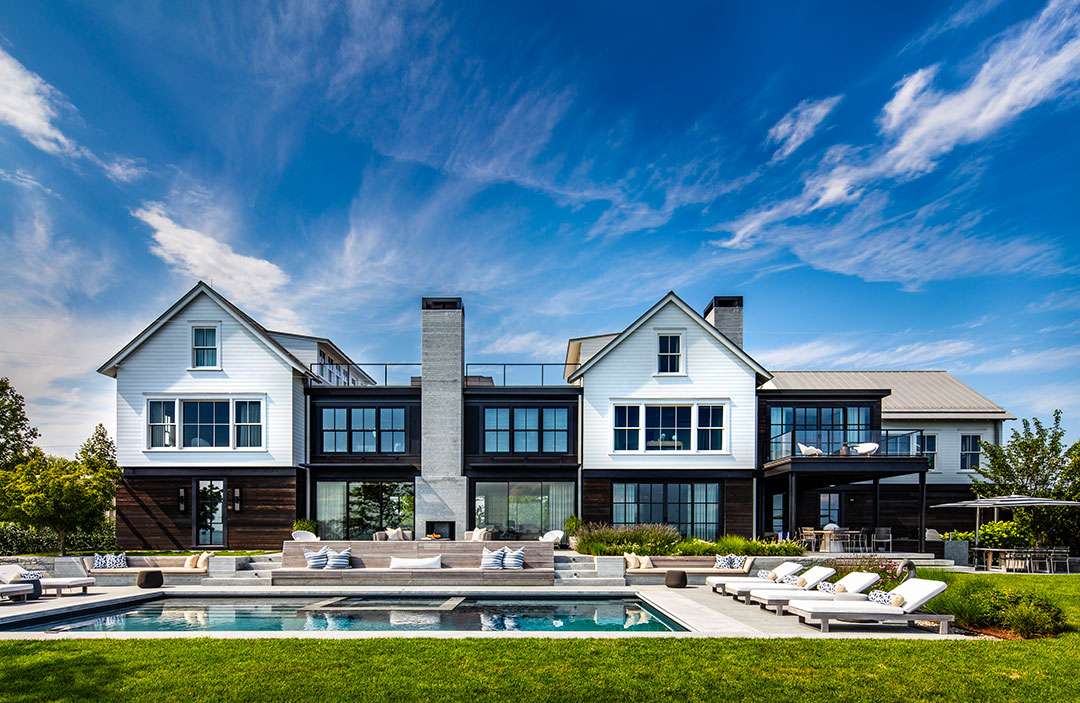
A series of steps allow for seamless water views both inside and outside. “If the terrace is at the same level as the living room, and you put furniture on the terrace, the furniture is going to block the view,” Hutker says. “When you come outside, you step down the height of the furniture that you want to look over. And when you go to the pool, you step down so that the chaises are not blocking the view.”
“I like the thought of discovering this house for the first time in a boat on a foggy morning, and you see the silhouette of the house and the landscape and you’re like, ‘Oh, there’s nothing different. It fits right in,” says architect Mark Hutker. “But then as the fog starts to clear, you realize the details are very crisp, clipped, and much more contemporary.” Hutker and his team (firm principal Matthew Schiffer, AIA; project manager Ryan Alcaidinho; and associate Kevin Schreur) designed a waterfront structure fit for modern living, one that exudes a “new regional vernacular.” Hobbs, Inc. brought the six-bedroom, seven-and-a-half bathroom vision to life, while designer Thom Filicia created an interior scheme complementary to the architecture. “They wanted every room in the house to feel like they were usable and inviting; they were not just for entertaining, they were for living and entertaining. They were for weekdays and weekends, days and nights,” Filicia says.
Read on for a conversation with the interior designer and the architect.

The floating staircase makes quite the statement when you enter the house.
Thom Filicia: The one thing I loved about this space is that you come in, and it’s one of the only spaces where you don’t really see the water. I said the arrival moment needed to be incredibly powerful—from the scale and the size, to the color of the floor, the quality of it, and the front door. You open the front door, and all of a sudden you have this floating staircase, this really dramatic floor, this really interesting lighting. Between the art, the lighting, and the interior details of that entrance, it was about creating enough design weight to hold up to the view.
Mark Hutker: It’s a tour de force of structural ingenuity. It doesn’t touch the ground it, it doesn’t touch anything that you can see, except when you climb up it. It’s just kind of floating. I don’t think you can think about the stair without thinking about the grill on the window on the outside. The homeowner became nervous thinking about walking downstairs in the morning, or, more importantly, at night, when the lights were on inside and people looking into that window—so she wanted some sort of a screen. There’s a horizontal and vertical light play that happens when the sun comes in through that grill.

The kitchen is an unexpected surprise from the typical all-white kitchen one might expect at a waterfront home.
Thom Filicia: We wanted it to feel like it was part of the living space. What I love about it is the mix of materials: the stone behind the stove that is incredibly elegant, the hood is in a beautiful bronze-finish metal, the cabinets are a dark oak. It just so happens that the owners are amazing cooks—they’re total foodies. They love cooking and entertaining. When they’re in the kitchen and they’re cooking, they just don’t want to feel like they wish they were in another room. They wanted it to feel like it is one of the sexiest and greatest rooms on the first floor, in a way that is kind of like their living room.
Mark Hutker: One of our goals in designing every kitchen is to create what I call a ‘defensible kitchen’—a space that a chef can use and for people not participating in the cooking, it’s just as easy for them to circulate around, rather than through.
How did you choose the color of the kitchen cabinets?
Thom Filicia: I really wanted the color of the cabinets to play against the color of the lighter, natural, wide-planked floors. I wanted the cabinets to play closer to the steel. A lot of the cabinetry has dark, almost black, coming through—and it plays beautifully to the windows, and the doors, and the steel, and all of the metal detailing.

There is a breadth of materials used in the great room: Wood and steel beams, glass, wood floors.
Mark Hutker: I believe there’s an ontic, which means ‘factual reality.’ There’s a factual reality in human experience that when you see how the structure of the house is protecting you from the elements, you just feel more secure. You feel more enclosed and comfortable in that space, so the idea of expressing the steel is at once an aesthetic decision, but it’s also an ontic experience that we feel is deeply embedded in us as humans. We always like to bring that sensibility out in our architecture. It’s the same reason that we expose the wood beams on the ceiling, because, you know, it gives a sense of, ‘Oh, I see the big frame of steel is holding up these things.’ It’s simple empirical understanding of where you are.

Let’s talk about the bar in the great room.
Thom Filicia: It’s a little jewel box, but it’s not designed in a way where it jumps out. It’s almost done in a way where it fades away, kind of recedes into the wall. There’s a dramatic mix of materials, but they don’t feel flashy—they feel reserved and quiet.

The primary bathroom looks so serene.
Thom Filicia: The luxury of the space isn’t just the incredible materials, but it’s the scale of the shower and tub area. It just feels like you’re in a room, not a bathroom. It’s a wet room concept, where you have the bathtub and the showers within the same space. You have so much space, you don’t even need a door. When you wake up in the morning and go in there or when it’s the last thing you see before you sneak off to bed, it’s this really epic moment, architecturally, decoratively, materiality. And also the view—you can’t even believe it’s happening.
Mark Hutker: I want to give credit to the owners. I think the owners had great courage to follow our imagination about keeping these two showers as open as they are. The experience we were trying to give them was one of an outdoor shower experience, but indoors.
