


For a couple who spent their careers in healthcare, when it came time for a new home, they sought one that would prioritize health and well-being, connect to the natural world and elevate their spirits. “I was a radiologist in a demanding practice for 28 years in Flushing, NY,” says Lai Yu, “and my husband [Modestus Lee] was a neonatologist at Greenwich Hospital for 20 years. As physicians, we are keenly aware of how precious good health is, and the fragility of the balance of things.”
Having lived for 28 years in their previous home where they raised their children, the couple’s shared interest in architecture and passive homes fueled a dream to build a home that could better withstand climate change. The challenge was finding the perfect lot—a water view without being on the water, public utilities, walking distance to the town and train, safely above 30 feet of sea level—and someone to help bring their dream to life.

A friend referred the couple to the Amanda Martocchio Architecture website. “I fell in love instantaneously with the houses presented and the format of the website,” says Yu. “The user-friendly and totally logical layout signaled to us a degree of thoughtfulness. After meeting Amanda, we hired her without considering any other firm.”
The collaboration began with a deep dive into the clients’ specific goals for sustainable design. “In this case, reducing energy consumption was central to their sustainability objectives, as well as creating an efficient home that did not require ongoing maintenance,” says Martocchio. “‘Healthy living’ has both aesthetic and practical features. Surrounding oneself with plants and natural daylight can be uplifting, while cycling fresh air throughout the home with an ERV system has proven health benefits.”
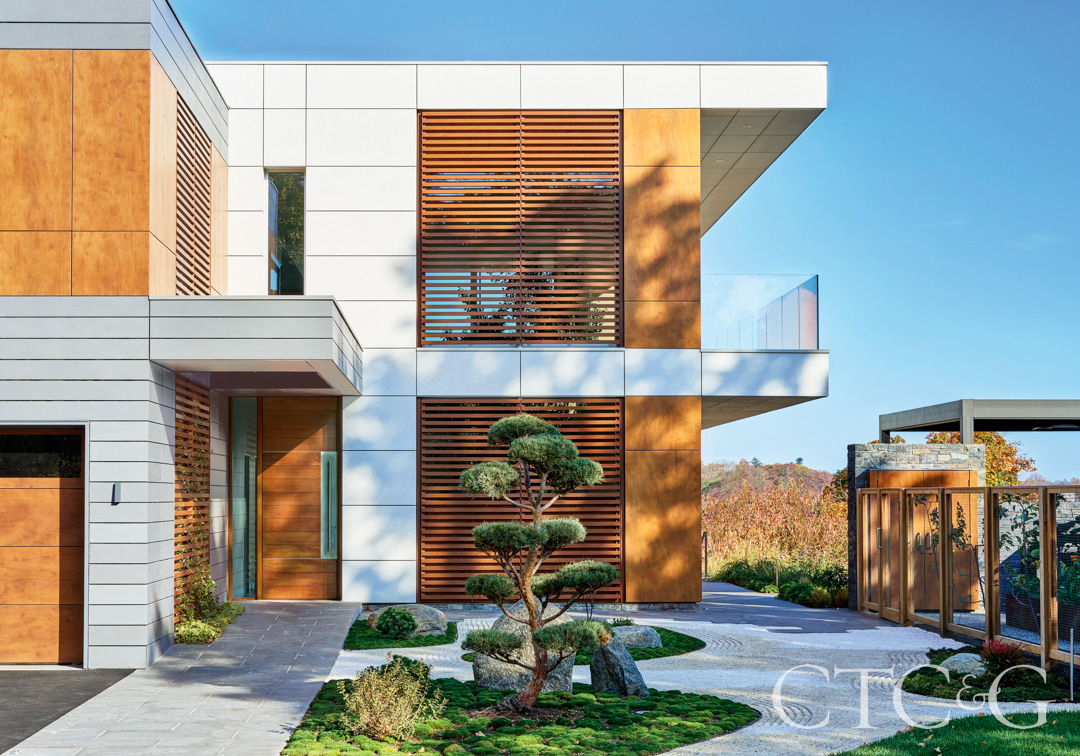
“Aluminum louvers are located over the large windows for additional privacy, for creating a vine-growing trellis, and for diffusing light in the stair hall. They create wonderful shadows, and on the exterior, they provide textural interest,” says architect Amanda Martocchio. The front door is custom through Rockwood Door.
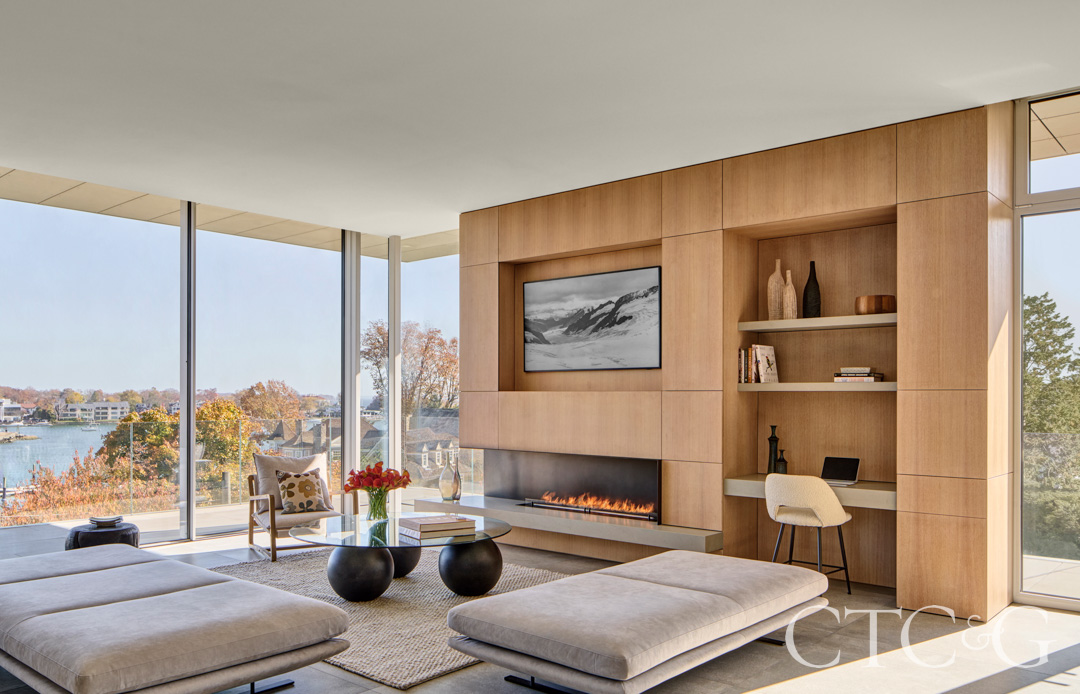
A NetZero Fire fireplace in the living room produces its flame by combusting bioethanol vapor; sofas are from Ligne Roset; and the floor tiles are from Porcelanosa.
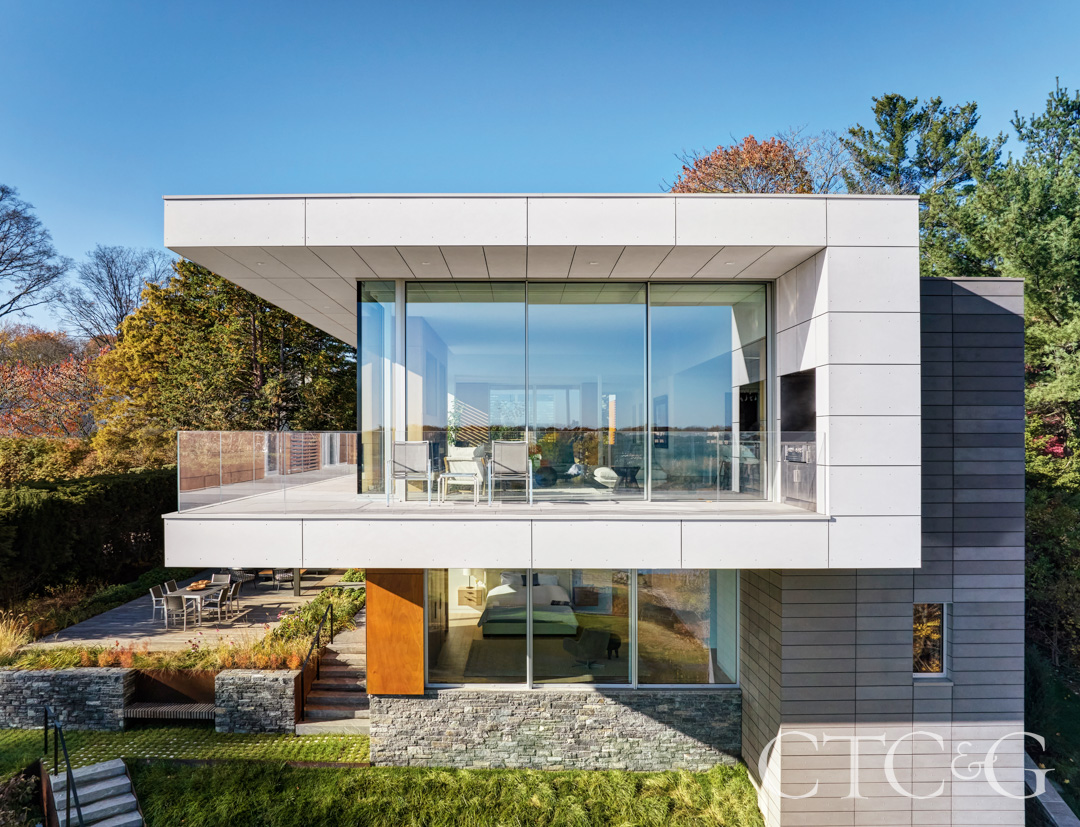
The upper living level features floor-to-ceiling corner windows and a wrap-around balcony, while the primary bedroom—on the entry level below—is tucked directly under the protective cantilever.

Caesarstone kitchen countertops complement custom millwork by Fine Line Finish Carpentry, and the counter stools are through AllModern.
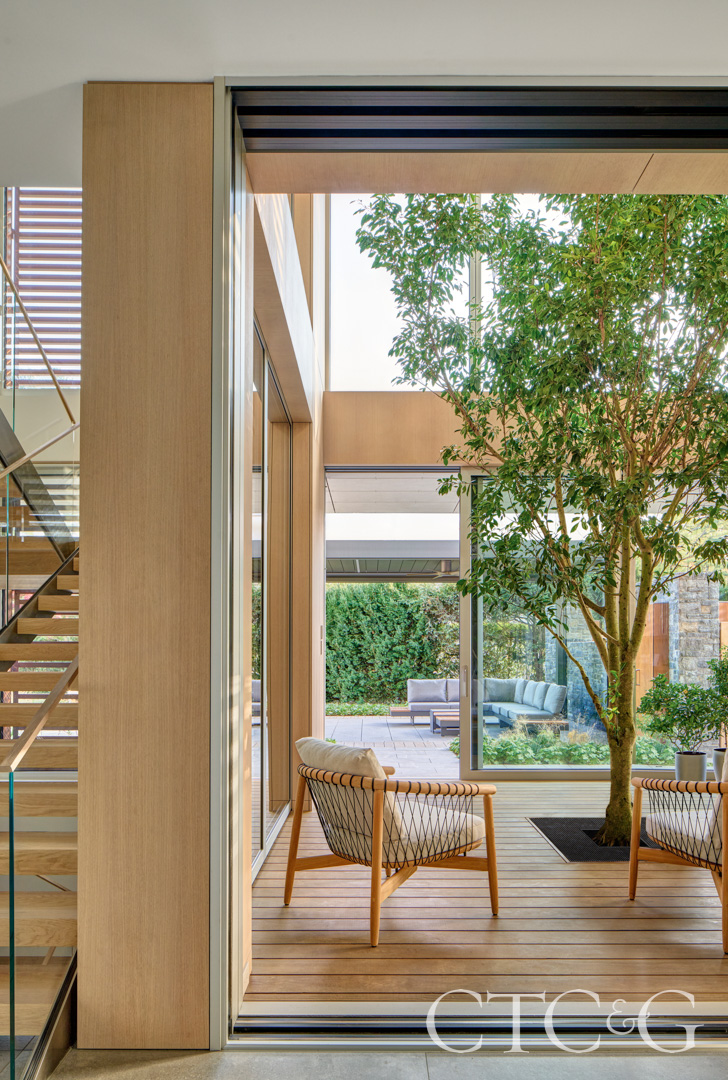
In the atrium, Crosshatch chairs from Design Within Reach top Kebony decking through Ring’s End.
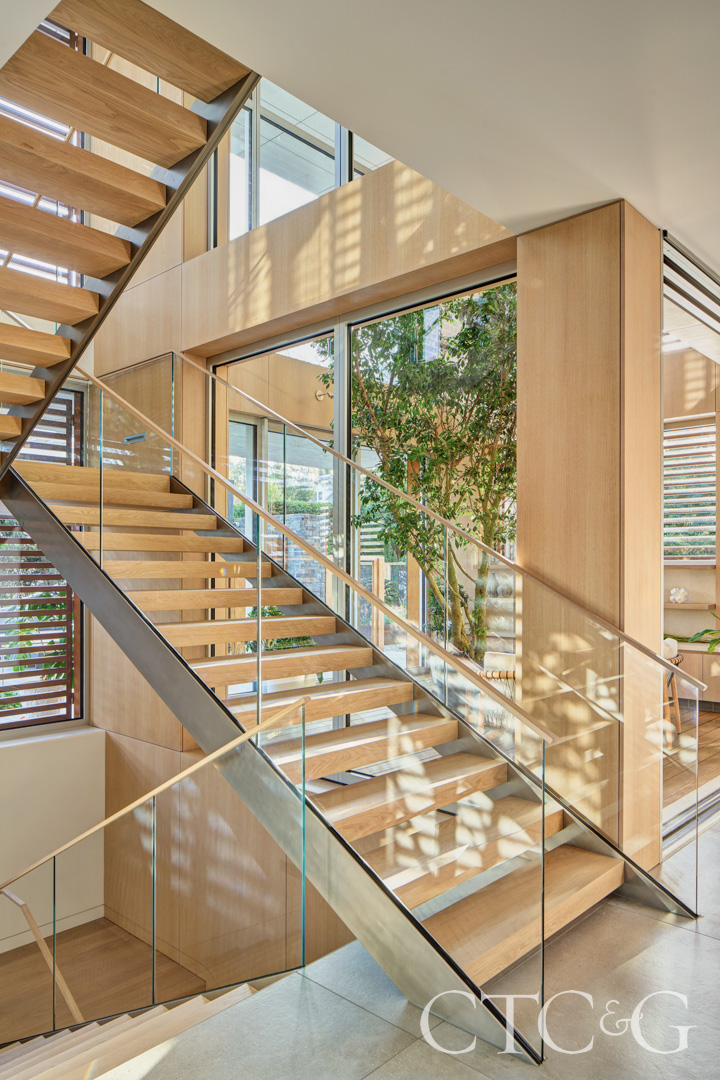
“Primary spaces are located on the upper floor accessed by elevator and a central stair that ascends along the atrium,” says Martocchio.

A second-floor view of the atrium shows the Marvin skylight and recessed grow lights from Kessil.

The indoor-outdoor connection continues with pergola access to the atrium through a triple-glazed glass door.

Custom built-ins provide storage in the primary bedroom.
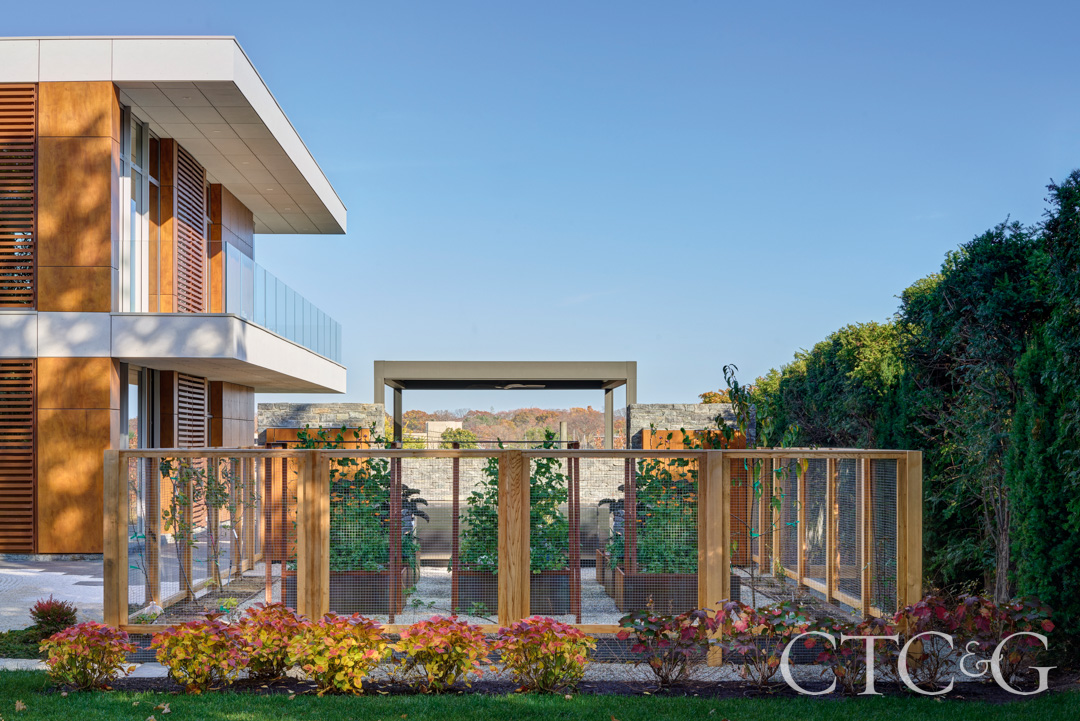
A Renson outdoor pergola is visible just beyond the fenced, raised-bed garden.
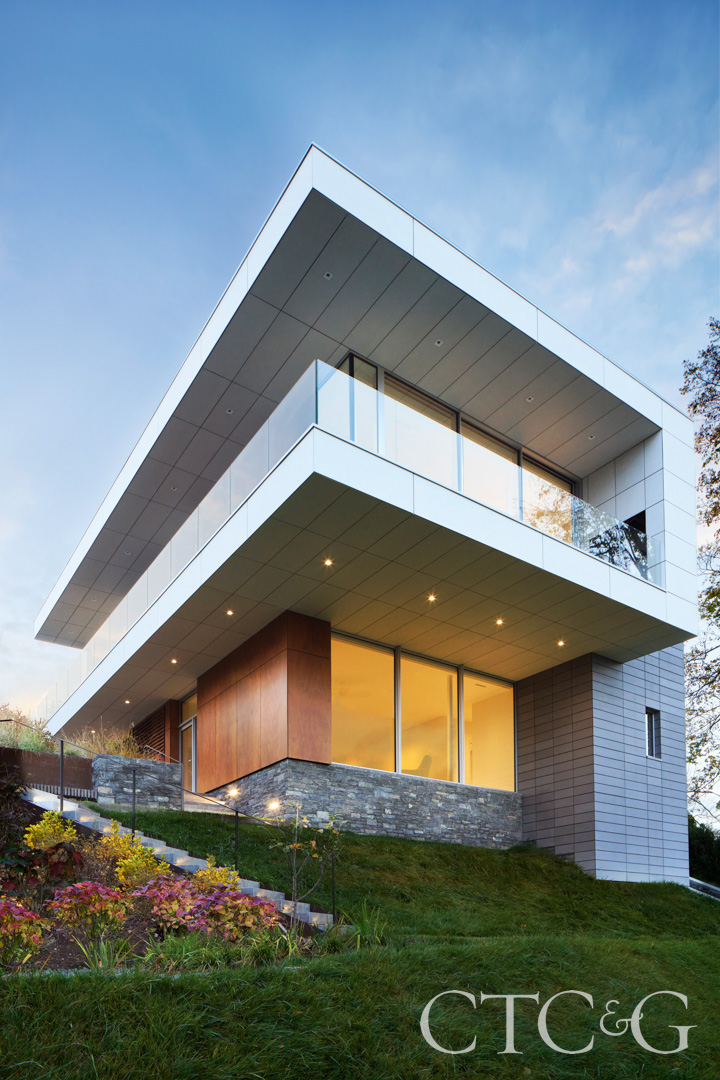
The home, built by Prutting + Co., has a granite stone base through Connecticut Stone.
So, the design needed to be efficient, employ sustainable and durable materials, and maintain a low carbon footprint, while also providing for aging in place as this would be their primary residence. “We incorporated features that would allow for disabilities, such as an elevator, a ramp to the front door, showers with easy entry and low-profile thresholds,” says Yu. “The generous halls and open floor plan make it easy for one in a wheelchair and has been tested by a family member.”
Martocchio learned that a love of gardening, nurturing plant life and, more broadly, the earth, was central to the couple’s world view. They also wanted to connect with the natural landscape and views of the harbor, which, they felt, would contribute to their sense of wellness. “These priorities became the seeds of our architectural response to the site and spatial layout within the home,” notes the architect. “The atrium at the core of the house would serve as a ‘living’ environment for reflection and recuperation and would be experienced throughout the two levels of the house both visually and acoustically with the accompanying sound of the atrium’s fountain.”

An open-riser stair connects the living spaces with the glass-enclosed atrium. “The atrium gives me a bright indoor-outdoor space year-round,” notes Yu. “Being a plant enthusiast, it is a dream. We have many fruit trees and plants in it with hopes of our Sunburst Tangerine getting large enough for the built-in planter. I find it a lovely place to be in, especially on a gloomy day. It probably is the antidote to seasonal affective disorder.”
Open-plan interiors have built-in oak cabinetry and paneling throughout. “The Prado sofa sectional by Ligne Roset fulfilled the owners’ criteria for ultimate flexibility and comfort. Back cushions can be rotated to face either the kitchen area, exterior views or the fireplace and TV,” says the architect. “Alternately, the cushions can be removed altogether to create daybeds.”

The home consumes little energy and requires minimal ongoing maintenance given the durable, weather-resistant exterior materials that are meticulously “panelized” as an open-jointed rainscreen. Rooftop photovoltaics combined with heat pumps contribute to zero-carbon emissions. “My husband’s favorite elements are the passive house components and the smart house features. He looks forward to being net zero. He has the house on schedules and speaks with Google all the time. We’ve gotten so used to the conveniences that when we are away, we flinch at the need of using buttons,” says Yu.
The surrounding landscape, by James Doyle Design Associates with project landscape architect Shufan Feng, includes a covered pergola, dining deck, fence-enclosed planting beds and a Zen garden. “The front Zen garden design was embraced by both the client and architect with JDDA using symbolic elements like rocks (mountains/islands) and raked sand,” says James Doyle. “The minimalism aspect was complimentary to the modern architecture. The client is an avid gardener and collector of plants, so we were able to infuse the spaces with an interesting plant palette and create a growing/ kitchen garden.”

“After living in the house for over a year, it has exceeded our expectations,” notes Yu. “The conveniences that we thought up have come into use the way we imagined. The beautiful view with breathtaking sunrises makes us feel that we are on vacation. And I absolutely love my yard: It is my playground and I can spend hours in it.”
