


Upon arriving at this Sagaponack house, what comes into view first is what lies behind it. While the two winged, red cedar-clad residence announces itself as a distinctive architectural presence on the land, it’s the fields beyond, dense with fruit and lavender trees, that assume a visual priority, with the plantings backdropped by the shimmer of Sagaponack Pond.

Prior to conceiving their design, the husband–wife architects Janara Garcia Soule and Steve Soule of Merrell Soule Architects recall the house that had once occupied the site, an otherwise “old, funky structure,” says Steve. “But there was one nice moment about it and that was a breezeway that served as an aperture to the backyard. We expanded on that when we designed this house for the clients.”

When coursing the handsome bricked walkway toward the house, what appears to be the front door, head on, is instead the glass breezeway linking the wings, through which is seen the private agricultural reserve. Suddenly, the walkway takes a sharp right angle to a discreetly recessed entry. “When we design front entrances, we rarely do it right in the middle,” says Janara, a detail that is one of many surprise elements they introduced.
Indeed, Janara and Steve both admit to conceiving every residence based first on a “diagrammatic process, rather than one based on style,” as he says. Each of the two wings contains three bedrooms, with a downstairs floor plan that is immediately logical and discernible. They even echoed their rectilinear plan on the ceilings, fashioning what the interior designer for the project, Kathryn May, calls, “a modern take on the traditional coffered ceiling.” As Steve emphasizes, “The ceiling is dissected into the same module gridwork as the house itself.”

The exterior shows the architectural design of Merrell Soule Architects.

Pendants from Palecek hang above a sofa by Thayer Coggin in the living room. The coffee table is from Arteriors.
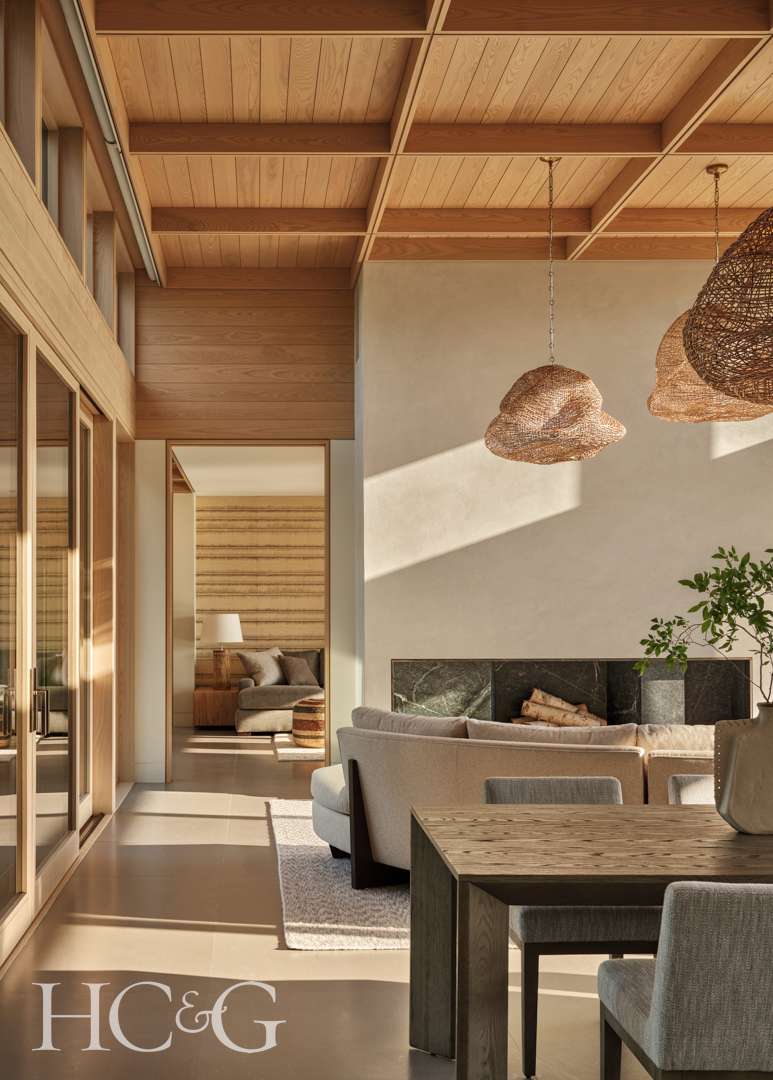
A dining area looks out onto the living room.

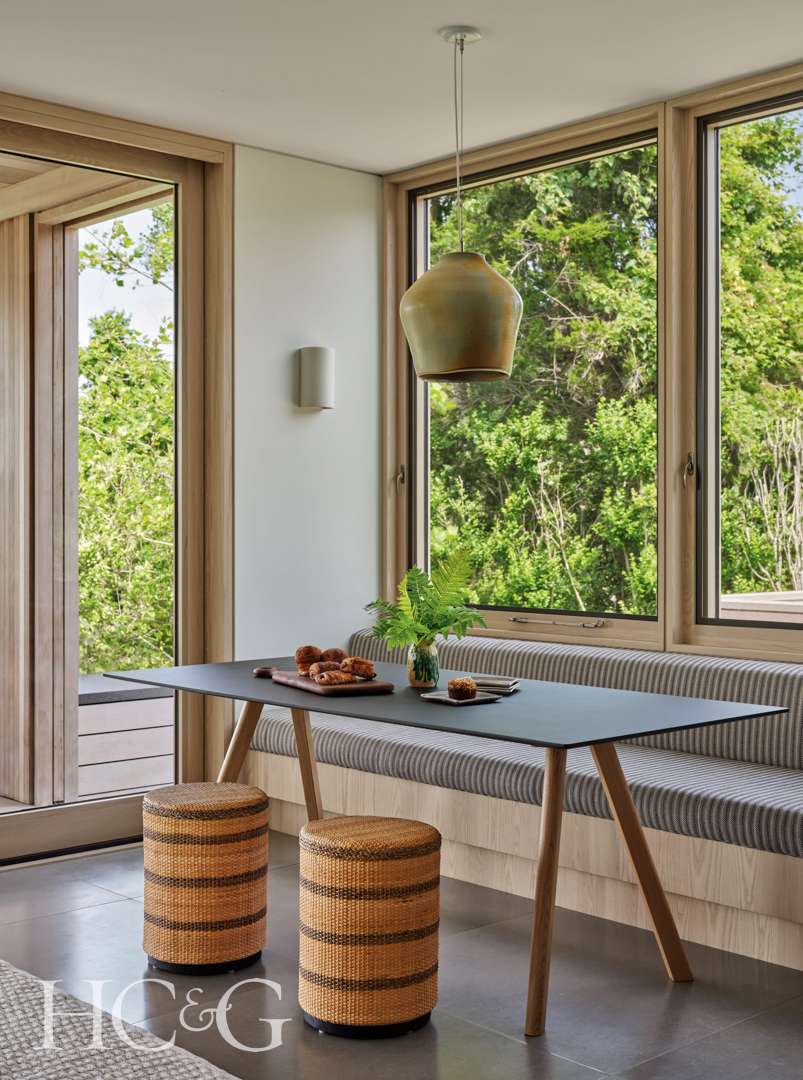
A custom bench covered in a Fabricut fabric is paired with a table from Design Within Reach in the kitchen dining area. The stools are from Made Goods.
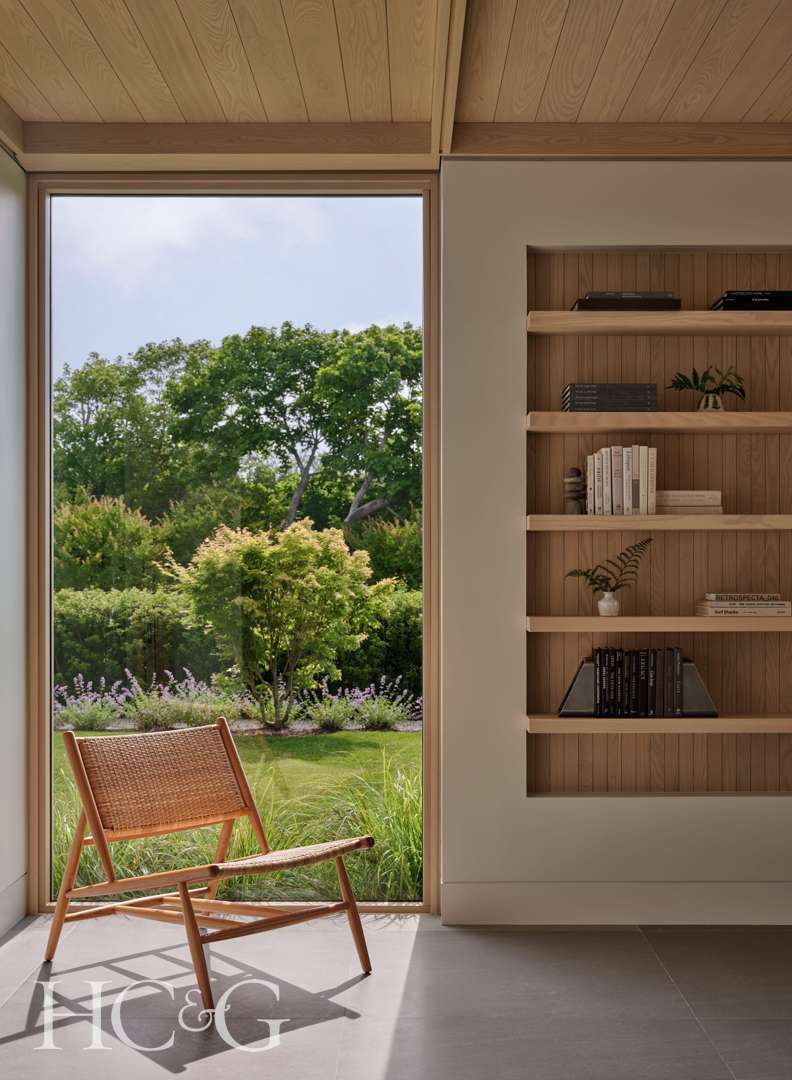
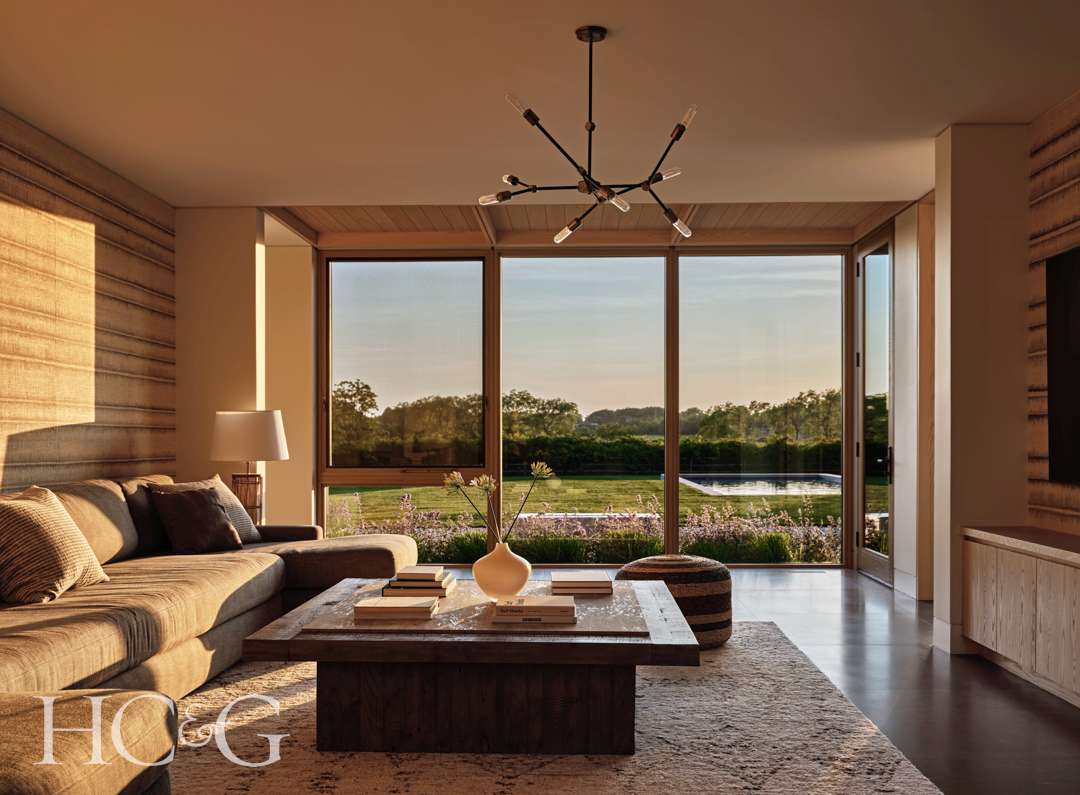
A chair from Noir is placed next to custom shelving in the media room.
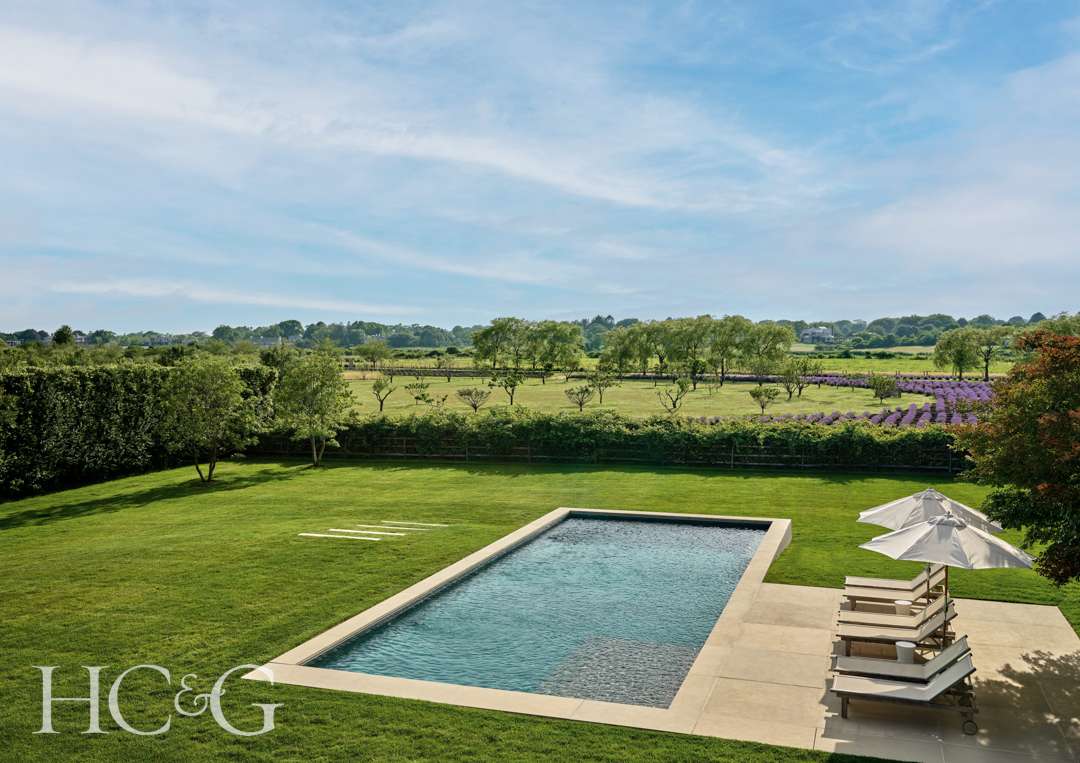
The surrounding area of the pool features landscape design by Michael Donnellan of Summerhill Landscapes.

The staircase leads up to the second floor.
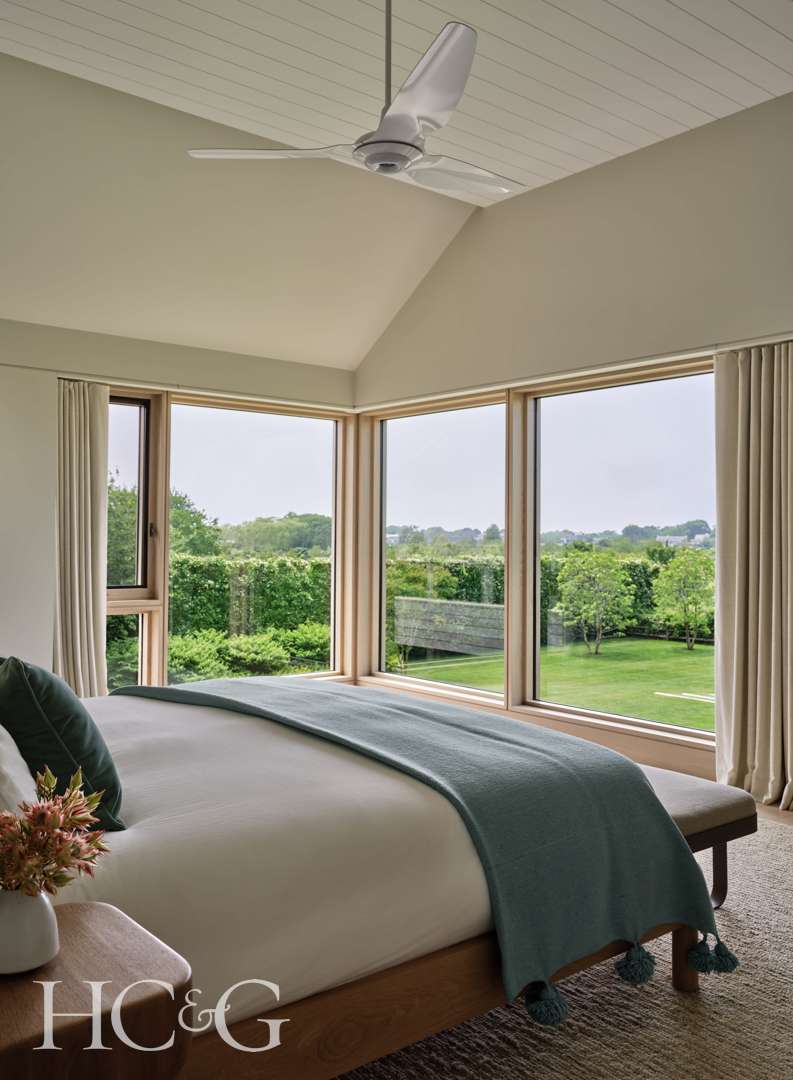
The primary bedroom features vast views of the surrounding landscape.

Sconces from Lumens flank a custom vanity and mirrors in the primary bath.
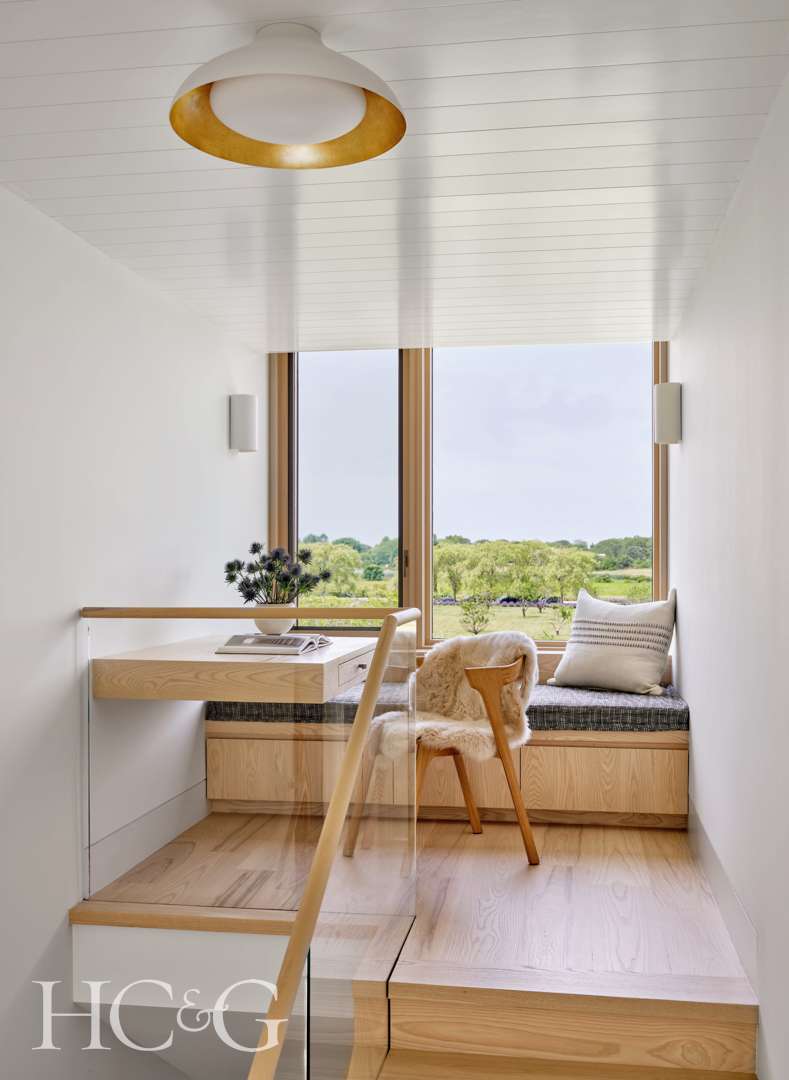
The bench and desk in the home office are custom.
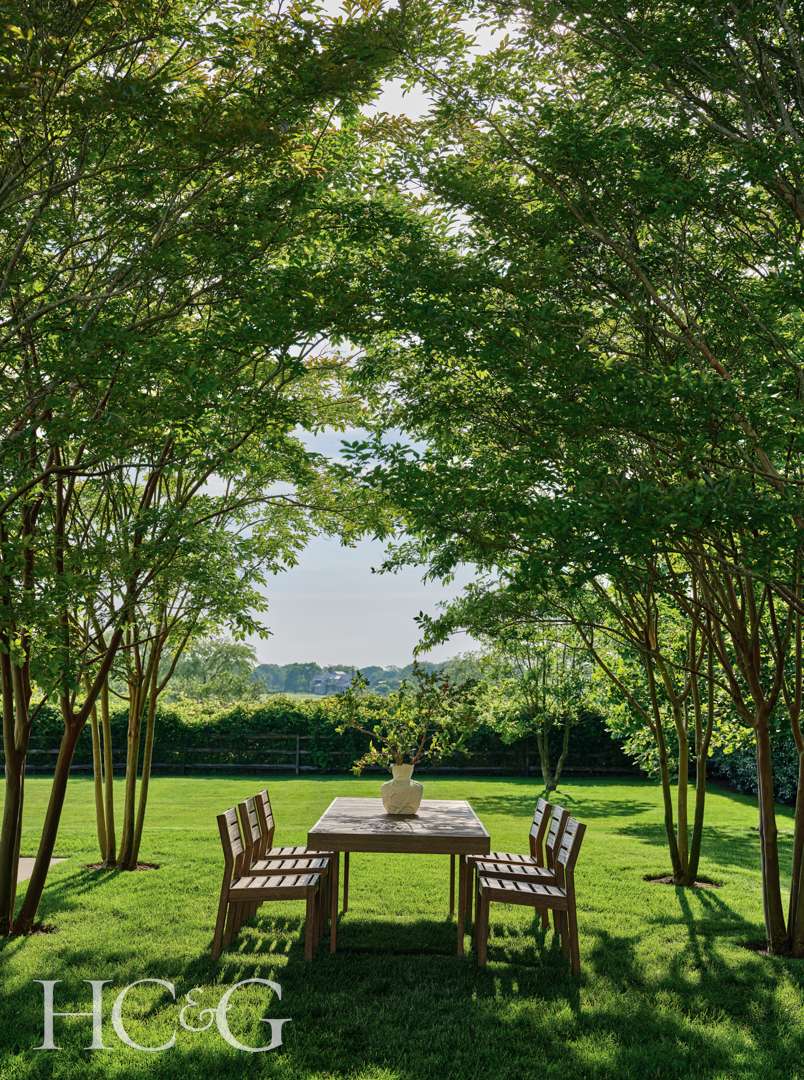
In the outdoor dining area, the table and chairs are from West Elm.
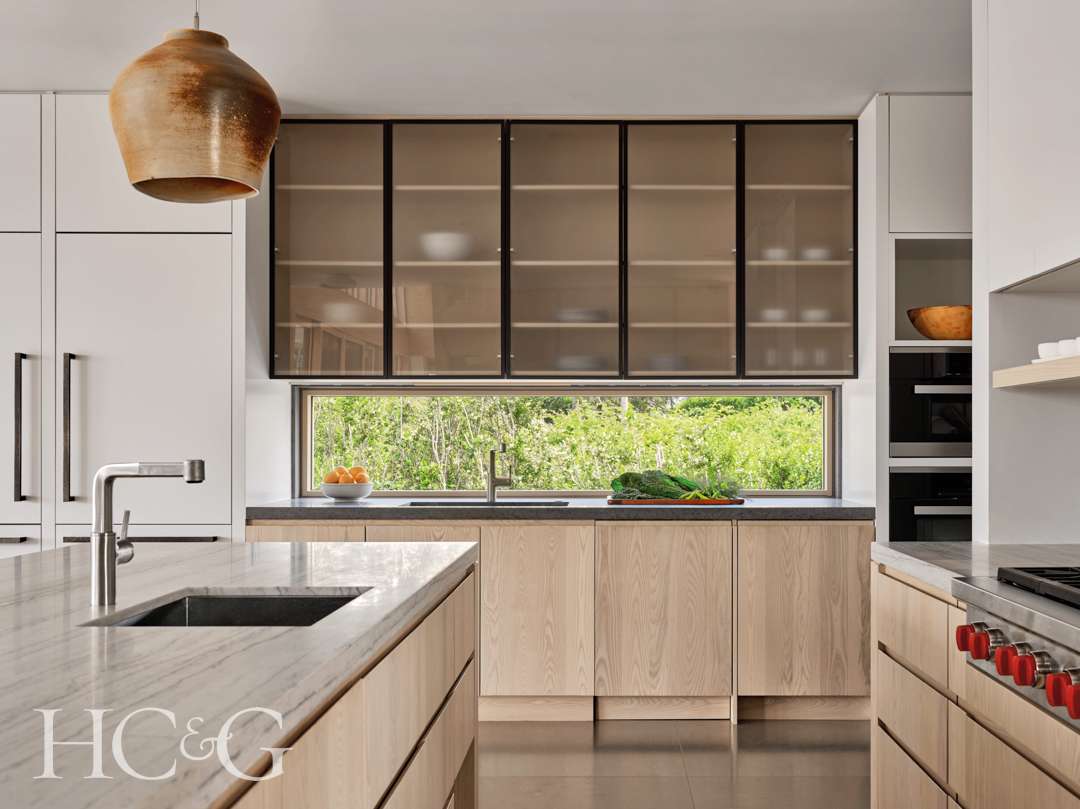
So attuned to effect is the Soule team that they chose ash wood for the interiors. “The clients, who are from Jamaica, wanted cool limestone floors,” Janara explains, and “we thought the ash would provide a better, lighter contrast.” The architects carefully ensured that the very graining of the ash wood would feature “cathedral graining,” whereby raw logs are cut flat to reveal the innate pattern. Meanwhile, all of the ash used in the kitchen as cabinetry and for the island was cut to emphasize a vertical grain. “The effect of the wood in the kitchen is softer to the eyes,” says Janara. A single horizontal pane of glass serves as a backsplash, while frosted-glass cabinets become strong visual moments, while still serving their purpose

custom. Photography by Read McKendree/JBSA
The house manages to foster a constant interplay between indoors and outdoors. A roof deck situated over the main living area allows for expansive views of the terrain, while his and her offices are tucked into dormered areas that embrace the landscape. “We wanted to get those two offices higher than any other place in the house,” says Steve, “and that was a challenge. But by putting them where they are as dormers, they’re essentially a half-story higher than anything else on the second floor.”

The clients commissioned May, a fellow Jamaican with whom they had worked on their home in Jamaica, to configure the interiors. “What I love about this house,” says May, “is the rectilinear qualities that the architects were so keen on.” But to soften those sometimes hard effects and to present a corollary to the right angles, May chose curvaceous sofas and coffee tables, rounded ottomans and lighting fixtures that assume sculptural forms. Wood-fired porcelain pendants hang over the kitchen island, which were sculpted, fired, and tinted by her brother David Pinto, a noted Jamaican-based ceramic artist. “The thing about wood firing is that you never know how it will affect the finish, but these came out right,” she emphasizes.

Elsewhere, for instance in the media room, May speaks about wanting to “honor the architecture and the masculinity of the design, but also to add warmth and comfort by using elements that are natural and organic in shape and color.” By evening, the living room assumes a glow from an ordered galaxy of amorphously shaped wicker fixtures from Palecek.
The house has settled—seemingly grown—into its site. “It’s rare to have clients who really appreciate architecture,” says Janara. “They gave us a lot of liberty to express what we wanted.”
