


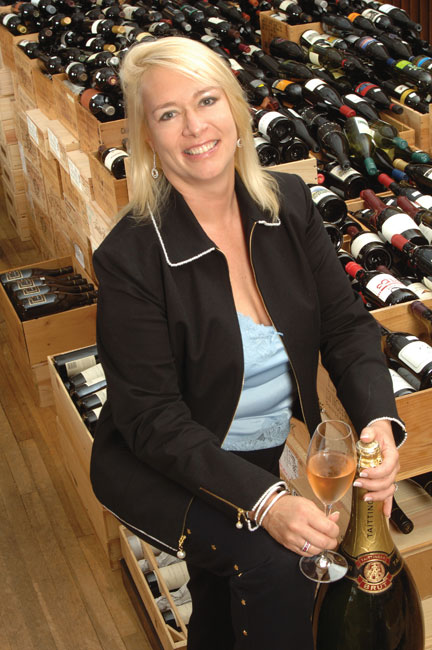
Looking for a New Year’s resolution that can lead to a lifetime of pleasure? Wine collecting might be the answer. Here, your guide to Collecting 101.
Start by establishing a budget. Can you set aside $5,000 or $10,000 or possibly finance a priceless collection? I posed these three scenarios to Terry Rogers of Horseneck Wine & Liquors in Greenwich, who often helps newbie collectors.
Collections can be global, revolve around one country, focus exclusively on Old World established “name” wines or even single varietal wines. Storage is a main consideration. For beginners, the first step is to acquire a Sub-Zero wine storage unit (to keep the wines at an ideal 56 degrees) or simply set aside space in a cool cellar. Of course, constructing a wine cellar is yet another level of commitment.
Rogers relishes the challenge of matching collectors with just the right wines for their lifestyle. “On a budget of $5,000 and with space for a dozen cases in your cellar, you can divide the collection into three categories: everyday wines, wines for aging and select trophy bottles,” Rogers says. She suggests everyday drinking wines from regions that excel in well-priced food wines: Rhône Valley wines pair well with meat and poultry; Sancerre and Pouilly Fumé from the Loire Valley or sauvignon blanc from New Zealand are ideal for seafood; and Tuscan Sangiovese-based wines, Chianti and Brunello di Montalcino or Piemonte’s Dolcetto work well with Italian cuisine.
For the next third, consider California or Bordeaux wines in the $50–$80 range. These full-bodied wines from a good vintage year can last five to 10 years. Stags’ Leap Artemis and Caymus (California Cabernet classics) are good choices. Rogers suggests buying four to six bottles of different wineries to get a good cross section.
And save the final third for a few treasure bottles, Bordeaux in the $400-a-bottle range, Opus One from California ($200) or the Sassicaia ($175). And consider a Champagne component with some prestige cuvées: Taittinger Comtes de Champagne ($150), Salon Blanc de Blancs ($350) and Dom Pérignon Rosé ($485).
The $10,000 level collectors can allocate the final third to more expensive cellaring wines. Rogers recommends long-living Bordeaux, second and third growths like Château Ducru-Beaucaillou, Château Léoville Las Cases and Château Cos D’Estournel, which are more affordable than Château Lafite, Latour or Mouton Rothschild, but will still age beautifully.
A priceless collection requires a cellar with the capacity for 1,500 bottles or 125 cases. “Now you’re concentrating on wines with heritage from the best growing regions and terroir and with the full wine press behind them,” Rogers says. Auction houses now come into play, because many of the first-growth Bordeaux and California cult wines (Harlan, Screaming Eagle, Sine Qua Non) are not acquirable from wine shops. Long-aging wines of Spain’s wine regions (Rioja, Priorat, Toro, Ribera del Duero) are a great choice along with age-worthy Italian Barolos.
The priceless collector can explore the wine world’s magical and mystical realm, the wine-growing region of Burgundy. “Focus on the top producers: Ramonet Bâtard Montrachet, Niellon Chevalier Montrachet and Drouhin Montrachet Marquis de Laguiche’,” Rogers advises. And, she adds with a smile, “Domaine de la Romanée Conti La Tâche is always a favorite.”
DAILY AFFIRMATIONS
Everyday and higher-end collectible wines
Reds
Perrin Reserve Côtes du Rhône ($12)
Joel Gott Cabernet Sauvignon ($19)
Niner Syrah, Paso Robles ($20)
Querciabella Mongrana ($23)
Whites
Lucien Crochet Sancerre Blanc ($25)
Newton Red Label
Chardonnay ($25)
Bouchaine Carneros Chardonnay ($22)
Girard Estate
Chardonnay ($24)
Reasonably Priced Bordeaux
Château Les
Aromes De Pavie
(St. Emilion) ($75)
Château Batailley (Pauillac) ($53)
Château Bel-Air-Ouy (St. Emilion) ($60)
Château Du Tertre (Margaux) ($65)
Classic California Cabernets
Silver Oak “Alexander Valley” Cabernet
Sauvignon ($79)
Caymus Napa
Valley Cabernet
Sauvignon ($75)
Stags’ Leap
“Artemis” Cabernet Sauvignon ($59)
Shafer “One Point
Five” Cabernet
Sauvignon ($75)
Higher-end Cabernets
Staglin Family Cabernet Sauvignon ($189)
Araujo “Eisele” Cabernet Sauvignon ($300)
Shafer “Hillside
Select” Cabernet
Sauvignon ($250)
Pahlmeyer
Proprietary Red ($115)
Hundred Acres
ARK Cabernet
Sauvignon ($375)
Husic Cabernet
Sauvignon ($135)
Opus One ($200)
