


Furnishings designer Gregory Buntain calls his company Fort Standard, although his products are anything but standard issue. Made from natural wood, stone, and a variety of metals through unusual, yet contemporary methods, the pieces are distinctive for their remarkable detailing: perforated sliding doors on a credenza, for example, or columned walnut legs that smoothly pierce the top of a thick-cut marble coffee table. “I generally just follow my gut and translate things that spark my curiosity into functional objects,” Buntain says, “while working toward the goal of creating lasting, timeless design.”

“In-house” takes on true meaning at Fort Standard’s Greenpoint, Brooklyn, headquarters, which comprise an impressive wood and machine shop adjacent to a showroom and design studio. “We have 5,000 square feet,” comments Buntain, “but space is a commodity in New York City, so we are constantly shifting things around to make room for more people, machines, and lumber, maximizing our 18 feet of vertical space.” Buntain, a New Jersey native whose father was a machinist, studied industrial design at the Bauhaus University in Weimar, Germany, and at Brooklyn’s Pratt Institute, where he received a bachelor’s degree in 2008. He founded Fort Standard three years later.
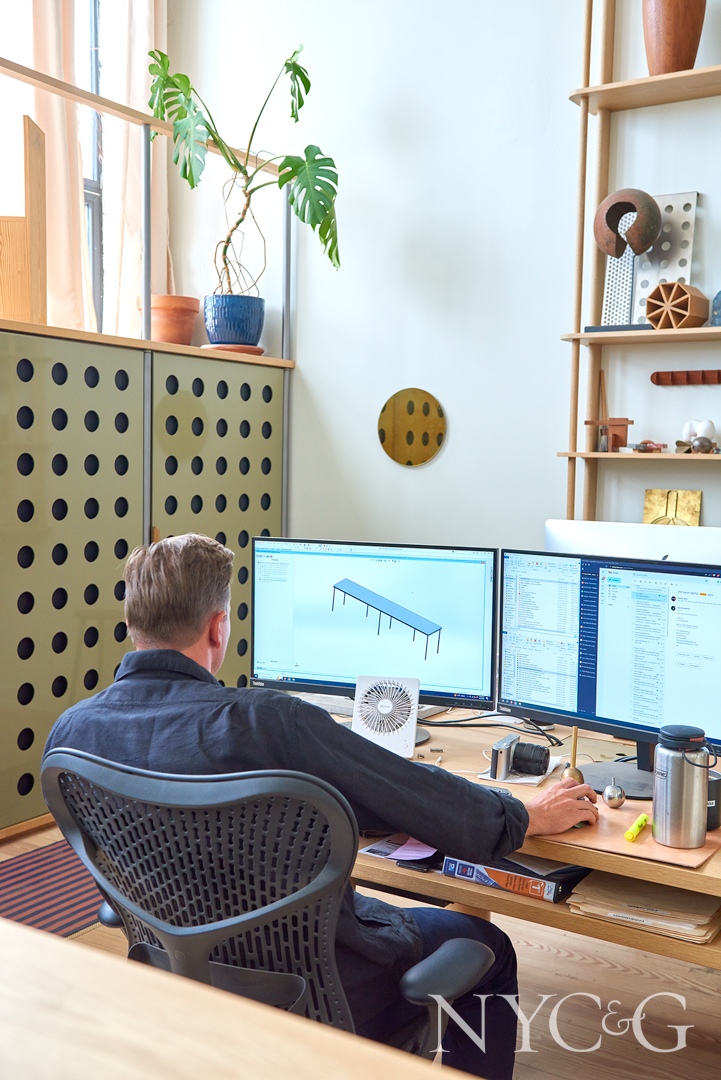
Like many designers, Buntain’s ideas begin with a sketch, which leads to a prototype created with a 3D-modeling program. “It can get technical very quickly,” Buntain notes, “and I am mechanically minded, which helps.” Among Fort Standard’s most intriguing offerings is the Strata credenza, which begins with hardwood surfaces joined by vertical steel rods to create a rigid framework, complemented by perforated doors with single-hole pulls that eliminate the need for any knobs. The piece calls to mind the work of French architect Jean Prouvé, who “is an inspiration,” Buntain says. “Removing material from the doors makes the piece lighter and more interesting.”

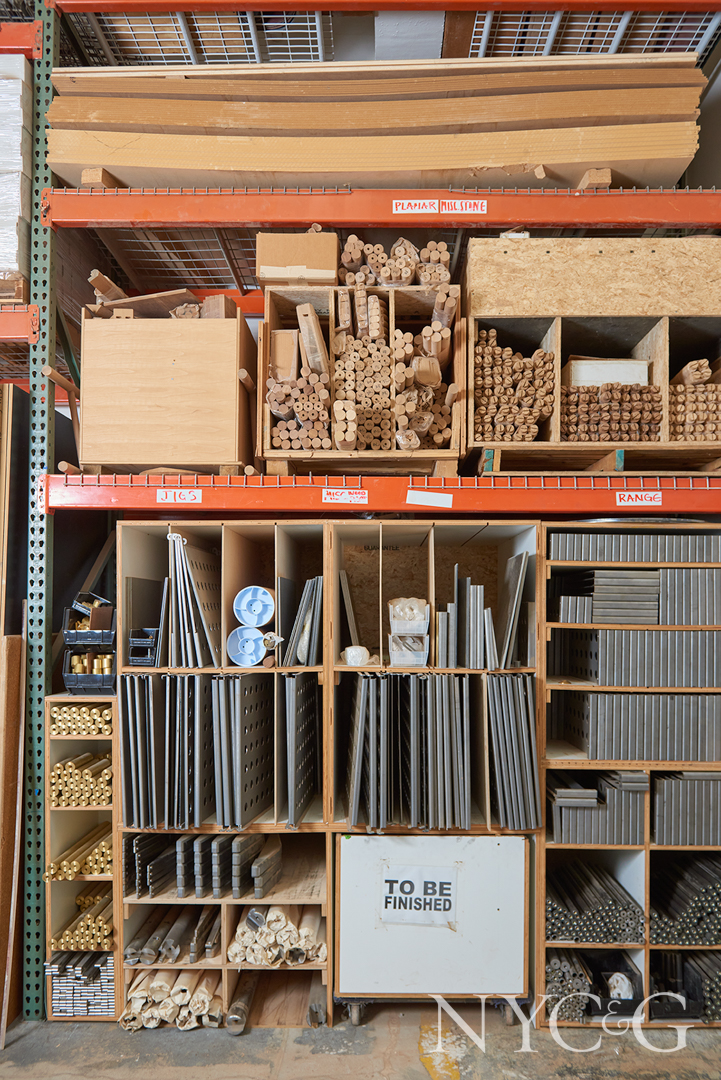
A wall of jigs used to produce various designs and create consistent results.

Buntain uses a resaw bandsaw to cut a precise veneer.

Unfinished perforated credenza doors and other standard-size design components are kept on inventory shelves.
Because Fort Standard has the space to store standard-size perforated doors in its inventory, the company can be more productive, keeping lead times shorter and allowing “components to be moved right into finishing.” Efficiency also comes into play with one-eighth-inch-thick veneers cut from stored lumber and intended for use on pieces’ interiors. “We can cut veneer from the same batch of lumber used for the solid hardwood components, like the top and bottom of a credenza,” Buntain says, “ensuring the color and character of the material is consistent within each piece.” He adds that he generally prefers standard finishes to “maintain the original tones of the material. I’m very drawn to the natural feeling of wood and almost want it to seem like it’s unfinished.”
Buntain is also something of an alchemist, experimenting with a mix of materials, such as the Italian marble and American walnut used in the firm’s Column coffee table. “My shop is unique in the sense that I have to train my builders to do things that don’t necessarily fall into the woodworking rubric,” says Buntain. “They need to have a basic understanding of working with stone and metal, too.” The most recent introduction during Fort Standard’s seemingly endless expansion mode: a new hardware collection of drawer and appliance pulls. “I feel fortunate and grateful to have been doing what I love for so long,” Buntain says. “And it’s cool when my kids come visit and run around—I think that will be an exciting thing over the years as they get older, to build something in Dad’s shop.”
