


Some new houses have notable ancestors. And sometimes the progeny resembles that which came before it. Where this eight-bedroom, waterfront home in Old Greenwich now sits was once an equally imposing house designed by Stanford White, noted, though, for its traditional masonry and a winding staircase set in a turreted tower. The interior design team of Arthur Dunnam and Kelly Zerbini remembered well that ancestral house, for they and the architect of this house, Joeb Moore, had all worked together closely with the clients to restore and furnish that now late residence.
“That historic Stanford White house that these clients had owned burned to the ground during Superstorm Sandy,” recalls Dunnam. “The fire took all their worldly possessions, all their artworks. They had to literally flee into the middle of the night. They wanted to rebuild on the same site, but have their new home be a very modern iteration of the former.”

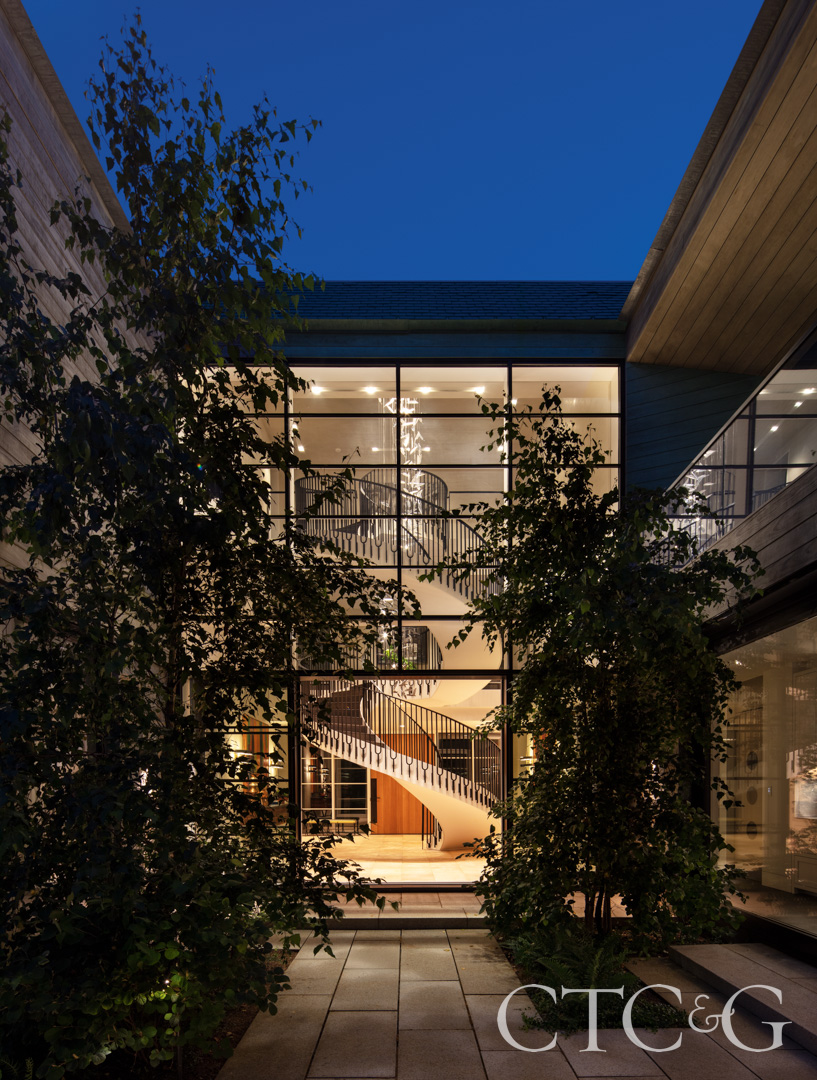
The most striking resemblance from the old house that carries to the new is seen in the winding staircase—though this version appears free floating at the entryway. When seen through windows at night, the staircase assumes the presence of minimalist sculpture, while remaining a practical means for accessing floors. “We had a great working relationship with Joeb from the start of the design process,” recounts Zerbini, “and this staircase is one of his best achievements.”
Moore was intent on referencing that now lost-to-the-ether original staircase. He designed this three-level, turreted staircase “as an homage to the original one,” he says, “and it is tied, too, to the larger context of our architectural practice, which is to establish a visual connection between the landscape, the art and the architecture of a home.”
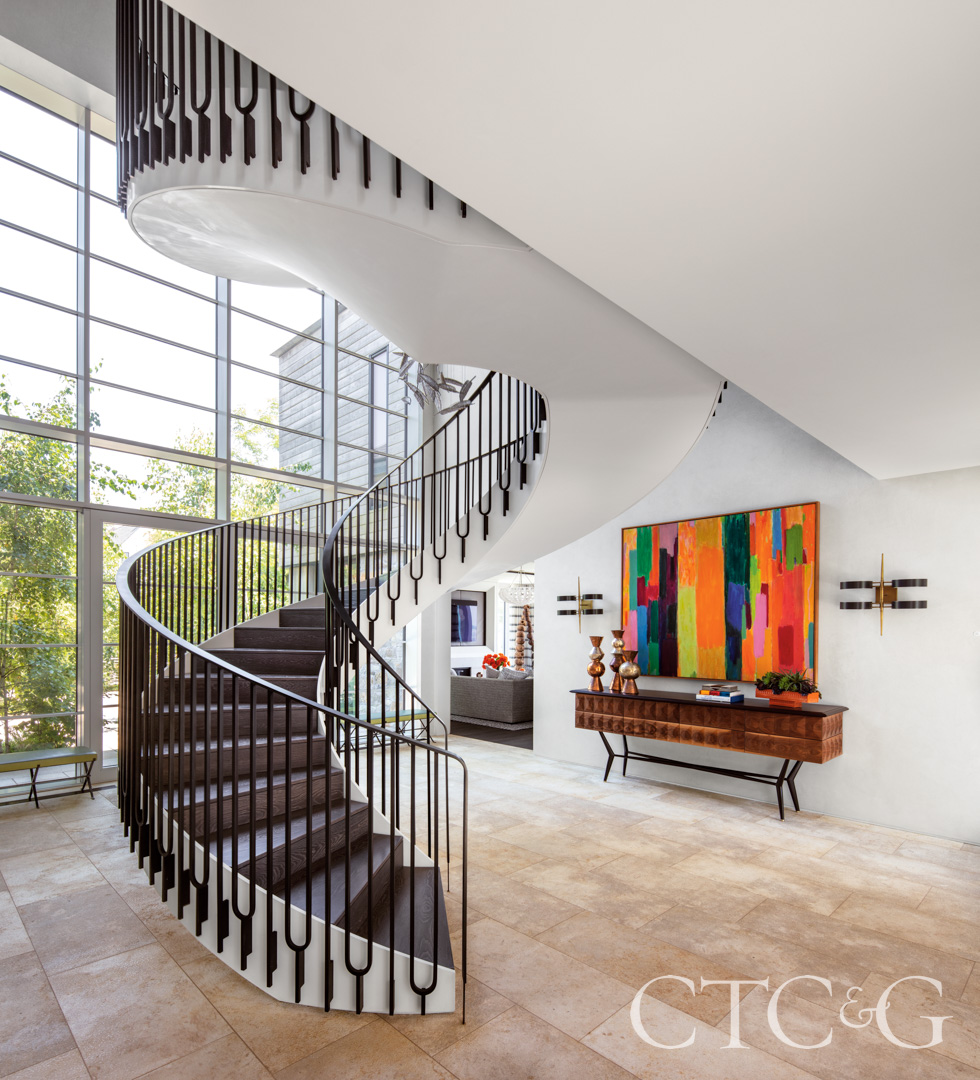
Architect Joeb Moore designed a winding staircase that starts in the foyer, which is furnished with sconces from Arteriors and a custom console.
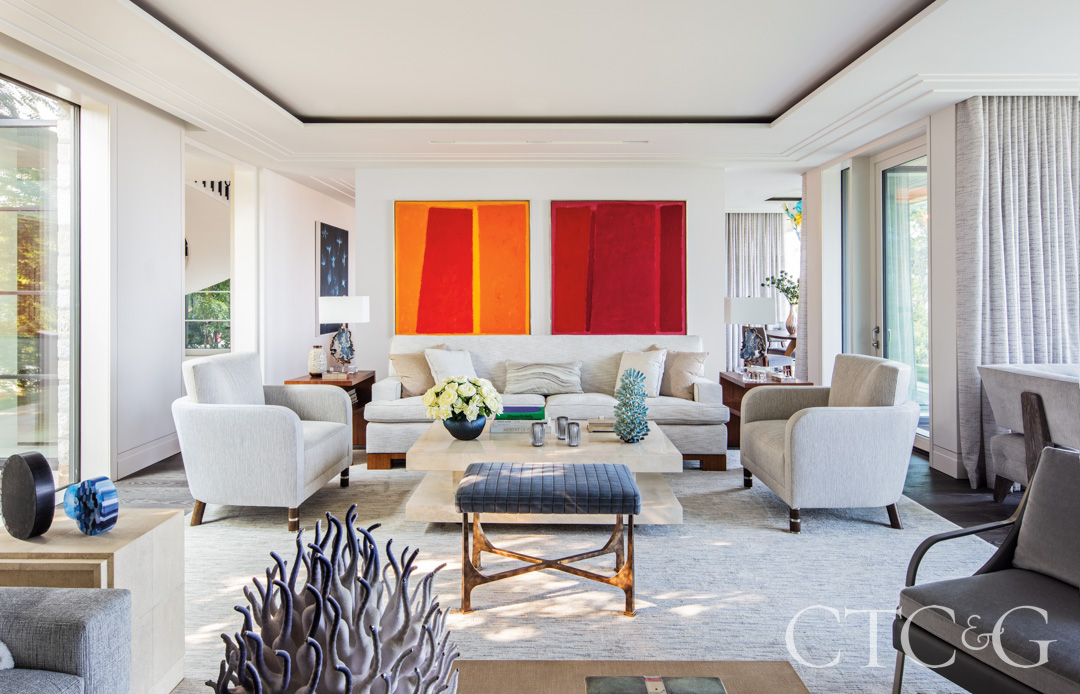
On one side of the spacious living area, custom chairs in a Colefax and Fowler fabric and a bench in a Holly Hunt flannel are among the pieces arrayed on a Beauvais area rug.
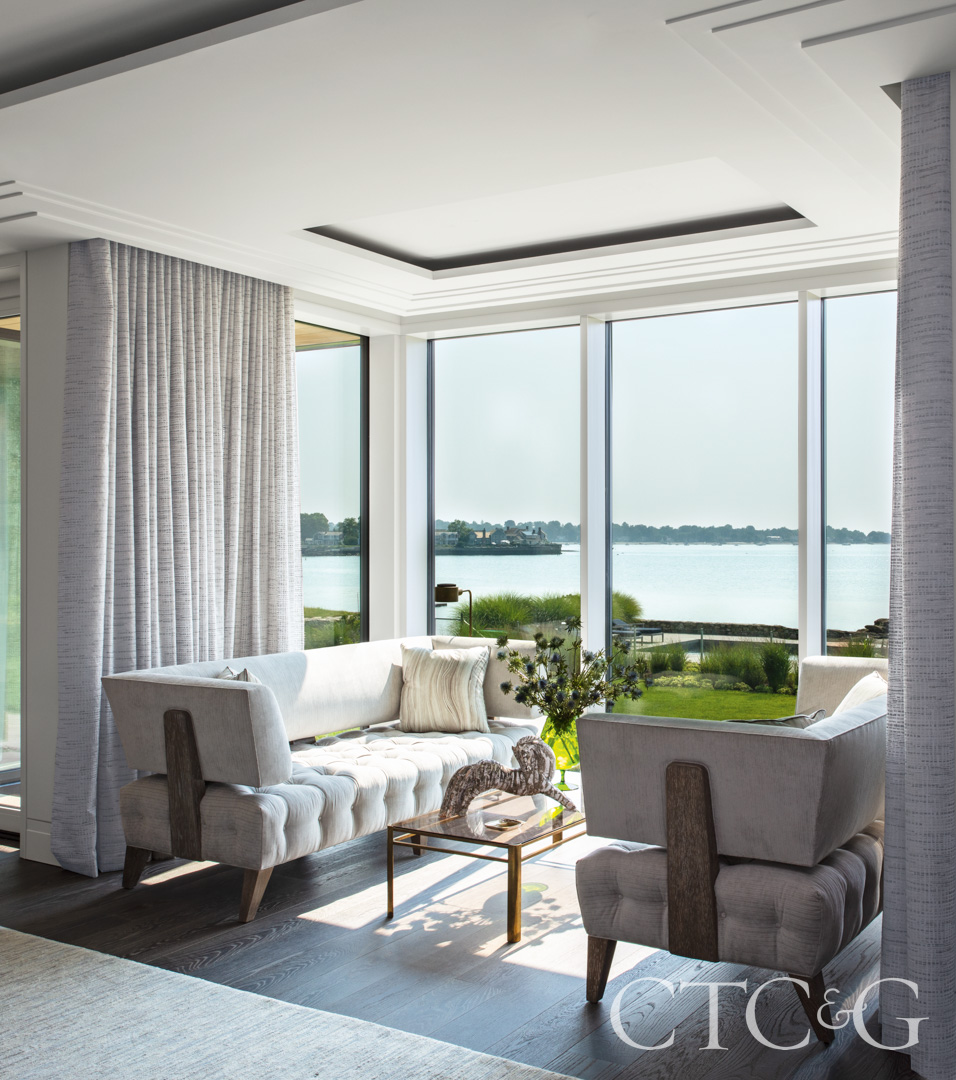
A windowed nook takes full advantage of Long Island Sound views.

In the dining room, Murano-glass chandeliers illuminate a custom table with curved bases in a bronze finish. The chairs are through Hollywood at Home.
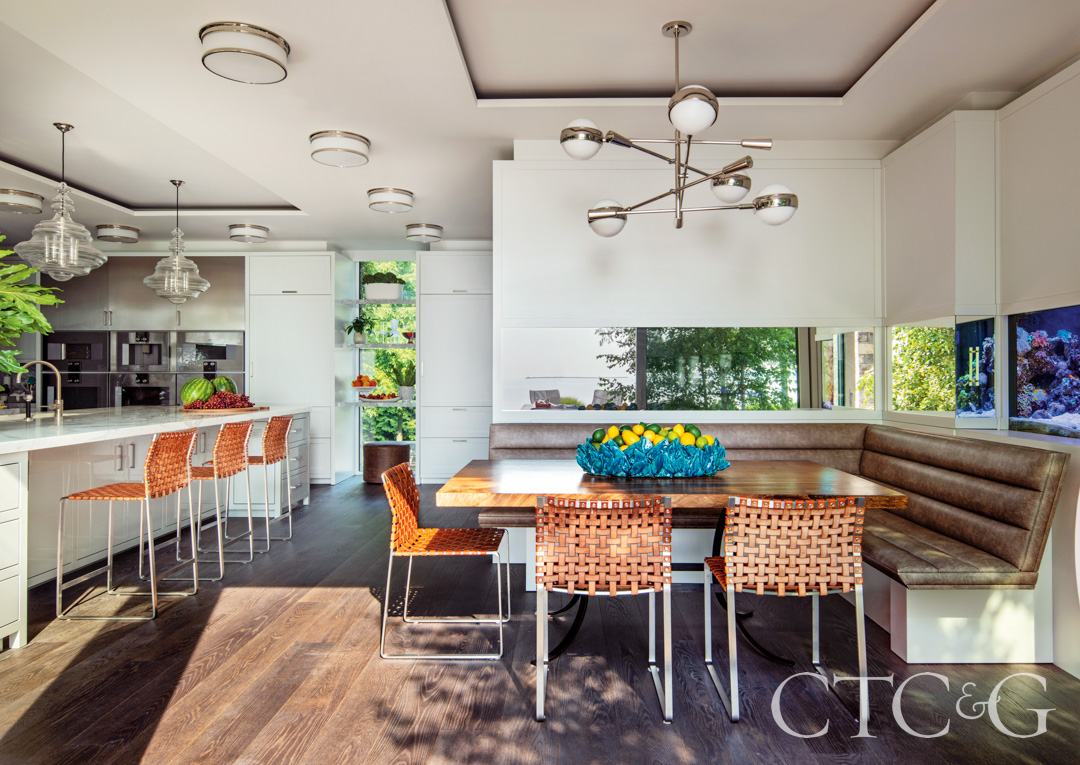
A Jonathan Adler chandelier hangs above the kitchen table and Mark Albrecht Studio chairs, while Hudson Valley Lighting flushmounts and pendants provide task and mood lighting.
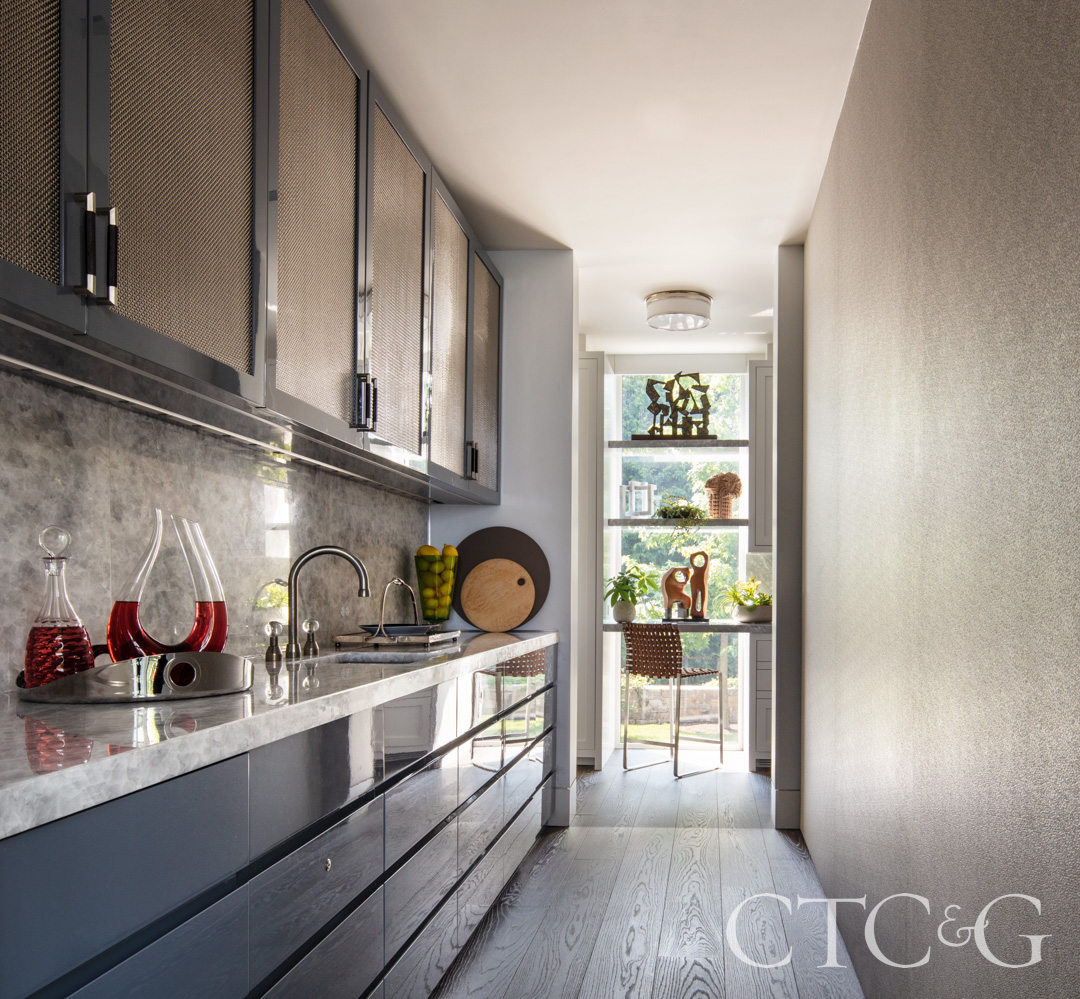
The bar hall—adjacent to the kitchen—features millwork by Segmento Design with upper cabinetry inset with a satin nickel metal mesh by Kent Design, while the countertop and backsplash are polished quartzite, and the sink faucet is from Rocky Mountain Hardware.
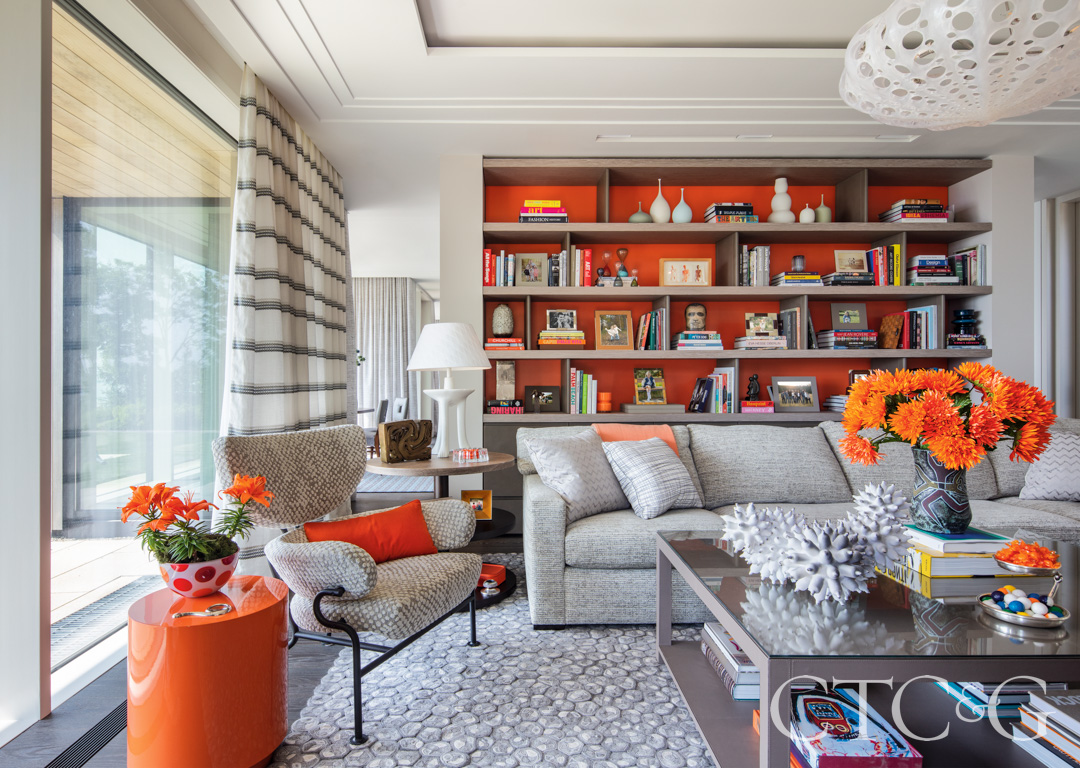
Family room furnishings include a Cassina accent chair, an Oly Studio chandelier, an A. Rudin sectional upholstered with a Pindler fabric and an area rug from Misha Carpet.
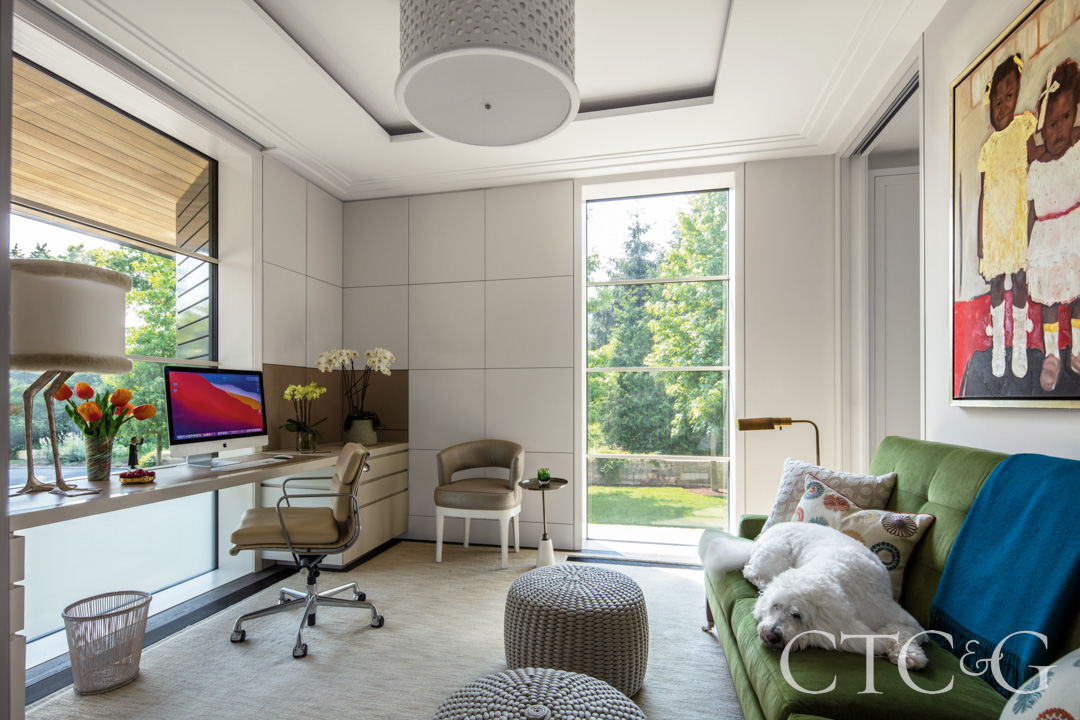
Her office is furnished with a sofa that sports a key lime–hued Duralee fabric through Robert Allen Design, while a neutral Misha Carpet area rug provides the base for the room.

A sitting area in the primary bedroom is set with a Jens Risom lounge chair through Ralph Pucci sporting a Kravet fabric.
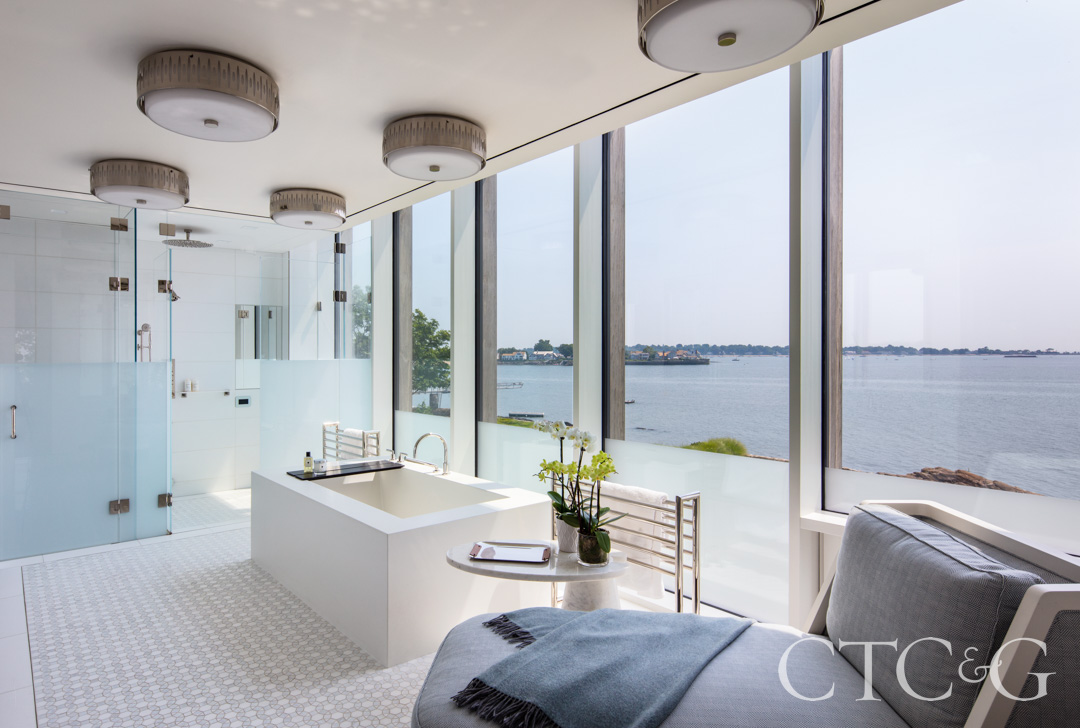
The floor of the primary bathroom is clad with Thassos and mother of pearl tiles from Studium, while the flushmount lights are from Robert Abbey.
Illuminating the main staircase, the custom chandelier is crafted of pieces that resemble feathers.
Dunnam and Zerbini further enhanced the effect of the staircase by filling its core with a glinting, gleaming, light-refracting Murano glass chandelier that appears, as Dunnam says, “to tumble down through the spiral. We wanted it to dangle so that a person ascending or descending the staircase could appreciate the journey along the way.”
While Dunnam and Zerbini consider the overall palette they employed as soft and restrained, each room wears just enough color so as to seem adorned with interior jewelry. For the dining room, the designers conceived a pair of chandeliers inspired by sculptor Dale Chihuly. “The homeowner wanted these fixtures to assume the tonalities of sea glass,” explains Dunnam. Circular forms of gold, turquoise and pearl layer to create a nautically inspired—even poetic—light in the room. By sheer coincidence, paintings by Eric Fischl that the homeowners owned feature hues complementary to those in the chandeliers.

In a house this expansive, the homeowners wanted a space just for themselves that would feel intimate in scale while taking advantage of its Sound views. Though smaller than the other rooms they use often for entertaining, the family room assumes, perhaps, the boldest effect, with a wall sporting a vibrant orange, along with select accessories in the same shade. “We worked hard on finding that orange,” says Zerbini. Dunnam adds, “It’s the same orange you find on the Hermès box—what the homeowner wanted.” Dunnam was happy to embark on that palette hunt. “I’ve always liked orange. It’s a happy color, not as primary as red, yet it has a lot of vibrancy.”
Elsewhere, colors play subtle, but powerful roles. A corner of the kitchen’s eating area is defined by a glowing aquarium, its deep purple cast revealing its fish inhabitants swimming amid coral décor. “It’s the husband’s pride and joy,” says Dunnam. “During the renovation of their Stanford White house, he wanted an aquarium to divide the kitchen from the breakfast room, and that’s what we did again here.”

While dazzling minimalist, abstract and select figurative artworks throughout the home incorporate blazing shades of orange, red, aqua, blue and green, “the view of the water remains the star element of the interiors,” admits Dunnam. And therein lies a difference in generations. Although the prior house was sited on this very spot, its embrace of the Sound was more minimal, with few windows taking in the vast expanse of water, sky and shoreline. Moore positioned rooms in an enfilade arrangement, so that every living space is aligned one after another, and each with views of the natural features. “The very materials we chose, too—notably the natural stone for the base—echo those of the former house,” Moore adds.
Stanford White would likely have been very proud of his relation that harkens to the house he had designed for the site. As Dunnam says, “This is a magical jewel box—a big one, yes, but one that’s just right.”
