


Even after Mark Tremblay, President at Marc-Michaels Interior Design, had finished designing every room in this Palm Beach house for clients, something that the residence had begun with back in 1936 remained. “It had charm—when it was built and it has charm still,” says Tremblay from his design office in Boca Raton (his main studio is in Winter Park). “I like that trait about the house.”

The reason for the residence’s enduring—and handsome—presence on its Intracoastal site near the heart of Worth Avenue is because Tremblay knew that his work would require keeping much of what was in place from the start. “This project was about updating the house, while also furnishing its rooms with new things. Sure, there were some significant structural enhancements that had to be done, like the windows, which seemed held in place by sheer imagination!” The house has such intrinsic charm that its homeowners, a couple who hail from the Northeast, had previously started renovating a series of three other houses in town before they came upon this one, recognizing it as the one they really wanted.

In the couple’s desire to update the house while preserving its 90-year-old character and architectural integrity, Tremblay juxtaposed their museum-quality art collection with dynamic furnishings, many custom designed, that assumed a presence as pronounced as the art. The vast living room features four distinct seating areas, each defined by unique elements. Over the fireplace, for instance, a round mirror breaks up the figurative, realistic artworks that bracket it, while visually animating the room. Meanwhile, at the far end, a midcentury-inspired brass and bronze chandelier hovers over a seating group.
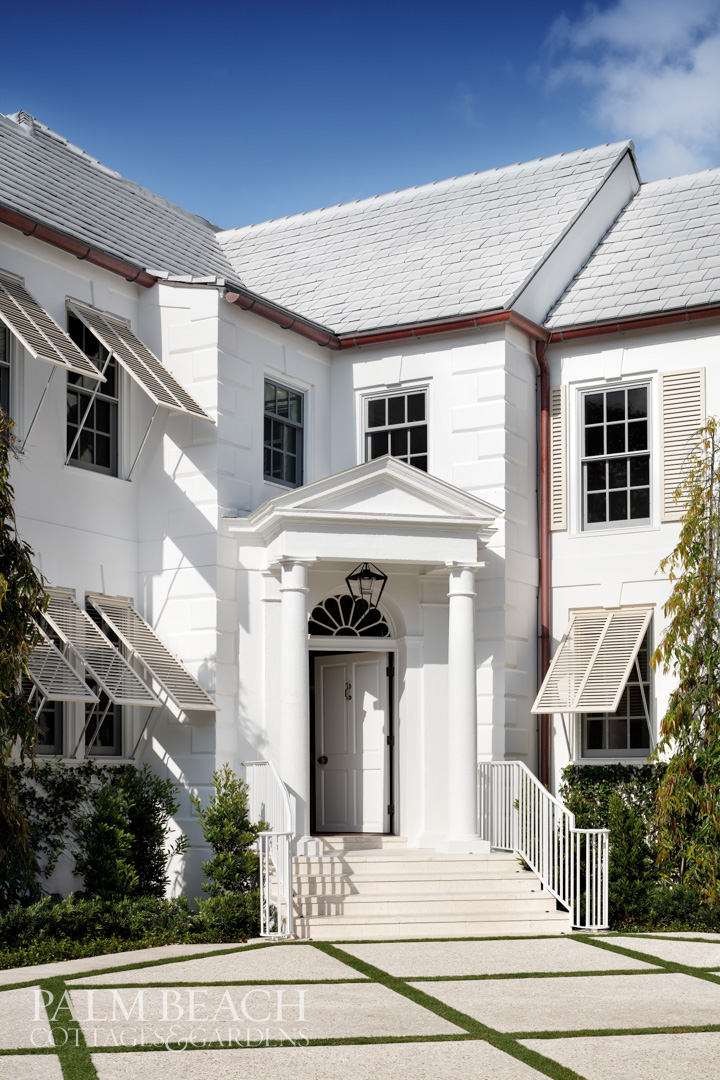
What might be referred to as a Plantation/Colonial-style house in Palm Beach has stood prominently on South County Road since 1936. Its entrance is cleverly positioned at the juncture of two wings.
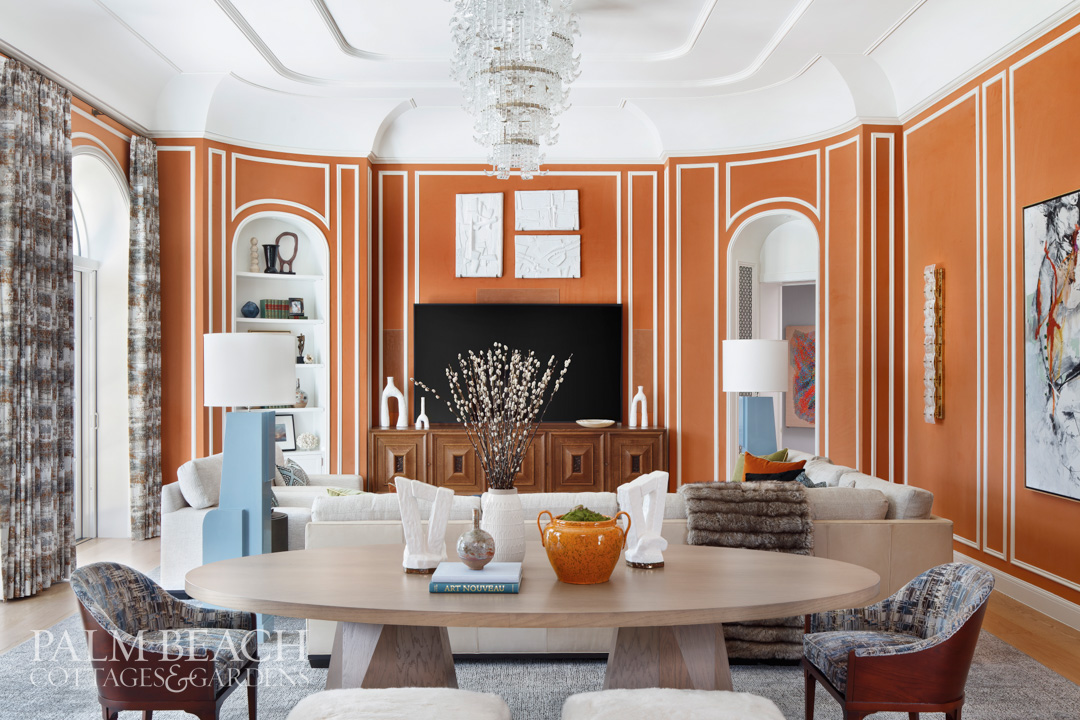
In the home’s media room, interior designer Mark Tremblay preserved the original orange-hued cashmere fabric, as well as the chandelier that has hung there for many decades. The custom floor lamps are by Tod Von Mertens.

The lighting fixture over the spacious custom island dates from the 1960s and came with the house. The hue of the range by Blue Star complements the subway tiles that define the walls and backsplash.
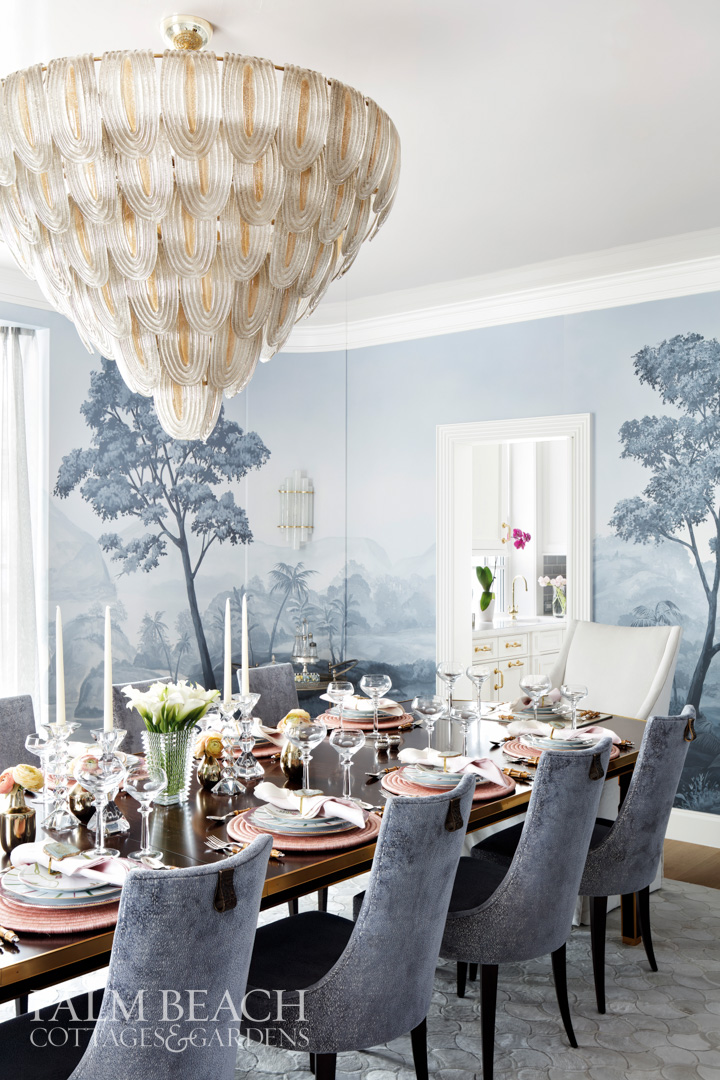
A telescoping vintage Murano glass chandelier illuminates the formal dining room; the Pulegoso Murano sconces, noted for their bubbly glass effects, are also vintage. The custom wallcovering was created by MJ Atelier.
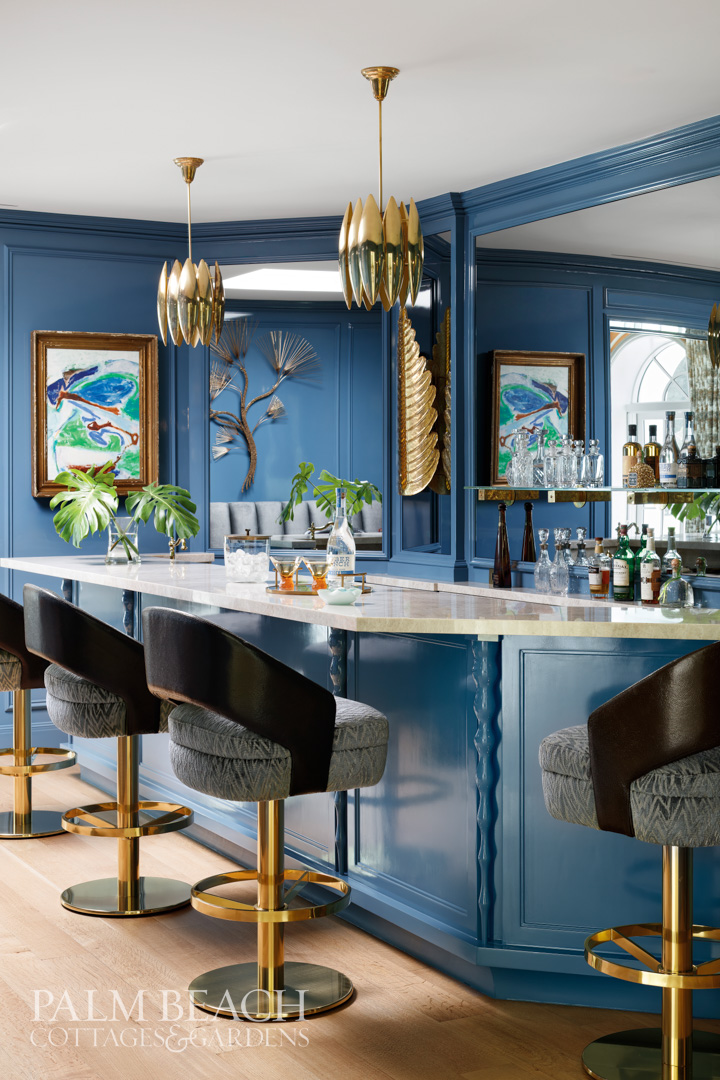
Just years after Prohibition ended, this house arose—and it came with this bar. Tremblay used Sherwin Williams’ Inky Blue to imbue the room with mood. The Murano glass chandeliers date from the early 1960s. The polished countertop is Taj Mahal quartzite.
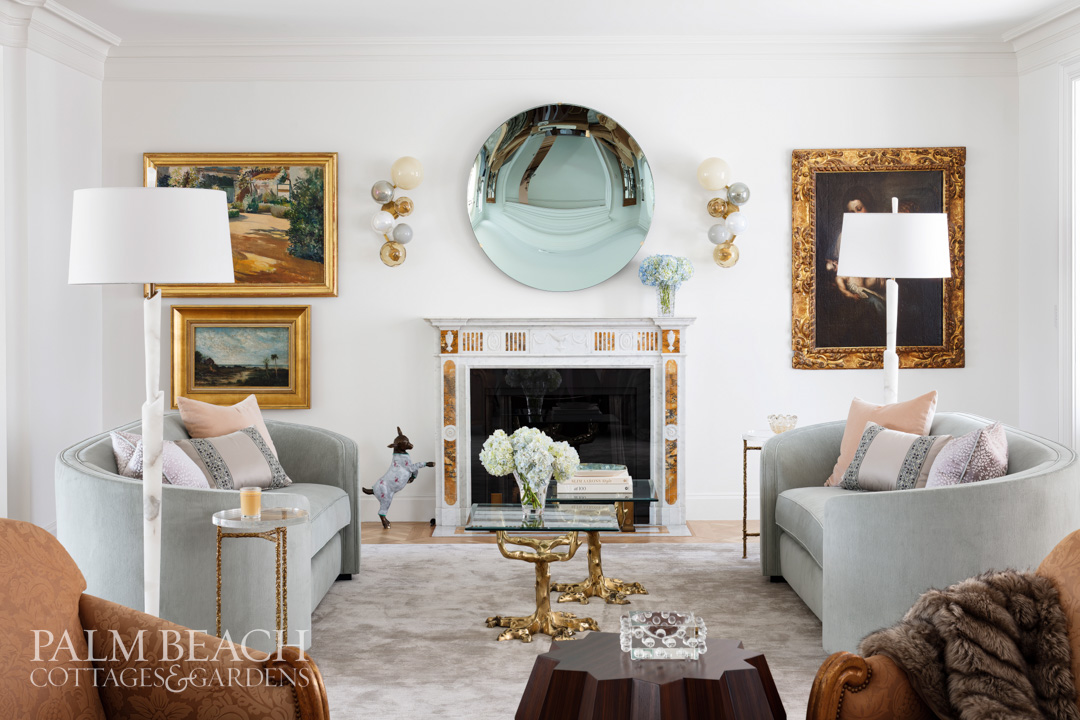
The homeowners’ original artworks are juxtaposed with a playful mirror that reflects an altered and decidedly unpredictable image. A pair of vintage Willy Daro coffee tables serve a pair of curved sofas. The goat wearing pajamas is by Tammy Lynne Penn.
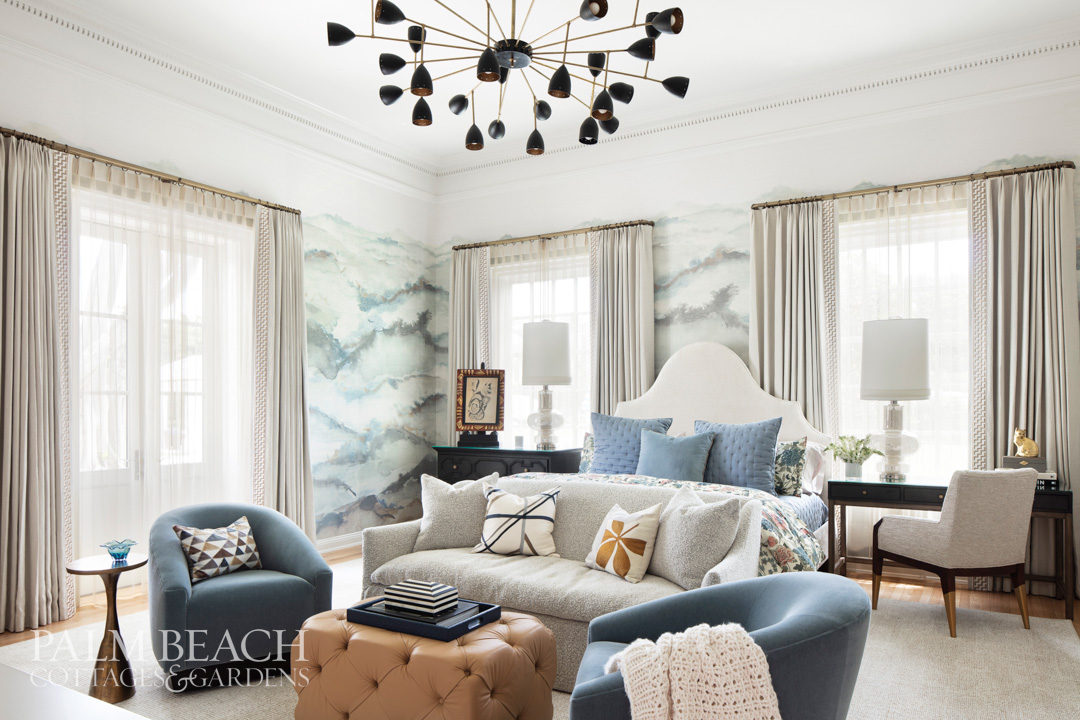
The walls of the primary bedroom feature a Phillip Jeffries covering. A Silvio Piattelli Alterno chandelier radiates over the room. The client’s existing artwork rests on its easel.
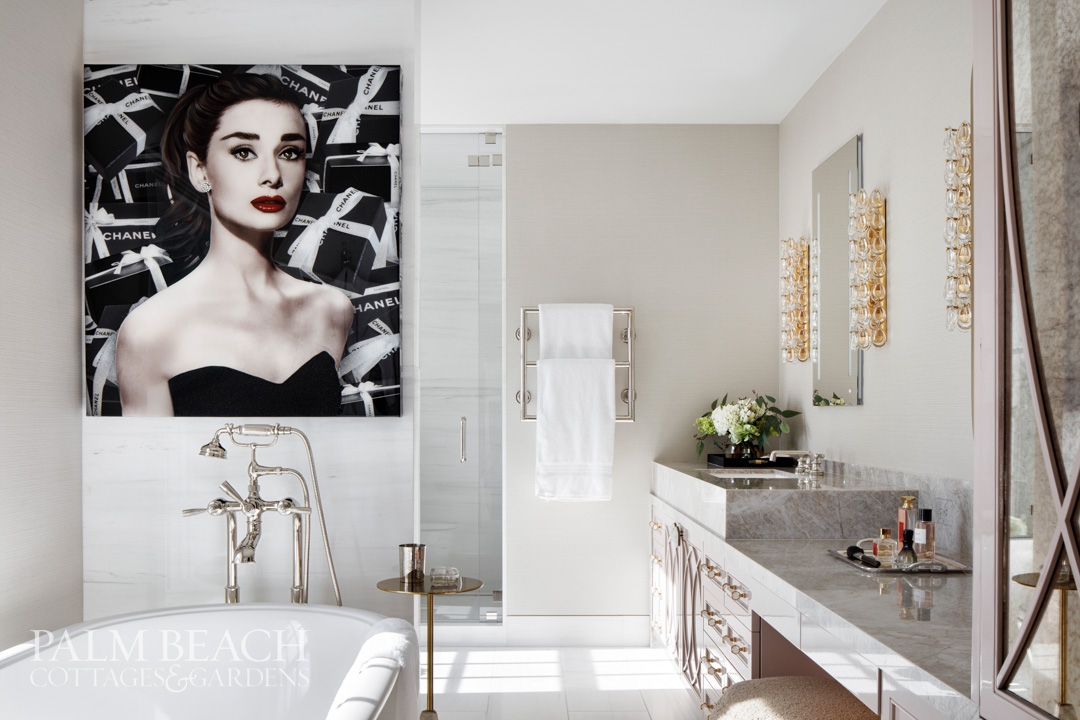
Her bath is equipped with polished-nickel fixtures by Waterworks. The cabinetry is lacquered.
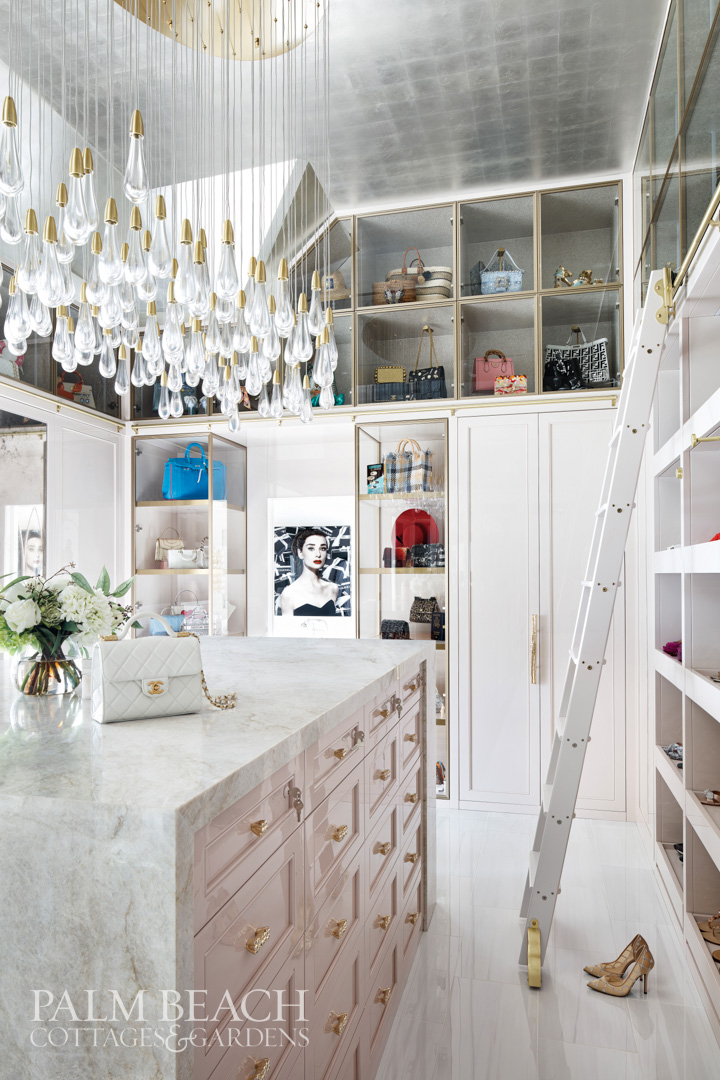
Her closet is a jewel box of a space, complete with a custom brass and crystal chandelier, silver-leafed ceiling, and Swarovski crystal cabinet hardware. The countertop is clad with Taj Mahal quartzite.
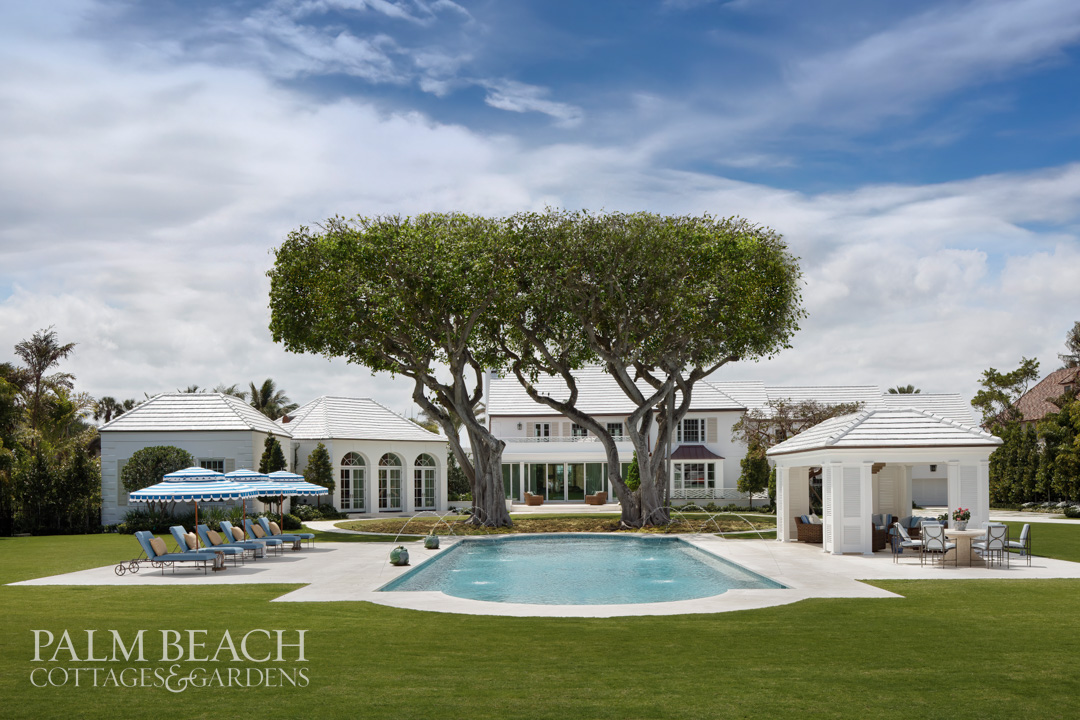
One of the property’s two pools is adorned with vintage elephant garden stools. Tuuci’s Ocean Master Cupola umbrellas provide shade and a visual statement.

Cushions that are upholstered with David Sutherland fabric are used in the firepit that was designed by Mark Tremblay.
For the couple, who are involved in numerous local charities for which they host gatherings, the dining room remains among the most memorable, and used, spaces. A dreamy botanical scene, painted by a muralist, envelops the room in a soft blue, the depicted trees seemingly asway in a breeze. A dazzling, multi-tiered 1960s Murano chandelier rises conically over the table and when turned on the light it casts onto the lacquered ceiling creates an extra shimmer and glamour to any dinner.

Although Prohibition had ended by the time this house was completed, people of the era were eager to add bar areas to their homes to celebrate the change. Sited between the media room and living room, the original bar and its millwork were preserved but updated by Tremblay, who bathed the space in a steel-blue, while adding a cantilevering quartzite countertop. “We lacquered the room, a perfect way to take something old and give it a new birth.” Such was the case, too, in the foyer, where Tremblay had the original inlaid marble flooring “buffed and polished to a sheen.”

But of all the rooms that Tremblay has honored most faithfully it’s perhaps the media room, whose walls are lined with a fabric he refers to as paprika. “That fabric is original to the house,” Tremblay points out, though it may have been applied at a later time. “It has a lovely velvety texture.” He had it cleaned and freshened, of course, as he did the original white trim that outlines the walls.

Tremblay’s attention to detail is seen also in his furnishing of the two pool areas, one in front of the house, the other at the rear. He preserved a pair of existing banyan trees that tower over the front pool, while at the rear, he designed a semi-circular bench centered with a firepit. “The homeowners and guests like to nestle there. It’s one of several destination points in the yard.”

The designer is able to understand what he accomplished with this project. “It’s nice to know, and to be reminded, that you don’t have to make everything super-contemporary when reworking an old house.”
