


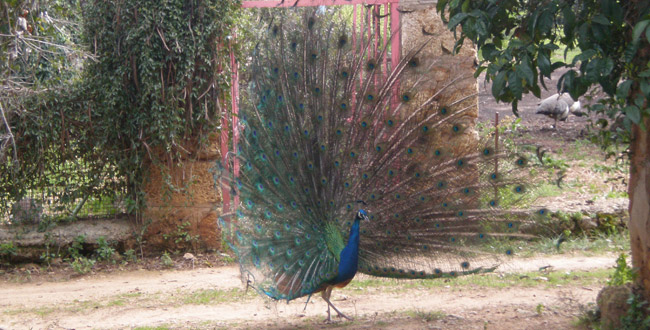
Ah, Vassilis … just the name transports me to Greece. I sipped wonderful Greek wines from winemaker Vassilis Kanelakopoulos, at Oceana and thrilled in Greek grapes with names like Mavrodaphne. Vassilis’s scenic Mecouri Estate in the westernmost Peloponnese is right near the water, on the Ionian Sea, where there are fantastic beaches. (I spent a summer looking at the crystal deep-blue water of the Ionian Sea when I taught waterskiing at Club Mediterranee in Corfu, but that’s another story too sexy for Liquid Liaisons.)

“Mecouri is a wine estate of peacocks. We have maybe fifty wild peacocks on the property,” Vassilis said. “Narcissistic birds, half wild, half domestic. You take the winding road through the Peloponnese and arrive at the winery and there they are, peacocks screeching in their high-pitched sound, fanning out their feathers and strutting among the vines. Luckily, they don’t like grapes.”
Over white tuna sashimi, sautéed shad roe, and grilled Pacific white sturgeon, I tasted the Mecouri Estate Foloi, a blend of Roditis and Viognier, a lovely aromatic wine served by the glass at many restaurants. The next white, the Kallisto, made from the Assyritiko variety, showed a nice minerality. With the sturgeon, I tried the Estate Red—made from Refosco and Mavrodaphne, which was aged in oak for 12 months—with its red fruit aromas, notes of chocolate, leather and tobacco. It’s a good buy (at $25) and has long aging potential. Then to my surprise, Vassilis showed off his aged (18 months in oak and 18 months in bottle) Mecouri Estate Cava ($60) which he decanted for two hours before the lunch. It’s a Greek collectible wine that when it ages becomes aromatically purple, smelling of violets—a characteristic of the Mavrodaphne grape. He admitted that in America few people would pay that price for a Cava. He’s right but I liked smelling the violets.
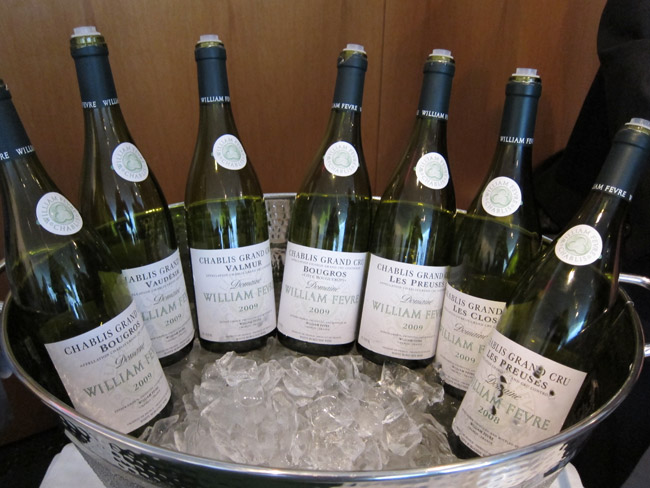
I’ve always loved Chablis for its delightful minerally (unoaked) Chardonnay flavors and its wonderful silky texture. In the summer I drink it as often as I can. I recently learned that the Grands Crus of Chablis are very different from regular Chablis. These are the top Chablis wines of Burgundy from the best vineyard sites, which are known as climats within the appellation of Chablis Grand Cru. I talked with Didier Seguier, for 12 years winemaker at Domaine William Fevre, a venerable winery that own 15 hectares of Grand Cru vineyards, four of which are in the vaunted Les Clos climat.
In a priceless succinct summary, Seguier explained Grand Cru Chablis’s top climats to me and what characteristics one can expect in those wines. (What follows here is for wine geeks only. Everyone else please skip to the next Alsace item.)
Chablis Grand Cru Bougros is a good introduction to Chablis. It comes from an area which is flat with SW exposure and clay soil and is known particularly for its richness.
From a south-facing steep slope but not clay soil, Chablis Grand Cru Bougros “Cote Bouguerots,” which is part of Bougros, has a strong minerality. It’s masculine, rich and powerfully mineral and very different from the other Bougros.
Again from a south-facing steep slope with vines that are known to mature early, Chablis Grand Cru Vaudesir is full flavored, though less so than Bougros. When it is young, it’s fruity and after a few years shows nice minerality.
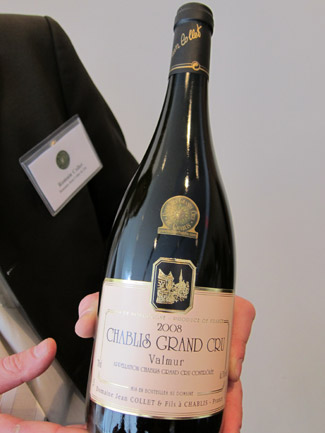
From the very top slope with SE and SW exposure and a cooler climate, Chablis Grand Cru Valmur displays freshness and a high level of acidity yet has a silkiness and beautiful body. This is the terror for aging (from 5-10 years) but you can start drinking it happily after two or three years.
Chablis Grand Cru Les Preuses has two parts: One, on a SE steep slope, results in wines with elegance and minerality; and the SW part is flat with clay soil, yielding richness and a feminine elegance. Often the wine is a blend of one third SE and two thirds SW, which makes for nuanced elegance.
Chablis Grand Cru Les Clos is considered the greatest Grand Cru in Chablis and commands higher prices than the rest. The wine has a full body and all the characteristics of the others—power, aging potential and minerality. The 250-year-old William Fevre family is the largest producer of Les Clos. The region of Chablis has around 5,000 hectares, one hundred of which are Chablis Grand Cru, which was classified in 1935. (End of lesson for the advanced wine enthusiasts.)
It’s always fun to dine with a winemaker whose family estate goes back to 1720 and who owns the prestigious Alsace winery, Domaine Joseph Cattin. Now run by Jacques Cattin, 27, and owning 50 hectares in the Upper Rhine area at the base of the Vosges Mountains (including the Grand Cru du Hatschbourg), the winery makes some fabulous Cremant D’Alsace white and rose. Grand Cuvee 2007 is aged for 2½ years (when most cremants age only a year or 18 months). The Chardonnay takes on warm toasty notes.
At Brassiere (a French restaurant that’s been in my neighborhood since an eternity and is still packed at lunch), we discussed how well Alsace wines go with Chinese food, especially spicy Szechuan. Pinot Blanc for mussels and lobster, Riesling for the fish and Pinot Gris for Peking Duck—a legendary pairing because the toasty notes of the Pinot Gris goes perfectly with the smoky notes of the Peking Duck. In fact, the Chinese people themselves have embraced Domaine Joseph Cattin wines and in 2010 Cattin became the number one selling Alsace wine in China.
“The Chinese took to the sparkling the Cremant d’Alsace Rose ($18),” said Jacques Cattin, “and they also especially like the Gewurztraminer because it’s sweet on the palate and tastes a lot like lychee—a favorite taste for the Chinese.” I have to say I share the Chinese taste of the Cremant d’Alsace Rose; it was fresh and festive with the fruit de mer tiered platter we shared over lunch.
Jacques looked around the large room of New Yorkers and admitted he was a bit dazzled by all the people. “My village has 500 people,” he said humbly. I asked if he knew everyone of them personally and of course he did. His village is 350 meters high, one of the highest villages in Alsace. And his family owns the region’s truly mythical vineyard, Clos Madelon, at an altitude of 425 meters, which was the site of a major battle during WWI, and planted only to a singular variety, Pinot Gris (whereas most Alsace vineyards are planted to many varieties). Yes, pair that with your next Peking Duck.
