


Language and cultural barriers start the moment you board the airplane, when you notice that most of your fellow passengers are actually Chinese and don’t speak any English. For most of the non-stop 15-hour flight (no screaming babies!) to Shanghai (as a guest of the Langham Hotel Group), everyone behaved themselves and stayed in their seats, wrapped up in blankets. A few passengers practiced Tai Chi in the back of the plane near the kitchen. Most noticeable is the feeling you get when you are summoned to jury duty: There’s no chance to escape or jump ship (or plane, in this case) during the never-ending flight.
Arriving in Shanghai at the airport is a blissful experience; it’s clean, orderly, and filled with civil servants in uniforms directing you, like robots, toward passport control and baggage claim. Soon, I’m driving in a luxury town car, past the urban sprawl of Shanghai that stretches 120 miles by 100 miles in every which direction, with towering apartment complexes (sooo Vegas) that leave very little to be desired. It seems as soon as they go up, these building start to look “aged,” with concrete facades and colorful laundry fluttering outside the windows from as high as 40 stories.
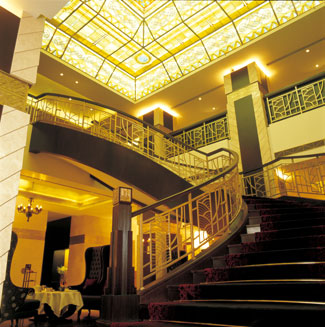
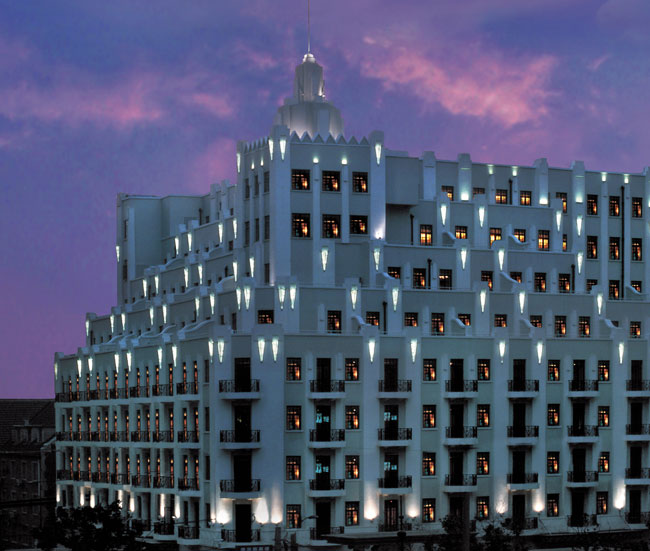
I arrive at the swanky Langham Yangtze Boutique Hotel in downtown Shanghai, greeted by a phalanx of tidy personnel. I’m in a state of mental confusion but notice the exquisite Art Deco exterior of sharp lines, the period lobby design, dating back to 1934, featuring rich, dark woods and golden fabric-colored walls and carpets. A dramatic circular staircase leads to the second floor bar. www.langhamhotels.com
Shanghai, for those who remember, was the center for the Opium Wars. As early as 1842, the British, then the French, set up concession governments in Shanghai. Opium, tea and silk were traded.
In the 1930s, this haven for Art Deco design dominated the Old Shanghai social scene. Besides being the third-largest hotel in the Far East, the hotel was the place for the upper class to mingle, meet and dance—the Yangtze Dance Hall was Shanghai’s first dance hall with a spring wood floor and air conditioning. Yao Li, one of China’s top pop singers from that era, became famous with her “Rose, Rose, I Love You” song which she sang every night as the hotel’s “chanteuse” from 1942 to 1946.
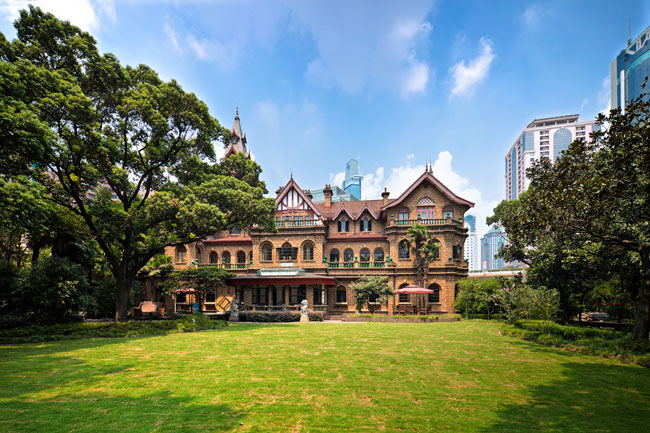
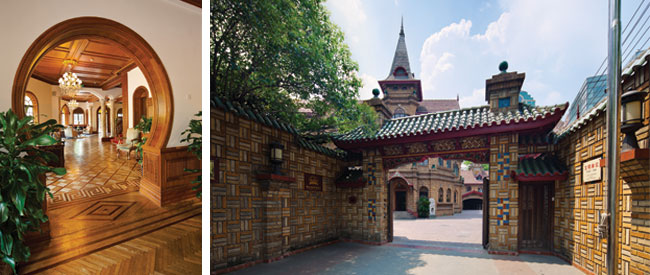
I spent several days enjoying escorted visits to different parts of Shanghai, such as the unique Villa Moller, a dream castle built in the middle of Shanghai for the pre-teen daughter of a wealthy businessman, as well as the button building and the textile building, where stall after stall of buttons and bolts of fabric were ready to be turned into custom-cut suits, shirts and jackets.
Furniture giant, Baker, a division of Kohler, invited me on a special trip to Hangzhou to visit its new showroom in an old city dominated by West Lake, a gorgeous park with a lake and botanical gardens. www.bakerfurniture.com
Hangzhou is one hour by the bullet train from Shanghai. The massive train station (one of several spread around Shanghai’s perimeters) where we boarded the train was immaculate and bustling with travelers. The train reaches speeds of close to 200 miles per hour (this was the same train that crashed in July).

Baker’s showroom in Hangzhou was full of vignettes featuring furniture by Bill Sofield, Laura Kirar and Barbara Barry, as well as some more localized furniture that reflected an Asian theme (gold leaf chests, embroidered bed linens) that the company has on hand for this market. Classic designs, like those in the Historic Charleston series, are doing well.
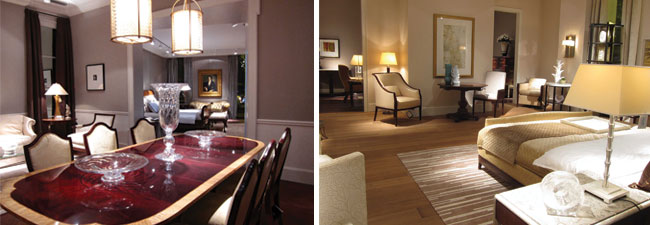
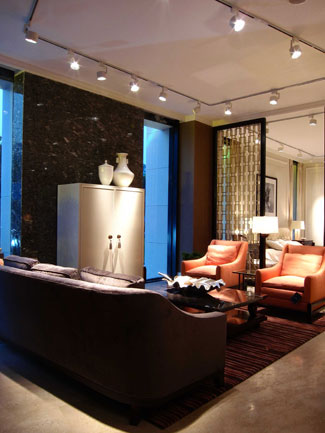
Staffers were well versed in the Baker heritage and collections. Behind Baker in the early years was Siebe Baker, a Dutch immigrant who settled in Michigan and started making cabinetry. His well-crafted furniture set the standard for design and manufacturing in the category.
Wandering around the new showroom made me wonder if the thousands of apartments and “villas” (townhouses as they are referred to in Shanghai) owned by the newly empowered and wealthy Chinese citizens would be filled with Baker furniture and how they would be decorated.
