


Almost 150 years ago, the quiet Shelter Island enclave of Dering Harbor was a hive of social activity, anchored by the brand-new 500-room Manhanset House Hotel, which welcomed guests including J. P. Morgan, Will Rogers, and John Philip Sousa. By 1888, resort developers Washburne, Beale, and Co. constructed three nearly identical homes nearby to house staff, all of which are still extant today. One of these, Eastgate, caught the eye of Samuel Ashner when he was looking for his own East End abode three years ago.

“I wanted something relaxing and not fast-paced, more akin to Cove Neck on the North Shore of Long Island, where I grew up,” says Ashner, who is a managing director for a private equity firm. “I couldn’t find anything that spoke to me, and then I discovered this house on Zillow. My real estate agent said, ‘You know, you’ll have to take a ferry to get there.’ And as soon as I saw it, I said, ‘I’m buying this house.’” Dering Harbor is the smallest village in New York State (16 full-time residents) and Cove Neck the second smallest, so Ashner felt right at home. “You slow down when you get on the ferry, and you slow down even more when you walk into the house. I don’t even own a microwave because I don’t want fast cooking!”

The Manhanset House Hotel burned down in 1896, was rebuilt, and then burned down again in 1910, after which Eastgate became staff housing for the subsequent Manhanset Country Club. According to historical records, it was “used and abused by employees and left vacant in 1916 because of the damage.” (Think original Hamptons share house.) A year later, Charles Lane Poor purchased the house and by 1932 had commissioned his son Alfred Easton Poor to remodel it, altering its façade from late-Victorian to Greek Revival.
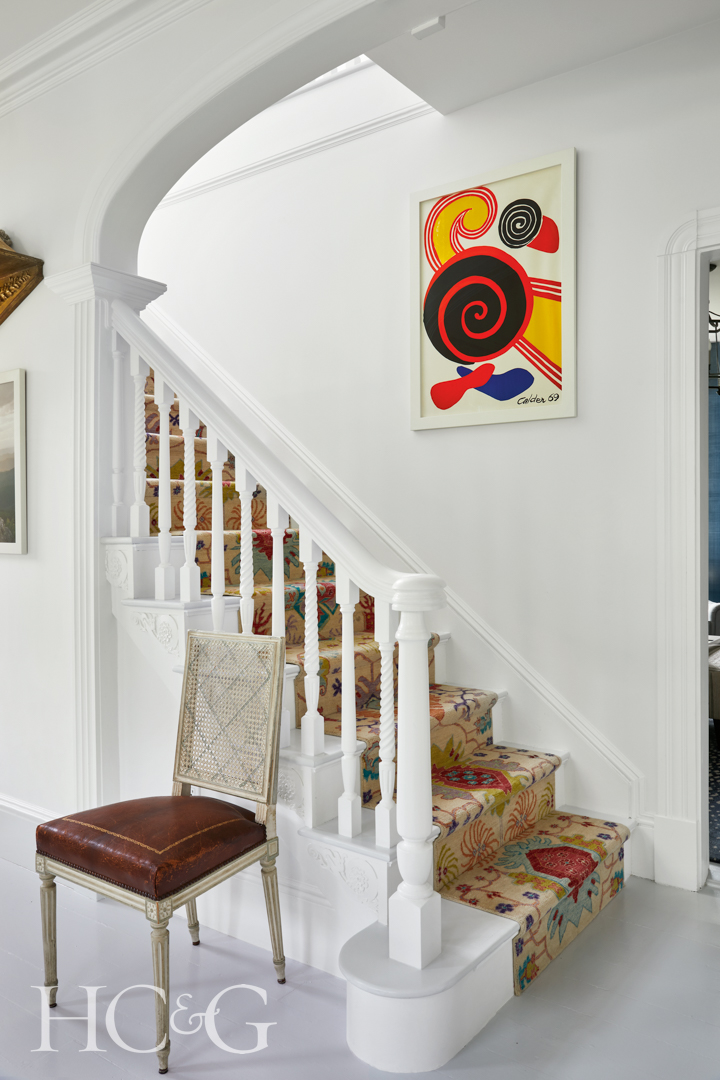
Just off the entryway, an Alexander Calder lithograph hangs above a Liam stair runner from Kravet. The painted French side chair is from Faustina Pace Antiques & Interiors.
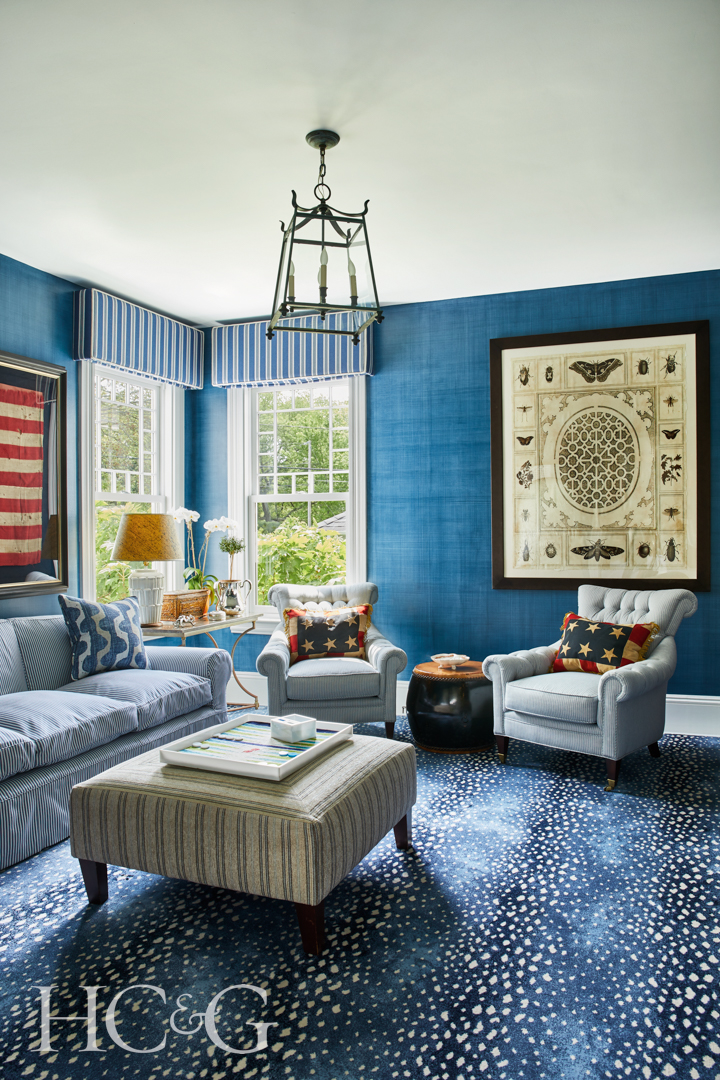
The den includes a pair of vintage Ralph Lauren armchairs upholstered in a striped fabric from Schumacher. The rug is from Stark.
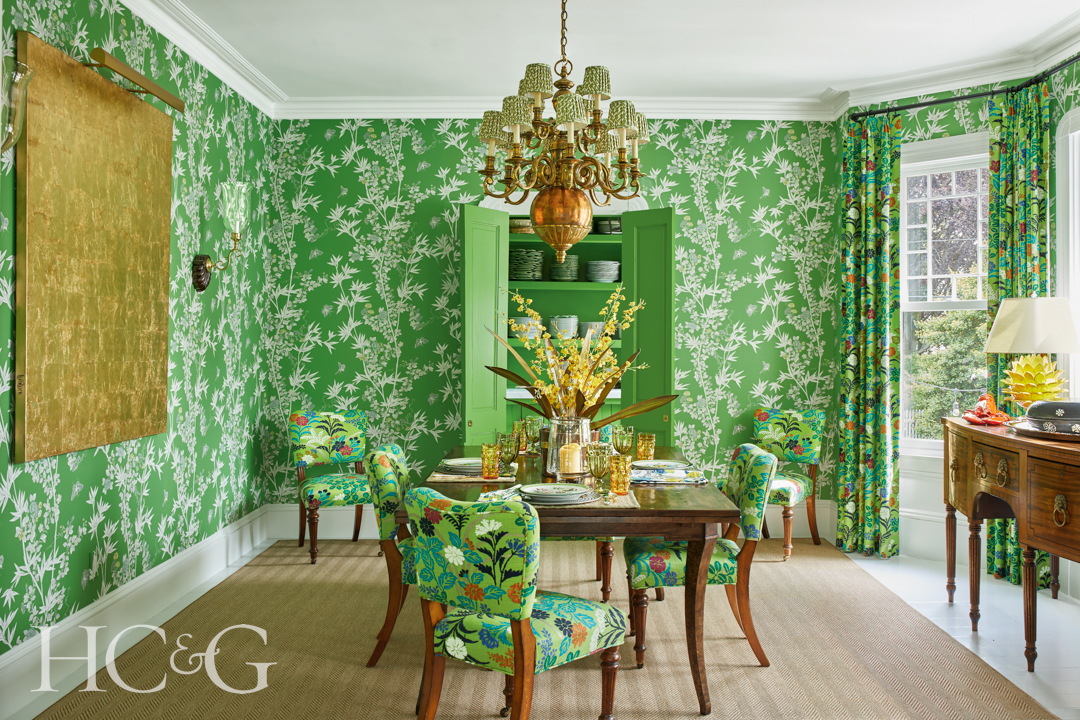
Scalamandré’s Jardin de Chine in Jade covers the walls of the dining room, where an artwork by Addison Jones provides stark contrast. The chair and curtain fabric is Jim Thompson’s Floret in Parrot Green.
The kitchen features Thibaut’s Mulberry Tree wallpaper and a pair of barstools from Indecasa. The double wall oven is from Wolf.

The banquette in a corner of the living room is covered in fabrics from Victor Thomas (back) and Scalamandré (seat). The photograph is by Moises Esquenazi.

In the living room, a pair of vintage chairs are upholstered in Lee Jofa’s Verbier Diamond in Leaf/ Teal. The vintage La Barge brass “rope” coffee table is a score from Beall & Bell.
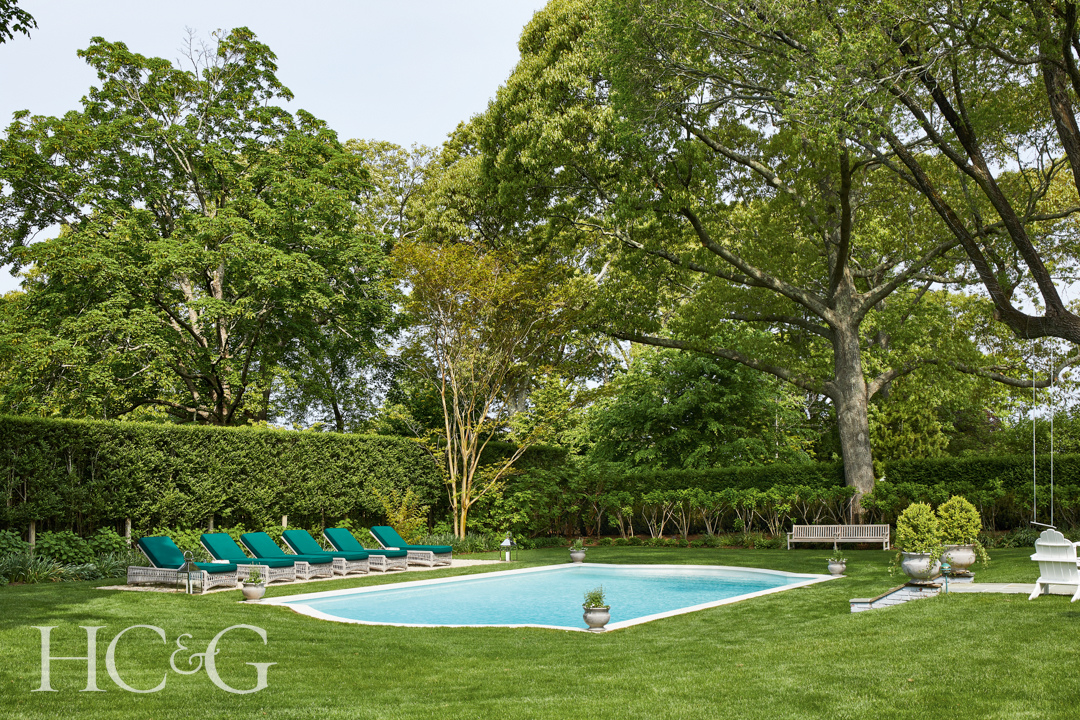
Lloyd Flanders chaise lounges from Walters line the backyard pool. The Anamese planters are from East Hampton Gardens.
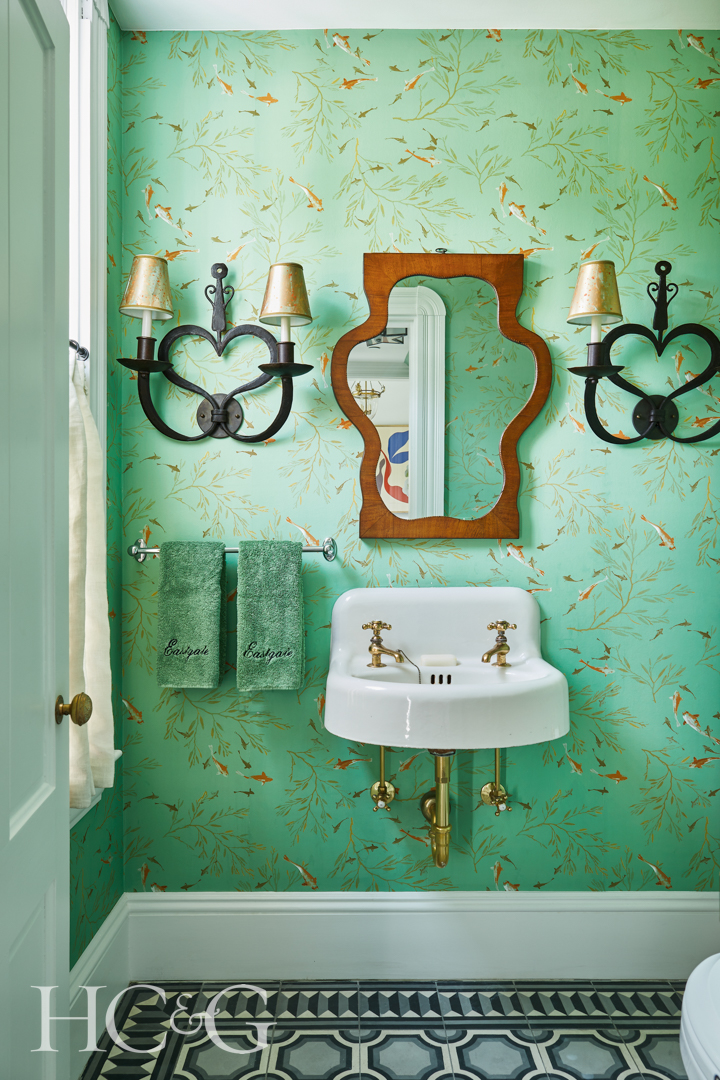
In the powder room, whose walls are covered in Galbraith & Paul’s Koi Pond in Aloe, vintage sconces from Heirloom wear custom shades from Shandells.

In homeowner Samuel Ashner’s office, a striped wall covering from Farrow & Ball lends shipshape appeal to a variety of vintage furnishing pieces.
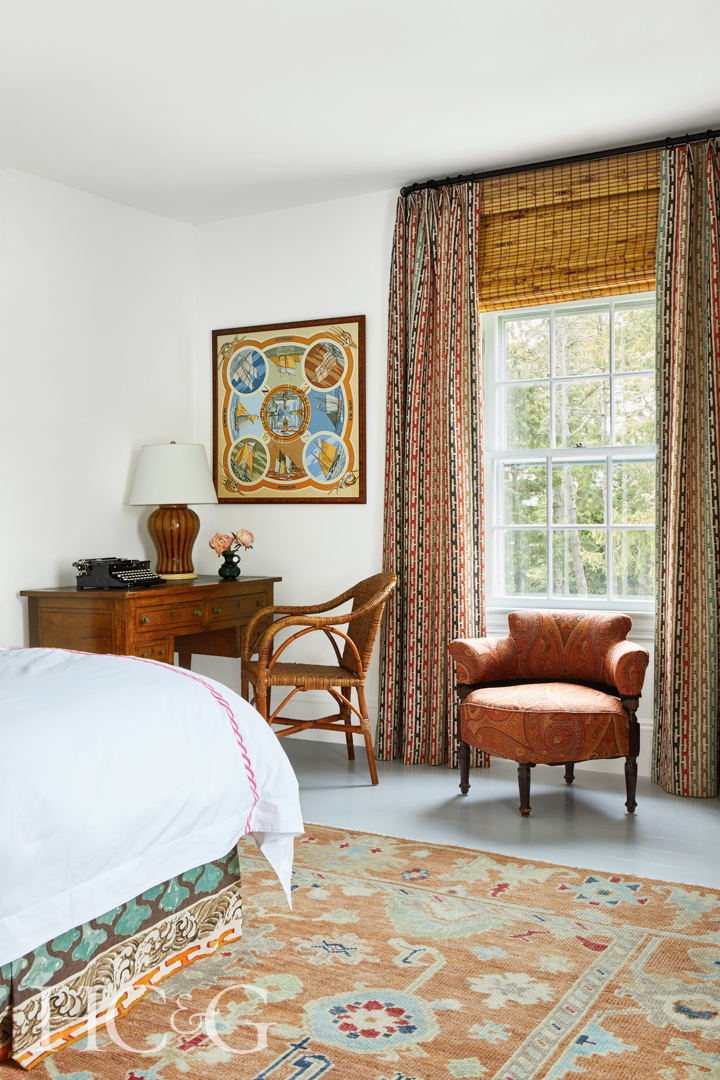
Curtains made from a No. 9 fabric from Jim Thompson hang in another guest room.
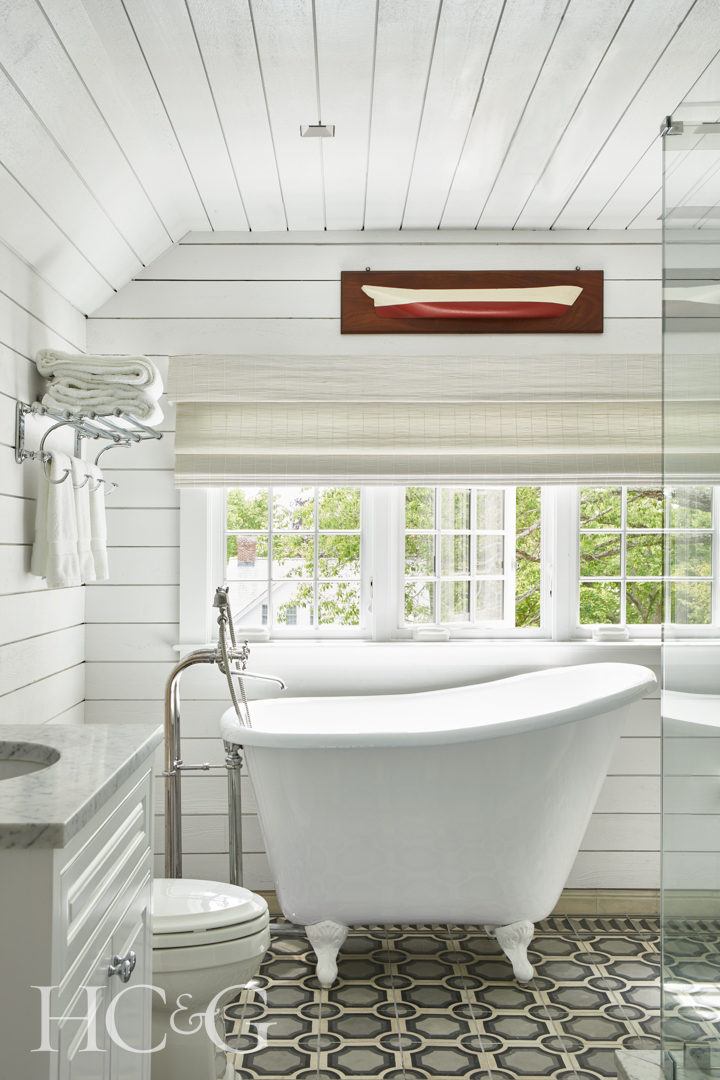
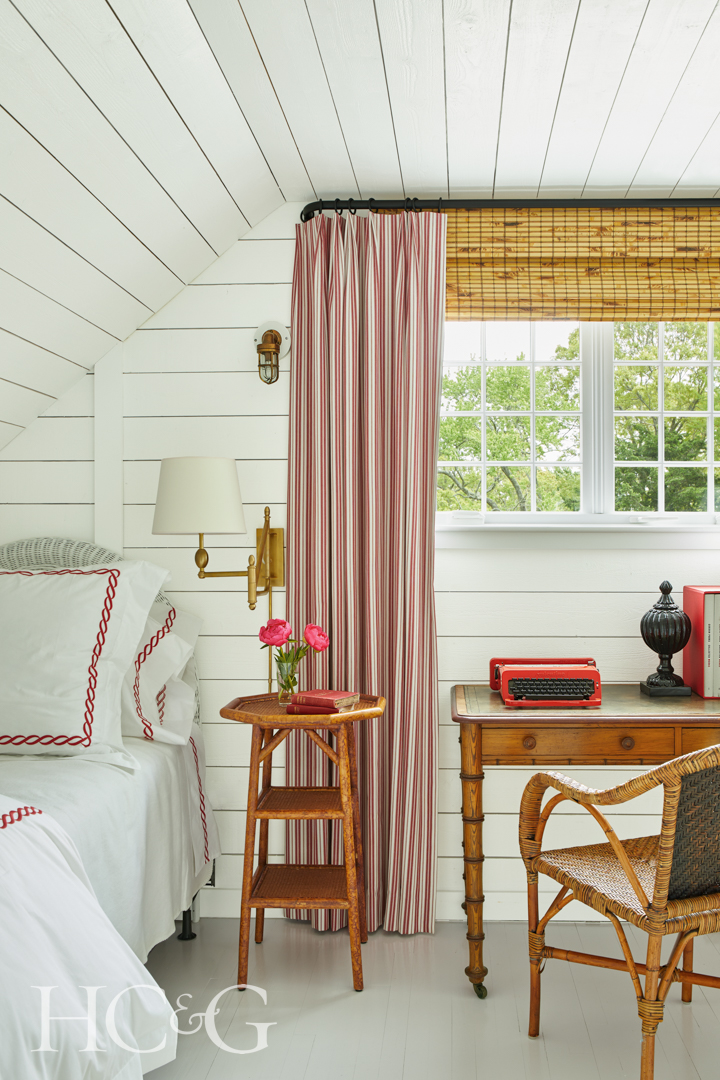
Curtains made from a candy-striped Scalamandré ticking hang in a guest room. The linens are from Matouk.
Dating from 1888, the late-Victorian house’s façade received a Greek Revival makeover in 1932.
Ashner has reimagined Eastgate as a timeless getaway for family and friends, an ample and commodious retreat nestled in a bucolic setting featuring rolling green lawns, gardens lush with hydrangeas and peonies, a large swimming pool, and even a rope swing hanging from a centuries-old tree. “I wanted the house to be very comfortable but also somewhat formal,” he says. “It’s attractive, and at the same time I like to think I can still drink red wine and keep my shoes on.” A thoughtful host and engaging entertainer, Ashner knew that versatility would be key to the interior design scheme, and today his dining room can morph from lunch for two to a sit-down dinner for 14, along with extra seating outdoors for a blowout family birthday party.
Ashner had met interior decorators Tom Samet and Nathan Wold of Hamptons House Design through mutual friends and knew that they were the ideal choice to pull off the decorating feats he had envisioned. Samet had thoughtfully suggested completing the renovation and decor in three stages, but Ashner, a get-it-done type of guy, was champing at the bit. “The day we closed,” he says, “we had a whole crew here getting to work.” Structurally, the house had great bones and the aura of a multigenerational family compound in Kennebunkport, but Ashner arrived empty-handed. “I had nothing except some art,” he recounts. “The great thing about working with Tom and Nathan is their knowledge and instinct and ability to work from scratch. I told them very little, just ‘No purple’ and ‘Don’t show me more than three options, because I can’t process it.’”
Vintage became the name of the game: Something old, borrowed, or blue was okay, but nothing new. This was music to Samet’s ears, since the designer has a penchant for finding what he calls “Rolls-Royce furniture in need of a little love.” His timeless, classic sensibility, fine-tuned by his work on projects in such locales as Locust Valley and Palm Beach, is on full display here, from the butler’s bar to the top-floor guest rooms. He and Wold, he reports, “bought well at secondhand stores and rebuilt parts of the home so that they have the same old quality but feel fresh and new.”
The living room sofa and chairs were even sourced from Ashner’s old neighbor’s house in Cove Neck and now have two sets of custom slipcovers, one for summer and the other for winter — a “Southern trick,” Samet says. Other choice pieces include a chinoiserie bureau in the entryway (bought from the Animal Rescue Fund’s salvage store), mirrors from an estate sale on Further Lane, and custom lamps made from old Spanish vases that Ashner “prays no one bumps into.” Wold customized the 1970s green pendants that hang in the kitchen, where Ashner, an avid cook, spends much of his time. Bold gestures come by way of the dining room’s vibrant green-and-white Scalamandré wallpaper (a nod to the property’s abundant hydrangeas) and a colorful stair runner handwoven in India.
“Nathan and I are big on scale,” Samet reflects. “There’s nothing here that couldn’t fit into another home, but we hope Sam stays forever.” Eastgate could very well be Ashner’s forever house, a place where each of the guest rooms features a bottle of water and a vintage typewriter from his substantial collection, at the ready should one wish to bang out a novel. It’s a fitting gesture for a home steeped in history, and poised for more storytelling as time goes on.
