


It may rhyme with Timbuktu, but Buku, the seaside capital of Azerbaijan, is no dusty third-world backwater. Shiny limestone towers line the spacious Bulvar promenade which stretches along its Caspian coastline, traffic whizzes by so fast that crossing the street is a challenge, and avenues are lined with boutiques selling the wares of Chanel, Hugo Boss, Prada, Dior and other familiar brands. Nestled within the town is what remains of the old city, and just up the hill iconic new buildings emulate three flames, for this is not only the “land of fire,” but also a capital of the international oil industry.
An important Silk Route crossroads, Baku was prosperous even before the mid-19th century when its oil became an important commodity and the Nobel and Rothschild families arrived to profit. Now most major oil companies have operations here, and just south of Baku is the starting point for the essential pipeline which carries its oil across the country, through neighboring Georgia, to the Turkish port of where it is an important source of world energy.
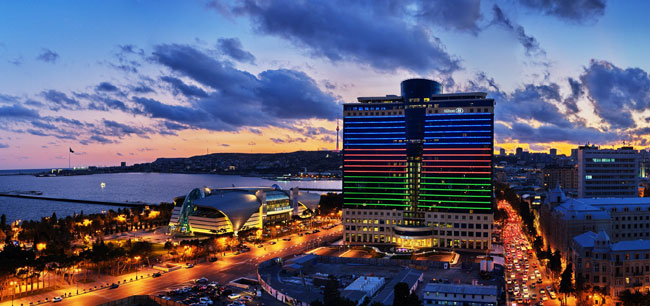
I didn’t know any of that when I arrived. I was merely curious to visit one of the former Soviet republics. Landing at the about to be supplanted Heydar Alief Airport, (one of many local institutions named for the popular president who was the father of current president Ilham Alief), I was whisked to the Hilton Hotel which turned out to be conveniently located on the major Neftcilar Road just across the street from the upscale Park Bulvar Mall and easy walking distance from the city’s historic and commercial centers. (Upon learning I was visiting for the first time, Tural Fataliyev, on of the very helpful staff members sent me up a package of unrequested guidebooks).

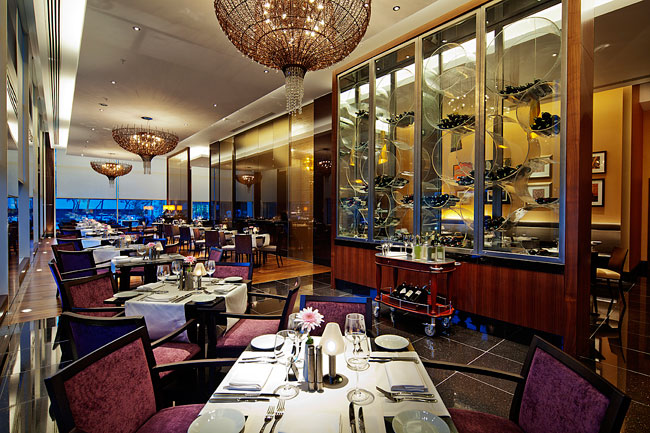
The next morning after sampling almost every fruit, cereal, egg dish and bread in the Hilton’s sidewalk Cilantro restaurant breakfast buffet, I set out and walked a few blocks to the Old City and rented a headset tour which led me from the Maiden’s Tower, past the excavated baths, the Dervish Mausoleum, the Palace of the Shirvanshahs and other significant historic sites. I ended up at an old caravanserie, one of the old camel “stagecoach stops” now converted to a social center where people were selling paklava and scarves and charming little boys were kicking up their heels in Cossack dances.

left to right: Young Cossack dancing at the fair; Fair at the Caravanserie
From there I made my way up the hill—even though it was Sunday, construction crews were at work all over town, and women with picturesque brooms were sweeping clean the streets.
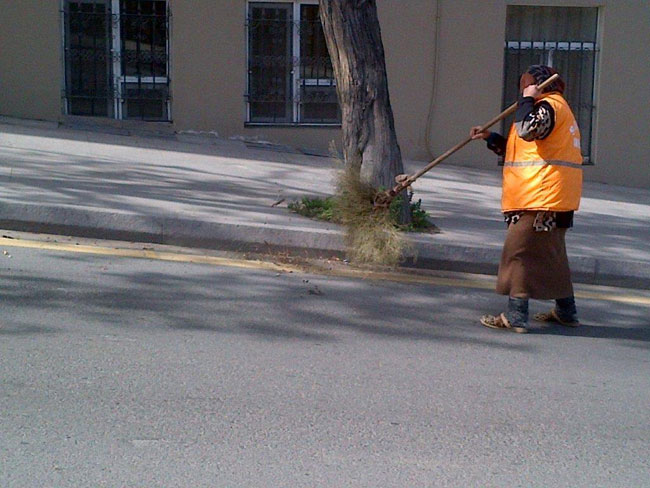
Sunday morning street cleaner
I paused at the State Art Museum housed in a pair of sumptuous oil-boom barons’ mansions, and admired paintings by Franz Hals along with more modern scenes.
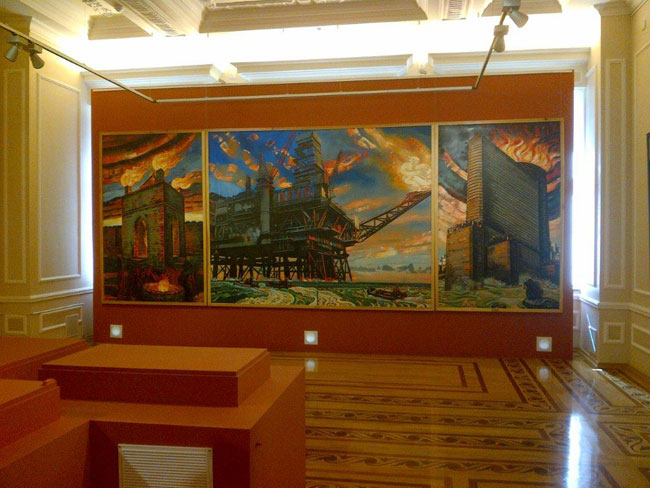
Oil derrick painting in the State Museum
At the top of the hill, workers were covering over the ancient stone steps with new limestone slabs to beautify the setting of Martyrs’ Lane and the eternal flame. Just adjacent, crews were putting finishing touches on the three unusual curvy “flame” towers, which will house offices, residences, and eventually the Fairmont Hotel.
Back down the hill, I strolled along the Bulvar, looking across the harbor at the massive flagpole, second largest in the world, and taking a spin on the Ferris wheel. Just about completed is the new carpet museum, designed to resemble a rug unfurling, and further along is the charming old-world puppet theater.
Some of the country’s most important historic sites lie on the city’s outskirts. With only a single day remaining I decided to hire a guide and the Hilton staff lined me up with the energetic and efficient Jamilia Sultanova.

Jamilia guide
We started heading south, past the head of the pipeline and ending up about 30 miles away at Gobustan. The Paleolithic drawings on the walls within the cave are some of the oldest known to man. They are displayed along with an ultra modern and informative museum, which lays the groundwork.
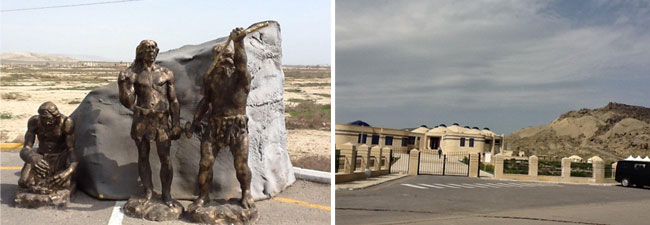
left to right: Gobustan Paleolithics; Gobustan Museum
Back to the city, I regretted not having more time to spend in the National Historic Museum with extensive displays of photos and artifacts detailing the pashas and Moors. The building itself is an exhibit, the former home of a19th-century oil baron.
Our next stop was the contemporary art museum. Designed by Jean Nouvel it is all white stripes and strips of wood with remarkably interesting contemporary work by Azeri artists such as Farhad Khalilov’s works reminiscent of Rothko, striking portraits by Tagi Tagiyev, the Turneresque landscapes of Huseyn Aliyev. One gallery features a sculpture by Dali and a Picasso painting from the museum’s collection.
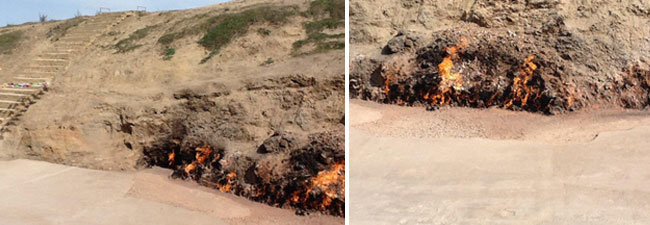
left to right: Land of Fire; Fire close up
Beyond the city and back toward the airport, the Asheron peninsula holds one of the country’s most sacred sites. Natural fumes from the earth have been ignited forming a flame that burns constantly in heat, snow and rain, which is the source of the country’s nickname “Land of Fire.” Stopping there was an appropriate finale to my introduction to an ancient country which is igniting a new era of prosperity.
