


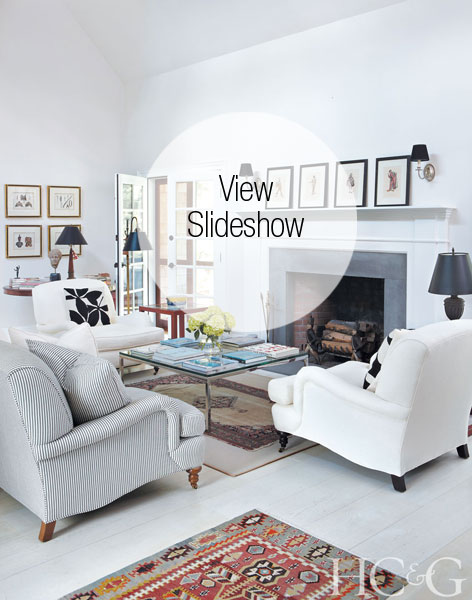
Designer Joe Macal’s Wainscott home is the quintessence of understated style, but it wasn’t always this way. The house, built in 1969, didn’t take on its present persona until after being fully renovated in 2006, when Macal, who bought the place in 1993, finally took the structure down to its foundation and started over.
Macal has loved houses ever since he was growing up in Decorah, Iowa. “I’ve always been a visual person,” says the designer, “and spatial flow, architectural structure, and interior design have always been part of my life, whether I’m working for myself or a client. Every project starts from the structural aspect of a space. Light is paramount, and I scrutinize how it comes into a house. Next, I focus on the overall coloration and the decorative details.”
While hardly ideal, the house Macal purchased almost two decades ago was perfectly located, close to town and a short walk to the beach. “I just loved the setting,” says Macal, who recalls a living room with five sliding-glass doors (each with broken vertical blinds) and a kitchen with peeling linoleum floors and rusting appliances. “After I bought the property, I did a quick fix to make it clean and livable. I replaced the sliders with French doors, added drywall and moldings to cover the board and batten throughout, painted the kitchen cabinets, and bought new appliances. Structurally, though, it left a lot to be desired. Slam the front door behind you, and pictures would fall off the wall!”
Macal, who previously worked as a graphic designer before seguing into residential design, expanded the house from 1,200 square feet to more than twice its size, creating rooms that are in sync both structurally and spatially. “Now everything flows and has a seamless quality,” he says. Acting as his own architect, he retained the house’s original H-style layout—the living room and kitchen/dining area make up the core, with guest bedrooms on one side—and then added a den and en suite master bedroom on the other. “I have a good-size lawn that I didn’t want to isolate from the house,” he says. “I wanted to be able to walk in the front door and look all the way through the house to the side garden.”
Macal ensured that the landscaping would be an integral part of the overall design. “I grew up with parents who were, and still are, avid gardeners,” he says. “I think that gene was passed on to me. I’m obsessed with beech trees and love the combination of boxwood, hydrangea, clematis, and roses. In the summer months I rarely miss a weekend visit to one or two of my favorite nurseries, if only to look, remembering that ‘Less is more.’
The pared-down interiors have a Swedish-style tonality, replete with white floors, painted furniture, gilded picture frames and mirrors, and natural linen and ticking. The designer describes his personal aesthetic as leaning toward the formal side of eclectic. “I like a neutral palette for interior rooms and then accessorizing with color,” he says, “and I’m drawn to furniture and interiors from different periods and places.” Indeed, the house is furnished with a mix of everything from Regency to mid-20th-century modern to Chippendale. “I’ve shipped items from England and France, but nothing compares to a great find from a local yard sale, the ARF Thrift & Treasure Shop, or Housing Works. I never go to Paris without spending a whole day at les puces at Clignancourt, rummaging through the stalls that pique my interest.”
A few judiciously chosen modern pieces have entered Macal’s carefully curated mix of antiques and curios, like the Knoll cocktail table and lacquered red side tables in the living room. “I’ve always liked light and bright rooms,” says the designer, “but I find that as I get older, I feel most at home in a comfortable but minimally furnished room. Less is definitely more.”
