


Haig Brown needed a solution. Faced with four acres surrounding the family’s New Canaan home—including two acres of woodland—he’s not the type to just let happenstance happen. Knowing that unplanned areas are likely to turn ugly, he was looking for space-fillers. And ferns just volunteered for the assignment. Haig and Ann Brown bought their New Canaan property in 1990 as an exit strategy from the Big Apple when Ann was expecting their first child. Initially, the attraction was the unique 1939 house. Crafted by unemployed boat builders, the house boasts idiosyncratic nautical elements. That aspect spoke to the Brown family’s love of sailing, but it was the fern colonies that ultimately steered the ship.

Haig Brown’s fern infatuation started gradually, creeping onto his radar and infiltrating into the landscape. “We never thought that we’d dive into this,” he admits. Outdoor activities were what the growing family did with their spare time in the late 1990s—encouraged by various recreational lawns and a pool. Haig was happy to keep the sunny play areas open, but the woodland was quickly becoming his Waterloo. “When we moved in, it was overgrown to the point of being impassable in places,” he recalls. However, he rather liked the islands of ferns that were thriving—and colonizing—in the woods. Sensitive ferns and hay-scented ferns were contentedly multiplying in the shade without fuss on his part, and they gave him an idea.

Autumn ferns and cinnamon ferns lead into the front fern walk.

A whimsical birdhouse from from the homeowners’ collection is perched on a dogwood stump.

A royal fern and maidenhair fern bask in the shade of a rhododendron and viburnum.

“This was the motherlode,” homeowner Haig Brown says of the original colony of rugged hay-scented ferns that has increased to fill the space.

Standing 5–6 feet tall, ostrich ferns love the damp soil in “Jurassic Park.”

The front pathway threads beside a Japanese maple and an ancient oak shading ostrich ferns.

The colorful fronds of a Japanese painted fern (Athyrium niponicum ‘Godzilla’) play counterpoint to hosta leaves.

“It looks like an engraver made the Polystichum setiferum ‘Divisilobum’,” says Haig.

Autumn clematis and honeysuckle climb the arbor beside the pool.

Sweet woodruff forms a groundcover below a Christmas fern.
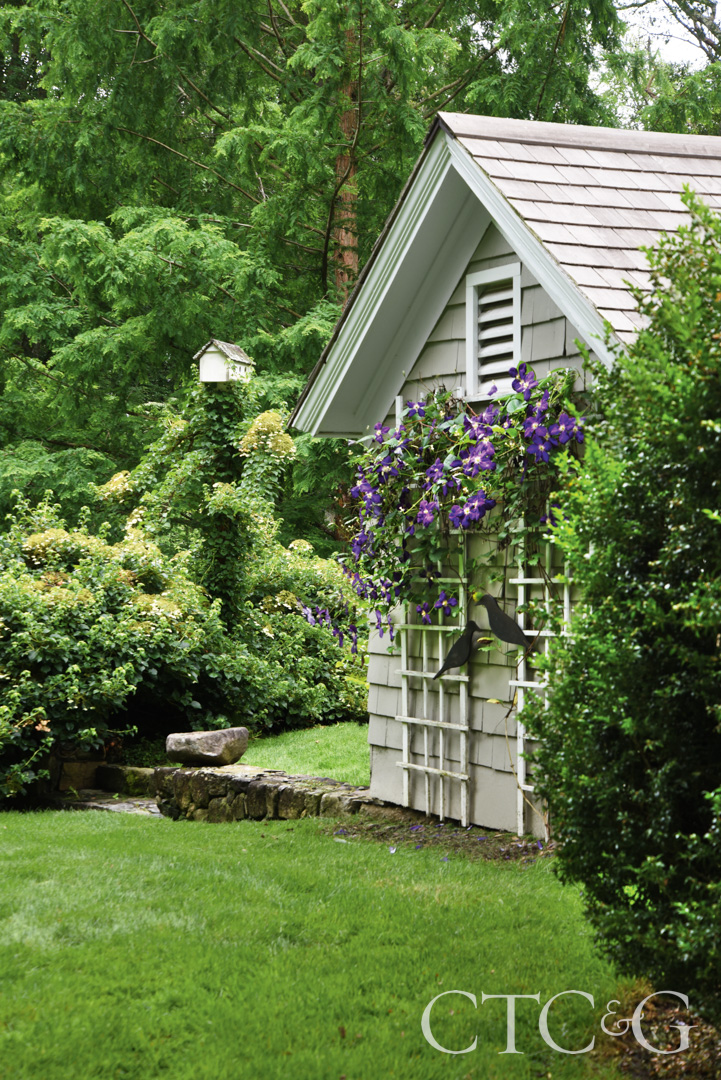
Clematis drapes the shed, while a climbing hydrangea mounts an elevated birdhouse.
By simply expanding his irrigation system, Haig could fill space with ferns. Handsome, easily hosted, and prone to covering ground on autopilot, ferns are capable of muscling out non-native invasive plants thanks to their sheer energy. Rather than endless annual mulching, investing in a permanent plant solution felt like a smart move while also adding a textural element to the picture.
Ostrich ferns and hay-scented ferns can be fast-moving to the point of being problematic, but because they were already in residence, Haig harnessed their pioneering spirit and encouraged them to form sweeps. “I probably have a thousand ostrich ferns now,” he confirms of the population that began with approximately 300. Now, their massive fronds stretch into six-foot tall other-worldly behemoths. “It looks like Jurassic Park,” he notes of the display with paths zigzagging to form a labyrinth.

Meanwhile, Haig and Ann began creating more shade while tweaking the wooded areas they were given. Three Japanese maples came with the property and ultimately produced 11 offspring. When the Browns decided to redistribute their arboreal wealth, the saplings ranged in size from 4 to 10 feet. When the root system of the 10-footer exceeded their wheelbarrow’s capacity, undaunted, they enlisted a toboggan to relocate the sapling intact. Now it’s happily stretching 20 feet tall—much to the ferns’ delight underneath.

Fern fixation is not without precedent. The Victorians were obsessed with what became known as Pteridomania with verdant “ferneries” outdoors and inside. Haig Brown is just a modern recurrence of that same fern fever fanned by kindred spirits. Joining the New York Fern Society put Haig under the influence of some serious fern firebrands. Then he worked with a group dedicated to restoring and stewarding the fernery at the Gothic mansion, Lyndhurst. Meanwhile, he’s become an ardent collector, exhibiting a lexicon of ferns that perform from first fiddleheads until last frost and beyond. “With a gene that allows them to photosynthesize in the shade, ferns are low maintenance plants with adaptability,” Haig enthuses. Ferns are what happen when practicality meets elegance.
