


Some houses and their gardens appear to grow into one another. Such was the intention for this home, whose grounds meld so seamlessly with the structure’s architecture that a hornbeam hedge and a classical-style pergola column might seem like organic brethren.
It’s not uncommon in coveted towns for a “flipper” to purchase an old property, restore it, and sell it fast for a profit. That hardly counts as a scandal, but, as Justin Quinn, the project’s landscape architect says: “The ‘flipper’ here didn’t add the best finishes or details to this house before putting it on the market. The homeowners hired me and architect Eric J. Smith to put some heart and soul into the house.”

Apart from preserving a couple of existing Southern magnolias and scattered holly trees, Quinn, a principal of Greenwich-based James Doyle Design Associates, had the land cleared, whereupon he began a replanting, a putting down of actual roots—and, in the process, establishing family roots for a couple who purchased the house with the intention of hosting their grown children and grandchildren. The homeowners, who live mostly in Florida, wanted this house to function as a year-round gathering place for all.
Part of the overall agenda meant restoring a guest cottage, a dwelling that architect Smith calls, upon first seeing it, “an eyesore.” He was commissioned by the homeowners to make that cottage into a true livable house, while also ensuring that it had a strong architectural connection to the main house, portions of which likely date to the turn of the century. “The cottage felt so disconnected architecturally from the house that it almost seemed as if it were something on a neighbor’s property instead of this one,” notes Smith.

Apart from beautifying the exterior of that diminutive dwelling, Smith designed a latticed pergola to visually link parts of the property. The structure, which provides shade and copious amounts of sun-dappled light, connects the property to deep-green lawn areas, the paved parking court and the swimming pool. “Even though the pergola faces south,” says Smith, “the shade it provides makes it completely possible to be outside and comfortable during the hottest of days. I designed it in a Georgian-Revival style, in keeping with the columns that already defined part of the main house.”
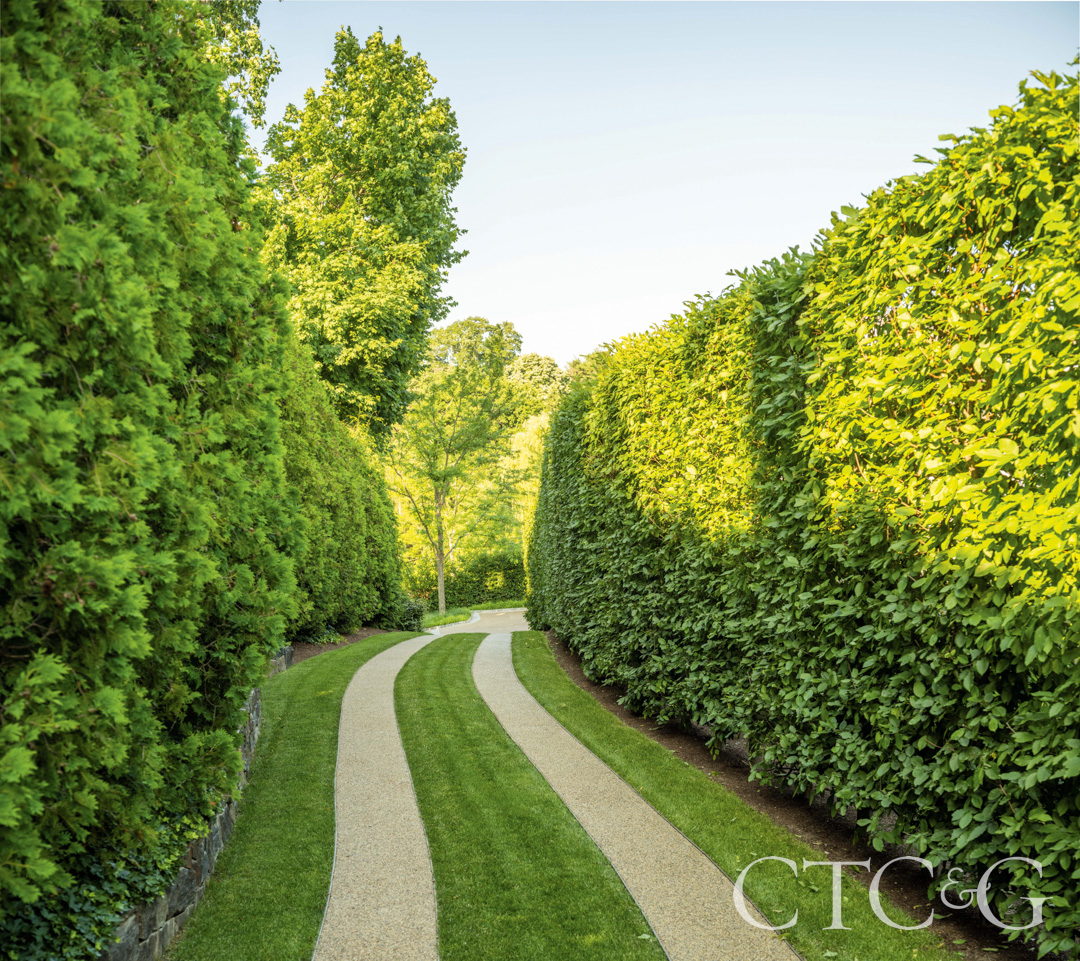
The driveway is lined with tall hornbeam hedges and existing arborvitae; the route is accented with paved areas interspersed with deeply hued varieties of Kentucky Bluegrass.

Beds of white Aster ‘Daisy Maes’ fill the cutting garden, with other groupings positioned by the swimming pool.

Architect Eric Smith fashioned a three-tiered stairway to one of the house’s entries. Plantings along the way include boxwood globes interspersed with Japanese Forest Grass (closest to the ground) and groupings of feathery aruncus.

Justin Quinn and James Doyle sourced an antique limestone trough from Sager Brunnen & Skulpturen, a Swiss company.
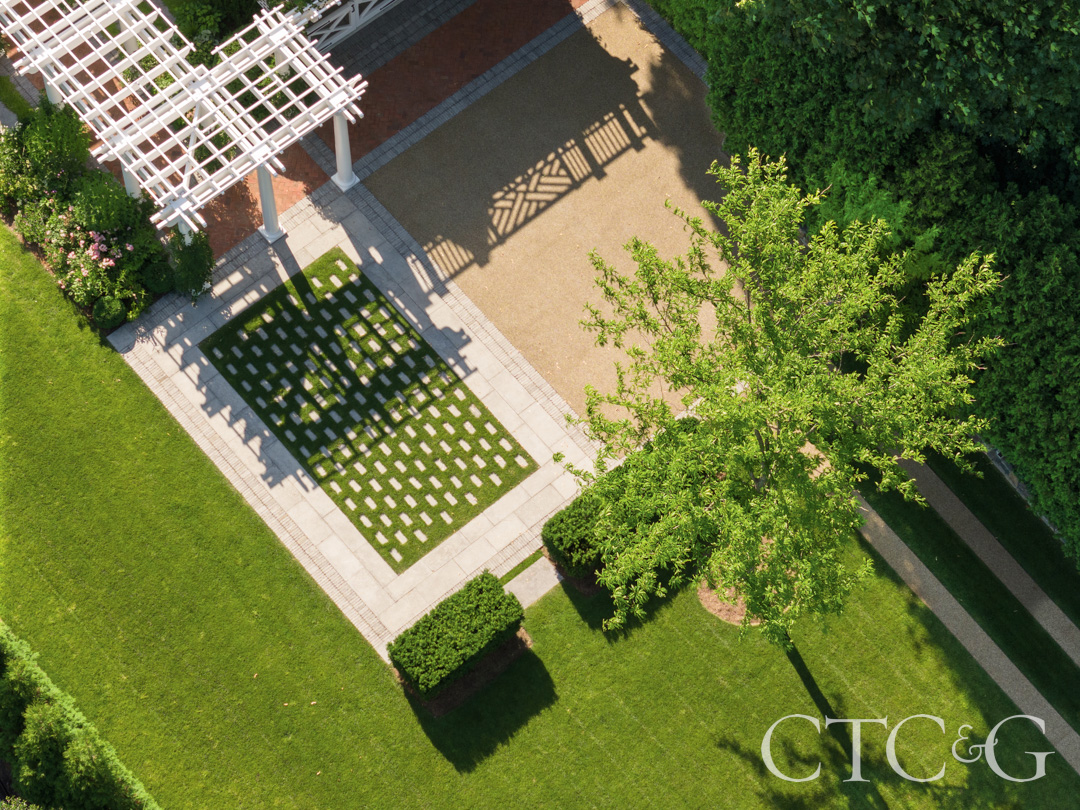
An aerial view of the parking court and gridded grassy area, on which cars can also park, reveals a tall honey locust tree and precisely articulated English yew hedges shaped as rectangles.
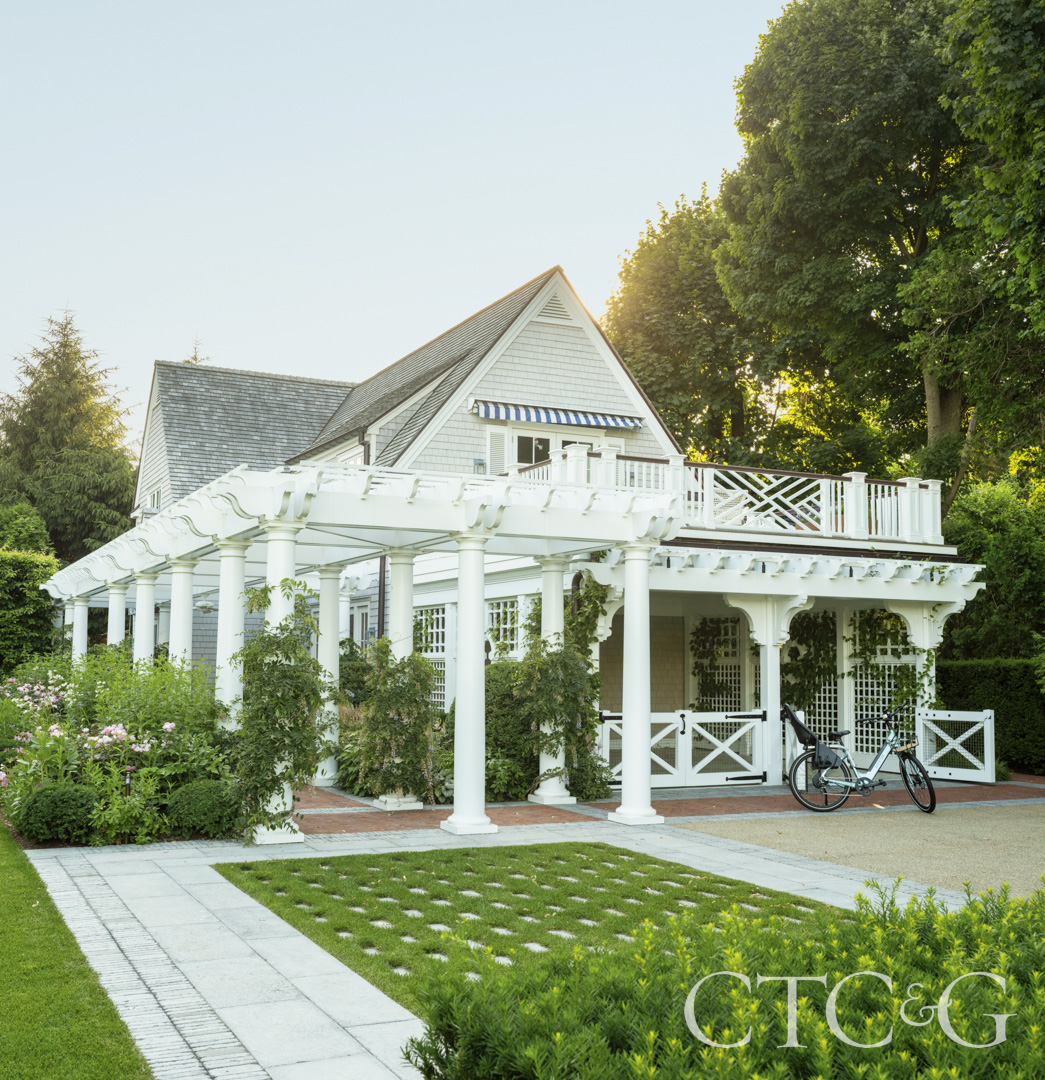
The pergola is host to honeysuckle, wisteria and chocolate vines (which, yes, emit a delicious chocolate-like fragrance).
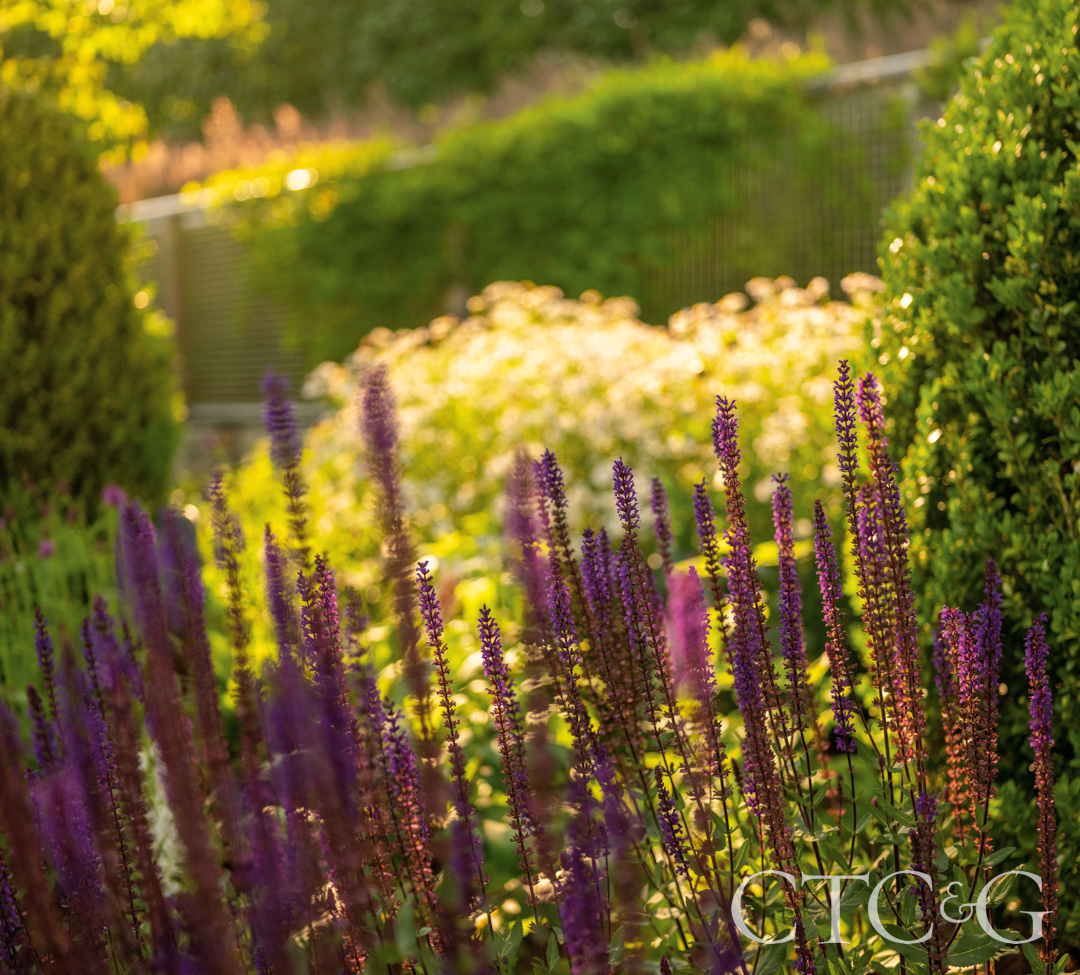
Among the most colorful plantings on the site are stalks of graceful purple salvia, which bloom from June well into September.
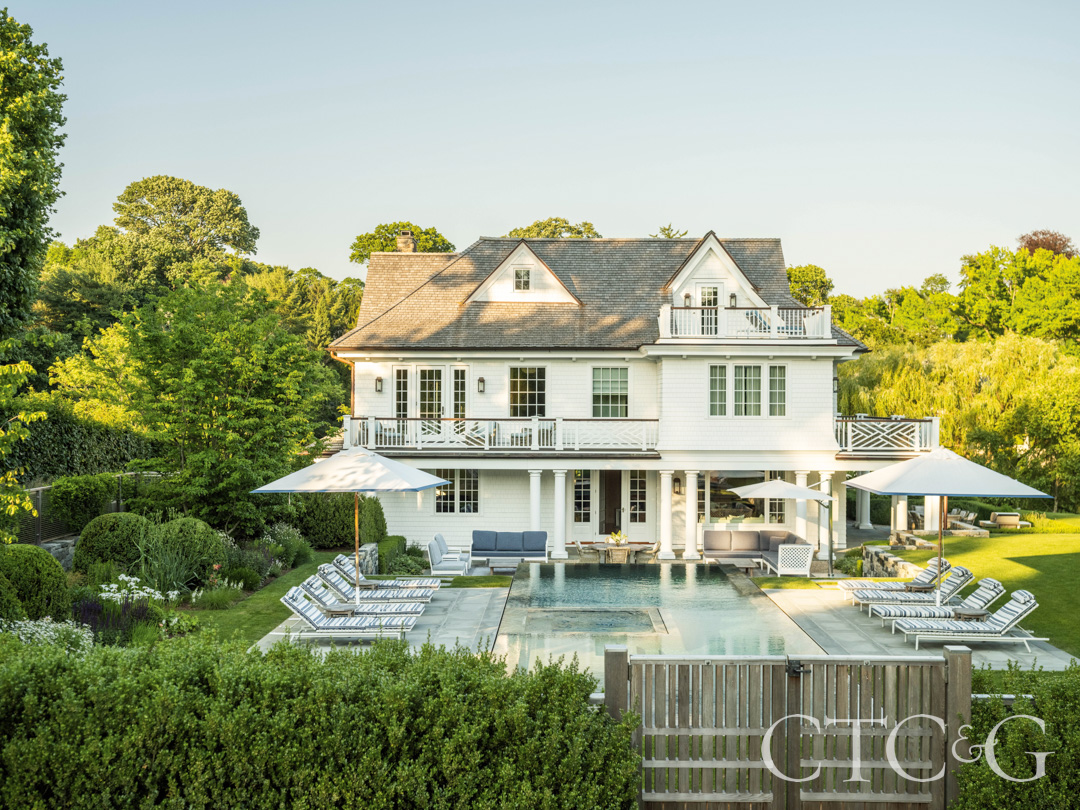
The swimming pool was built by Drakeley Pool Company, with GFX Site Development working as the masons. Ceci Bros. was the landscape contractor responsible for installing the plantings, and Nordic Custom Builders was the general contractor. The gate is custom by James Doyle Design Associates and built by Euro Fence.
For the main residence, Smith’s primary goal was to add exterior detailing, with the intention of making it seem as if these new features were original to the house. “One measure of success for projects like this is for people to see new details and think that they were part of the house from the start,” he emphasizes. To open up interior views to the pool that Quinn designed, Smith repositioned exterior columns supporting a recessed porch, allowing for unimpeded vistas. He added an expansive deck off the primary suite, thus creating an expansive second-floor outdoor room.

At one of the home’s entry points from the new parking court that Quinn defined with Flexi-Pave—a popular porous and polymer material—Smith fashioned an elegant stairway. The house is essentially a full story up from the driveway, and to lessen the effects of that climb, Smith’s staircase features three stone landings, its length accented with mahogany balusters and handrails. “By creating these ‘moments’ along the stairs, the ascent doesn’t seem as monumental,” he says.

Quinn’s work began ahead of Smith’s, with his chief commission as the landscape architect to design an “unconventional swimming pool” that would contain a number of elements, including a kid’s bathing area within it. He then continued to layer the property with perennials and annuals, establish cutting gardens and create outdoor rooms, some of which are demarcated by yew hedges.
An especially creative use of a Kentucky Bluegrass mix appears next to the parking court—essentially a rectangular plot of lawn interspersed with stone pavers and circumscribed with a paved border. He also introduced Parrotia persica trees on the property, “known for their elaborate branch structure,” and he filled the pergola with fragrant wisteria, honeysuckle and chocolate vines.

“The client wanted a swimming pool first, but now they have a series of outdoor rooms that they can live in during the seasons,” says Quinn. And Smith, upon looking at his finished work on the house itself says, “The architecture and the landscape are now knitted together closely.”
