


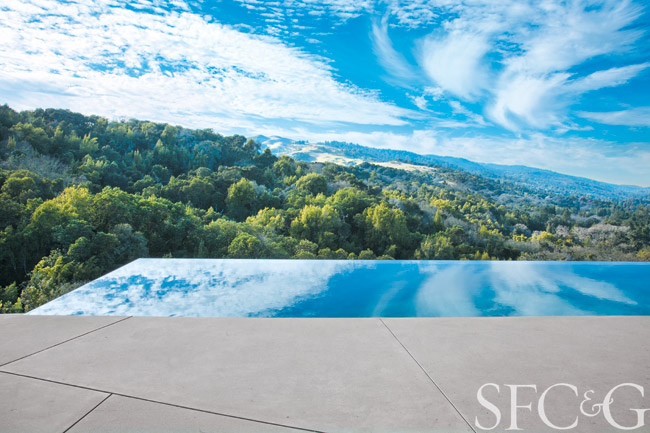
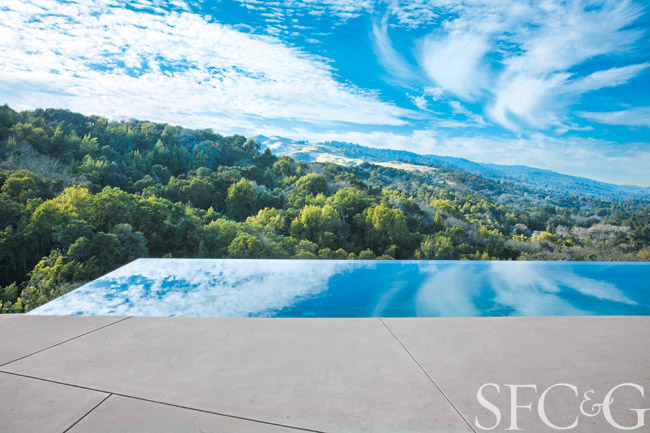
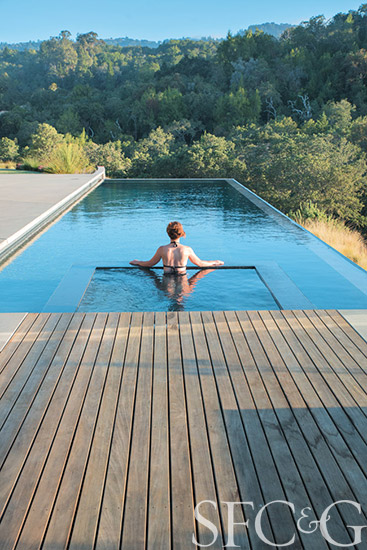
An infinity-edge pool by Skyline Pools overlooks Portola Valley.
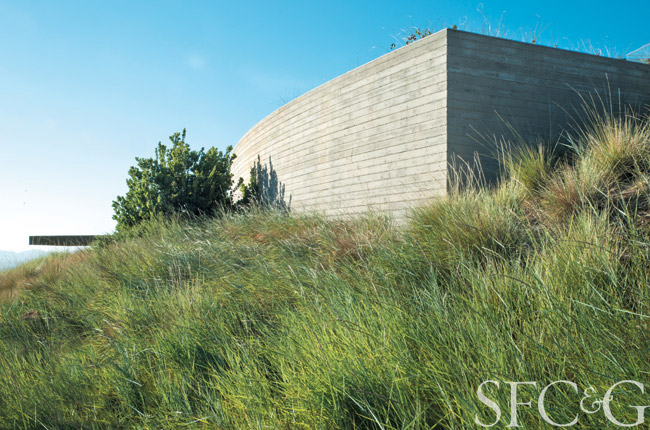
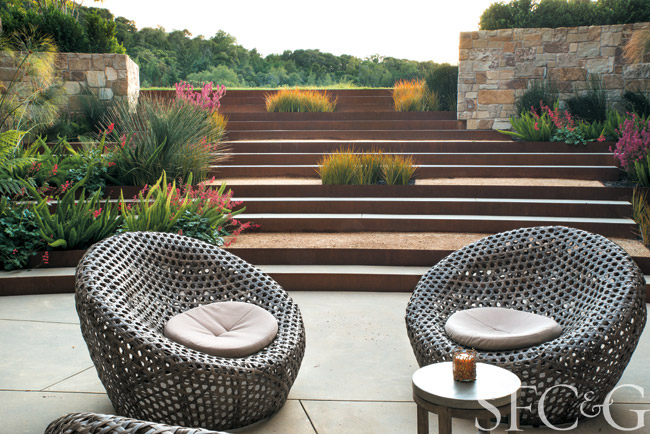
A sculptural stairway wall of board-formed concrete arcs into the chaparral meadow.

Of the infinity pool, Thuilot says, “We designed everything to be open to the sky. You feel like you’re swimming in the clouds.”
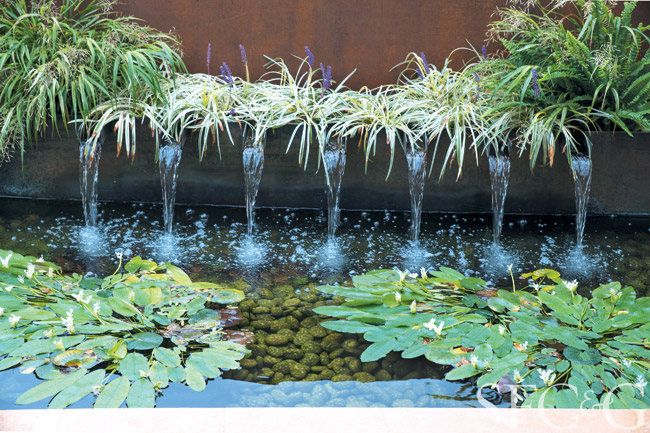
Says Thuilot of the water feature: “Frogs have made this their home. They provide a concert on the way to the house!”
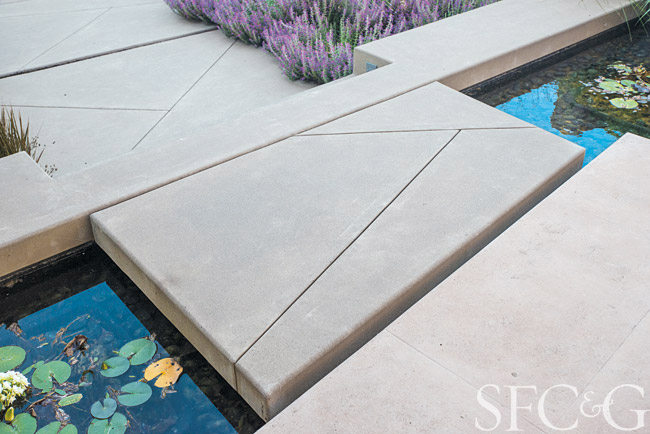
Stylish pavers mark the path to the front entrance.
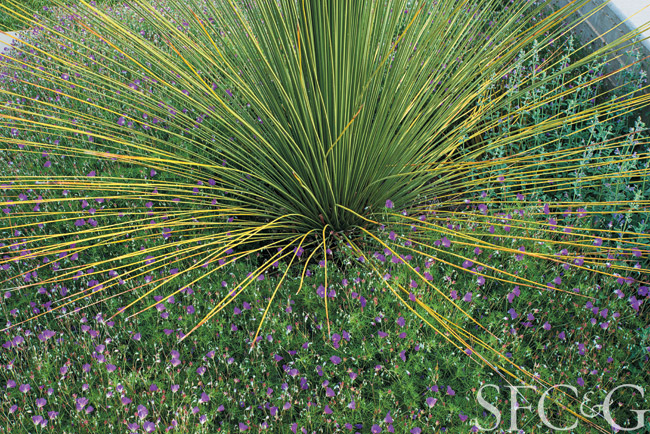
A Dasylirion wheeleri, or desert spoon provides visual contrast to the surrounding elements.
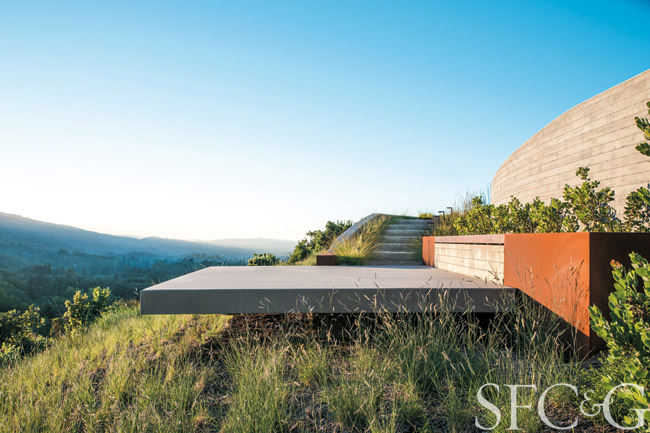
“At sunset, the concrete platform radiates the heat of the day,” says Thuilot. “You feel the warmth, the wind calms down, you start to hear the evening birds. It’s a very special little space.”

The view from the pool at the close of day.
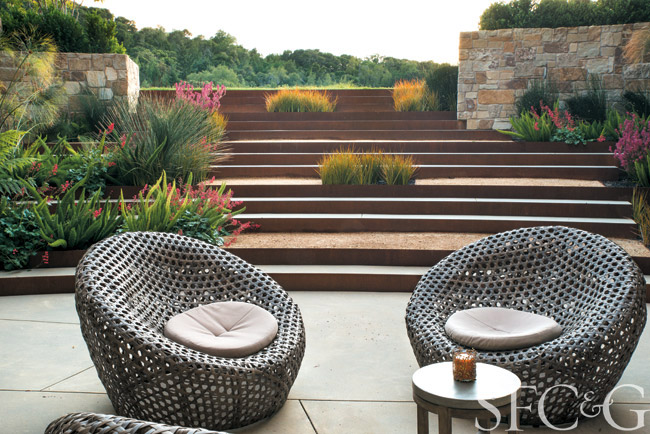
Thuilot echoed the curves of the steel arcs in the ovoid chairs.
A convex concrete wall divides the field like a prow in a Portola Valley landscape by Stefan Thuilot. It’s one of several gestures, including steel arcs radiating from a sunken terrace and a cantilevered platform thrusting out from a hillside, that reflect the architect’s Serra-esque concern with sculpting space. Thuilot, who holds degrees in fine arts and architecture, is also concerned with the content of his interventions—solitude and socialization, enclosure and release—and with their ecological impact. “The garden is experienced on multiple levels,” says Thuilot, “from floating above the breathtaking landscape, to descending into a sunken courtyard, to sitting at the edge of a lush, reestablished meadow.”
The immediate area around the house moves from a field of chaparral into woodland and denser forest beyond, while to the right is meadowy Windy Hill, a Portola Valley landmark. Thuilot designed experiences to enable the owners to enjoy the views from vantages both physical and psychological. “I always view gardens in respect that there are introverted and extroverted spaces, and there are spaces that remove you entirely from the house,” he explains. He designed a concrete platform that cantilevers 20-to-30 inches above the meadow and directs the viewer toward the open space. “The platform is also not seen from any point of the house or pool,” Thuilot says. “It is truly an area that has absolute solitude.” Another introverted space, but one that removes the dweller from the larger landscape, is a sunken garden amphitheater carved through with steel bands. “From above, the steel doesn’t reveal itself except as the arc of lines,” Thuilot says, “But from below, you are looking at the steel faces, it has a lot of rhythm, and the eye goes up to the ridgeline. It becomes a view out to the sky.”
The project also involved considerable conservation and reestablishment. For example, the site was home to dozens of mature Manzanita trees. “These trees are very precious; they are probably 50 to 60 years old,” says Thuilot. The ground on which they stood, however, had to be regraded and uplifted to accommodate the house. “We had the contractor scoop them up and put them into planters and in storage, and all of them survived,” says Thuilot. “We had them put back in a very natural pattern as well: The transitions from meadow to woodland are punctuated by them.” He also selected highly drought-resistant plantings, some of which can go a year without watering. “Being conscious about water was a guiding principle from the beginning,” he adds.
The homeowners were thrilled with the overall outcome of the garden, which received the 2014 Award for Residential Design from the American Society of Landscape Architects of Northern California. “They are really pleased that the garden feels part of the larger landscape,” says Thuilot. “It provides them with a grand experience in the context of serenity. It feels like an endless garden.”
BROWSE MORE PHOTOS FROM THIS FEATURE IN THE FULL GALLERY BELOW
