


“On a clear day you can see the New York City skyline,” enthuses interior designer Jack Leonard of Kennedy Leonard Design about the vista from the Fairfield County residence that he and partner Rob Lipsky worked on for an empty nester couple with four grown children. “We took advantage of the locale by introducing a neutral color scheme that wouldn’t compete with the surroundings,” he adds. Similarly, architect Ryan Salvatore of Burr Salvatore Architects also wanted to capitalize on the Long Island Sound vistas by designing a residence where every room has a view. “Our massing strategy came right out of an old rambling house, because to make that happen, we needed to stretch the house along the site,” he says.

The trio joined forces to create a residence that would honor the enviable viewscape. Plus, since the homeowners were moving from a historic home, they wanted their new domicile to be traditional with elements that felt instantly familiar both inside and out. For inspiration, Burr turned to architect Grosvenor Atterbury, who produced an array of grand mansions and estates in New York and Connecticut during the Gilded Age. “We looked to the Shingle-style houses of that era, and Atterbury became a touchstone to which we referred constantly,” says Burr, who committed to a palette that included side wall shingles, an Alaskan yellow cedar roof and fieldstone veneer to produce the desired effect.

Noting that many historic homes were added onto over time, Burr embraced that concept and invented a narrative in keeping with that idea. Ashe explains,“We imagined the main mass with the gambrel roof as the starting point, with a stone clad building, which may have been a guest cottage that gets tacked on. Then came the areas for the primary suite followed by the kitchen and family room.” The resulting Y-shaped plan angled the latter toward the views of the skyline and included a porte-cochère that separates the garage from the more dominant main house.

About the pool house, which is fashioned from the same materials as the main residence, the architect says, “It was located as close to the shore as we could put it.”
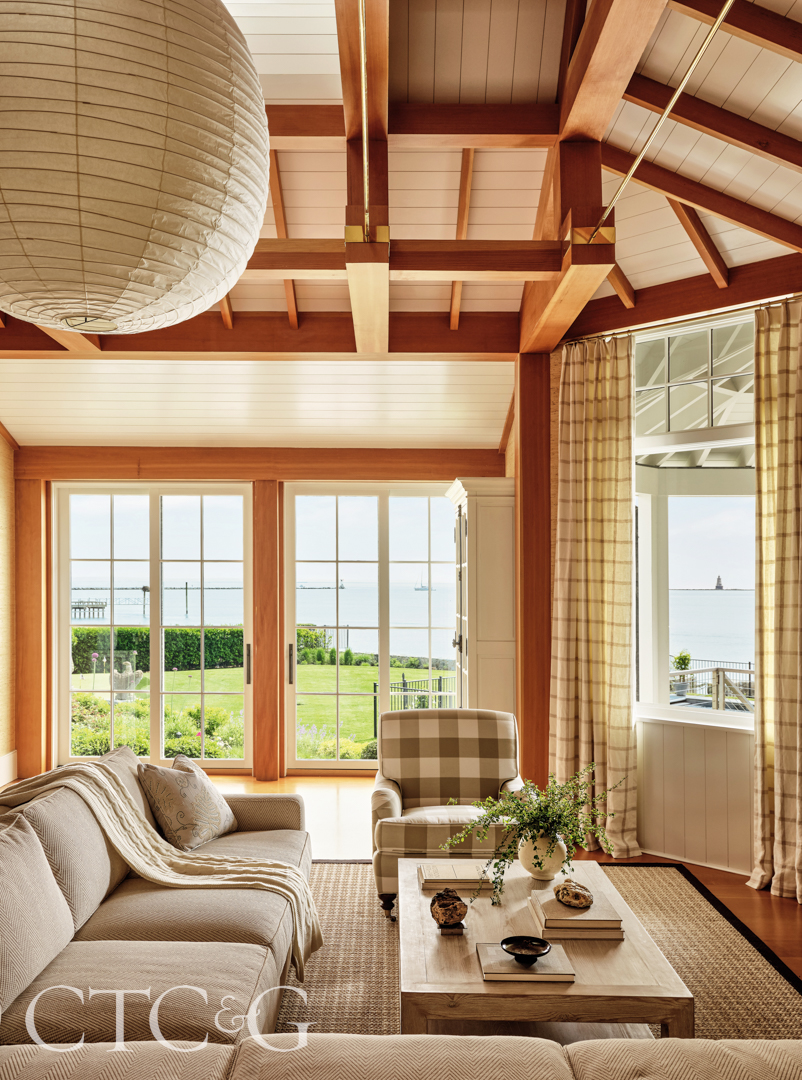
“We wanted a touch of classic modernism” says interior designer Jack Leonard about the Noguchi pendant and clean lines of the sofa in the family room.
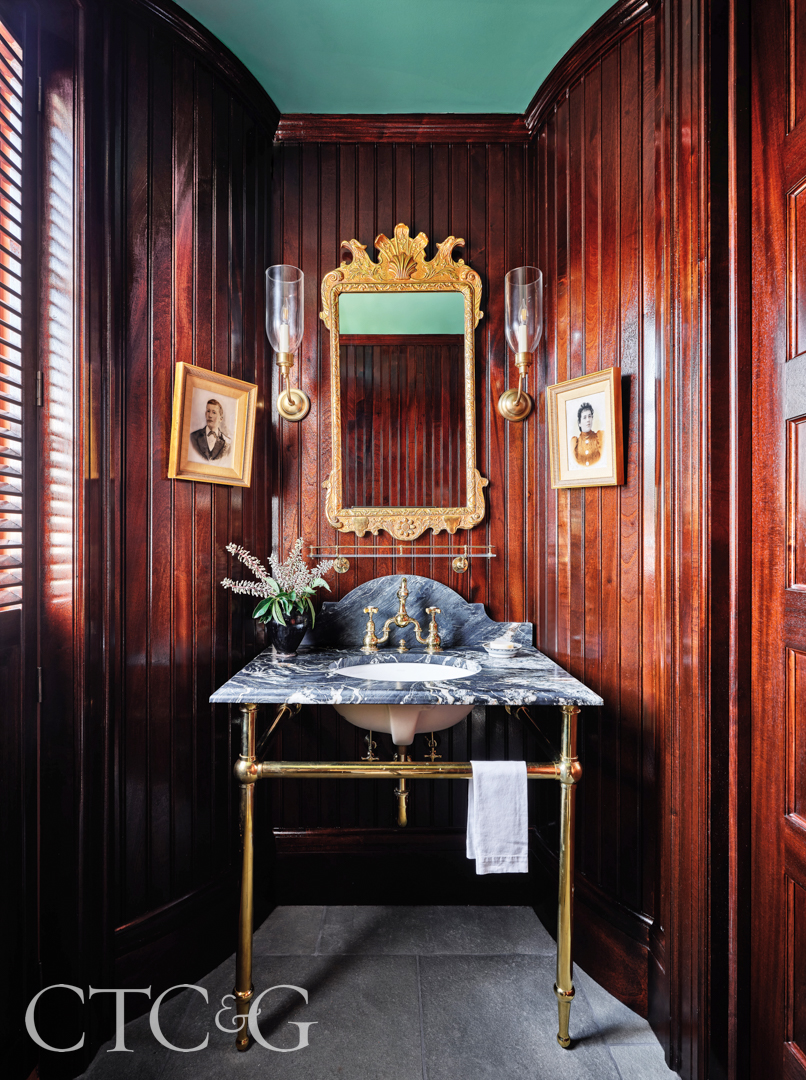
Crane Woodworking outfitted the powder room with mahogany, and the Urban Archaeology washstand is topped with granite from Genrose Stone & Tile.

Greenwich Fine Woodwork fabricated the kitchen cabinets, and a pendant by Urban Archaeology lights the polished quartz counters from Everest Marble, while the Delft backsplash tiles are from Country Floors.
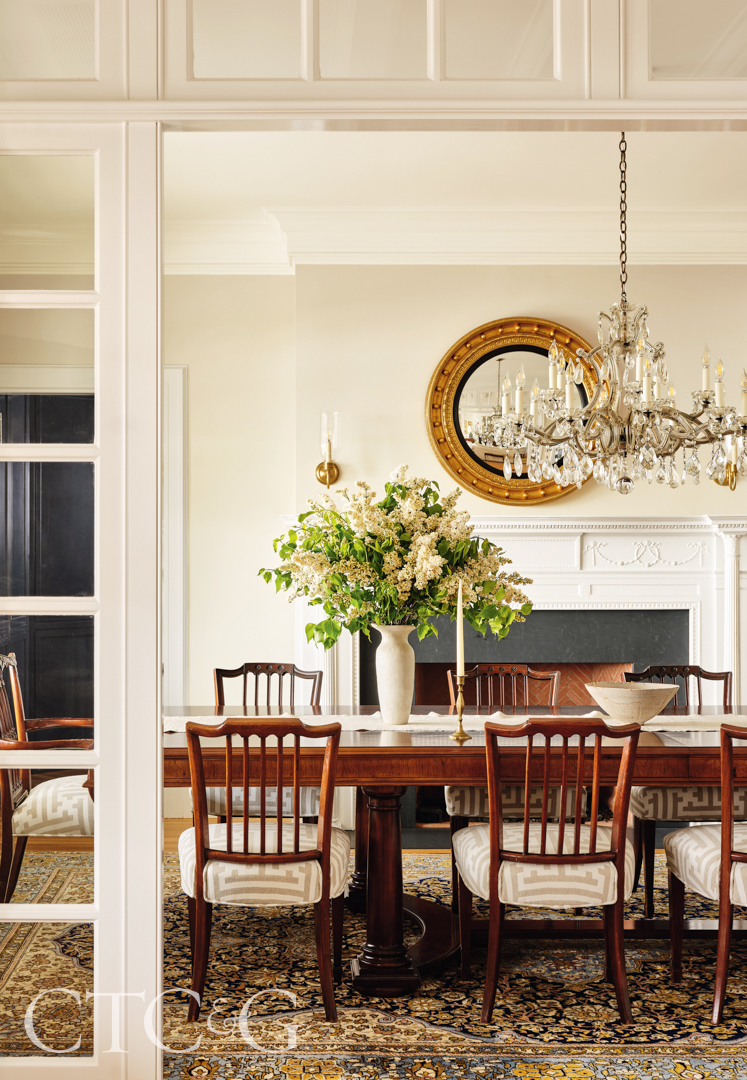
A refurbished vintage fireplace surround from Antique Revival provides a historic layer to the dining room where antique chairs reupholstered in Sunbrella fabric gather round a Ralph Lauren Home table.

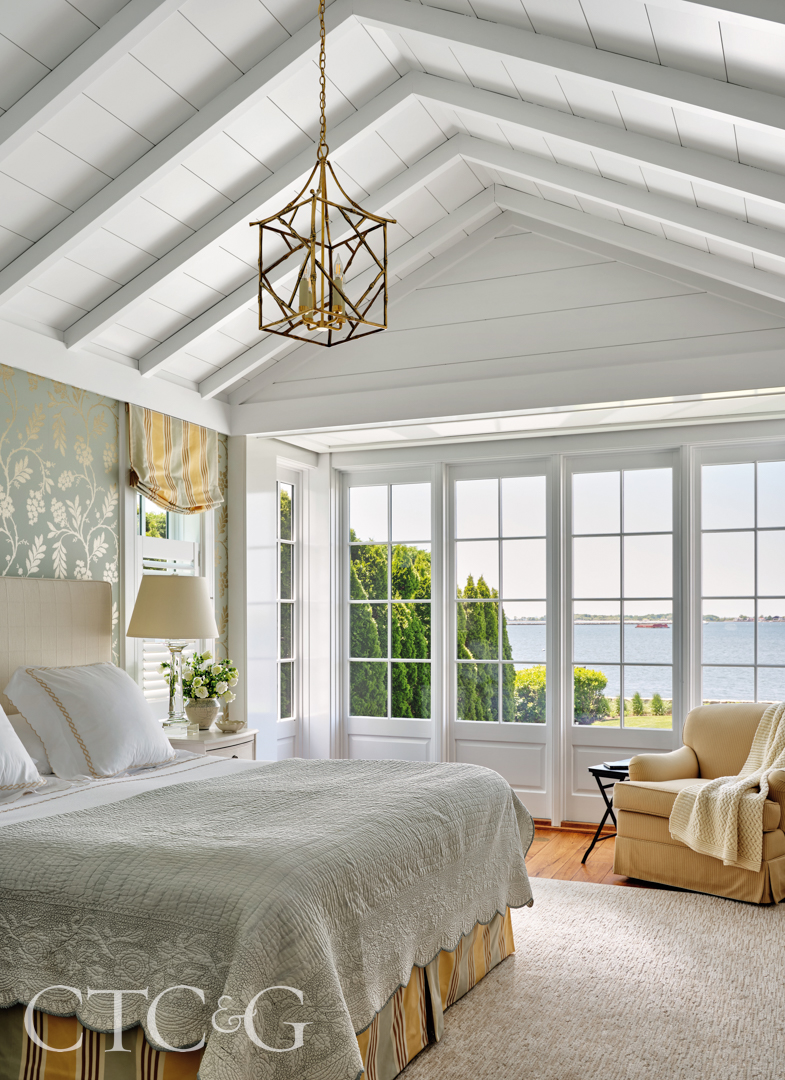
In the primary bedroom GP&J Baker wallpaper from Lee Jofa backs a custom upholstered headboard, while the lantern with a brass finish is from Vaughan.
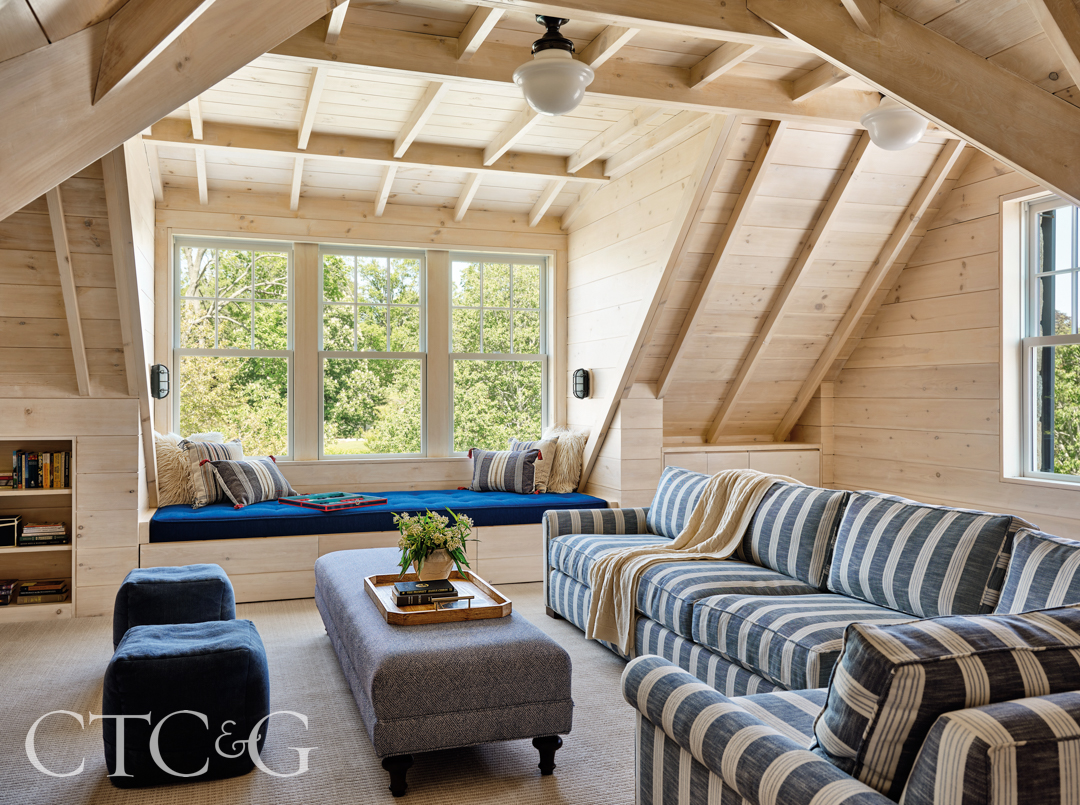
Pickled knotty pine from Ring’s End lines walls and ceiling of the recreation room, where the sofas and ottomans wear Sunbrella fabrics.

A porte-cochère with a fieldstone veneer suggests a time gone by.
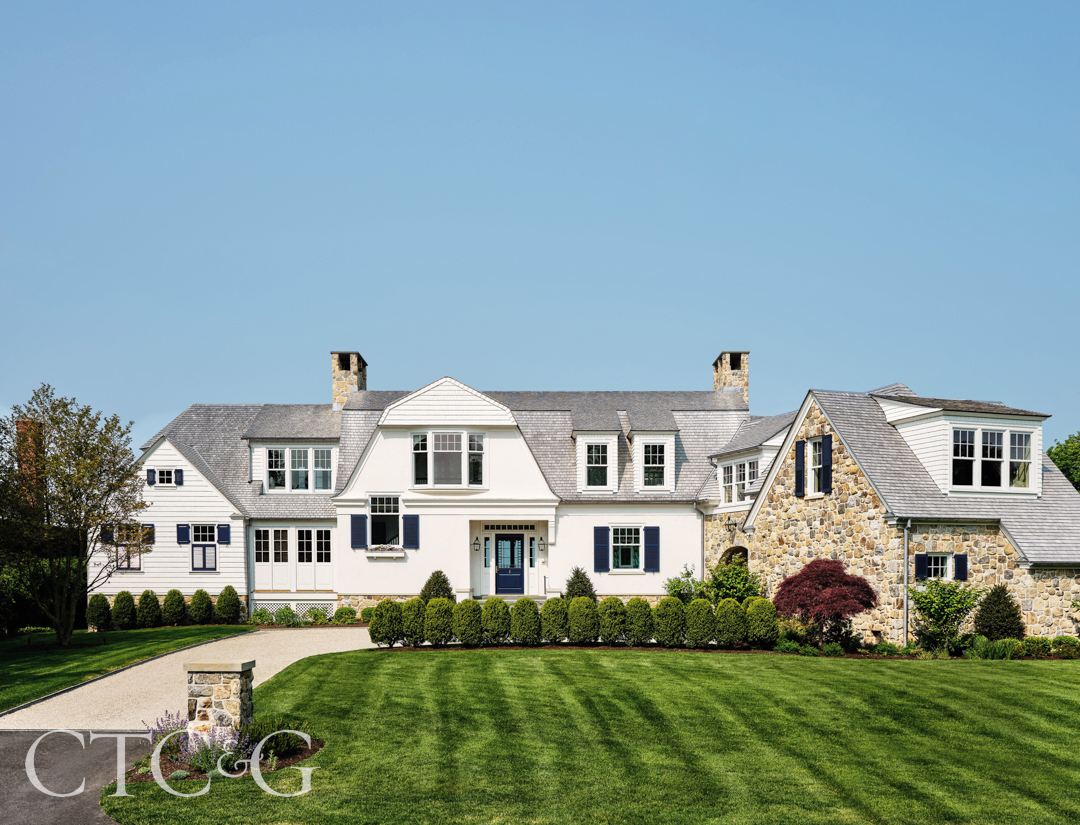
“Rather than one large mass, the residence was conceived more like a central main house with additions appended to it over time,” says architect Ryan Salvatore. The shutters are from Atlantic Premium Shutters, and the New England fieldstone veneer is from O&G Industries. Landscape design is by Spaulding Landscape Architects.
Inside, such add ons created a welcome quirkiness, and in lieu of a monotonous central hallway, the rambling plan is broken down with a series of vignettes. “Part of the hallway becomes a stairwell or a dining alcove or an anteroom to the powder room,” says Burr. “It’s almost like a charm bracelet with lots of discoveries along the way. It also provided places where Jack and Rob could really amp things up.” The powder room, for example, which the design duo sheathed in mahogany beadboard “feels like you are walking into the Titanic,” says Lipsky. “It’s a little jewel box.”

Opting to balance historic references with classic modern interjections, the designers coordinated with the architect on the selection of trimwork like crown moldings and antique fireplace surrounds. Builder Dave Skelton of Hobbs, Inc. retrofitted the latter to fit the new fireboxes, and at Lipsky’s urging, the interiors were outfitted with herringbone fire brick. “I saw that in an 1890s house that was torn down,” he says. “Details like that contribute to making this look like a house that has been here for a hundred years and was renovated.”

Meanwhile, mindful of the wife’s desire for a sense of familiarity, Leonard says, “The kitchen was personalized with hand-picked Delft tiles depicting different scenes like women baking and children sledding that were reflective of her and her family.” And in the primary suite, he adds, “The fabrics on the dust ruffle and window coverings had been used in three of their previous houses.”

A subtle shift occurs in the family room where the sofa lines are clean cut as opposed to rounded, and a Noguchi fixture warms the space.“We loved kicking things up a notch with some classic modern touches that are fresh and crisp,” says Leonard. “They are different but still familiar.”
