


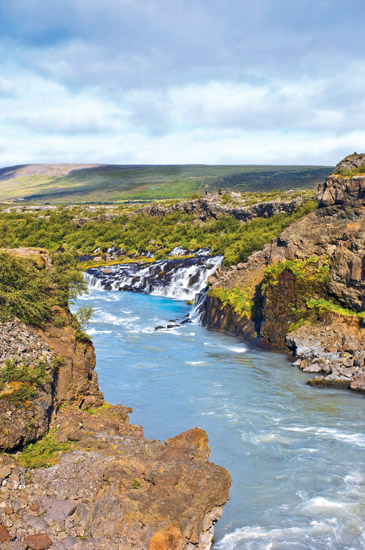
For years I’ve journeyed to faraway lands hoping to discover the real essence of things. Recently, in search of some of the best water on earth, I traveled to the North Atlantic’s remote land of fire and ice.
I traversed Iceland’s lunar landscape for hours by jeep over winding dirt roads flanked by lava fields, volcanoes and glaciers before reaching the source—a fjord on the island’s west coast. Some of the world’s purest water—that which goes into Martin Miller’s Gin—bubbles up through black lava rocks.
Unlike Kentucky bourbons or single malt Scotches, white spirits rarely have much sense of history or place. In its Icelandic water, Martin Miller’s Gin, though, soaks up its fair share of Viking lore and terroir. “The water, from a melted glacier, has been filtering through lava rocks for some 800 years,” explained David Bromige, the gin’s founding director, standing near a waterfall just above the source. “Most water that goes into spirits is de-ionized, lifeless. This naturally filtered water retains its vivacity, its surface tension.”
The late Martin Miller who inspired the gin was an eccentric character who owned antique shops and boutique hotels in the U.K.—and drank London dry gin like it was the water of life. Hoping to reinvigorate the gin category, he hired Bromige (a spirits maestro) to craft a London dry-style gin but with softened botanicals. Bromige devised a double distillation process, first distilling the earthy botanicals—juniper berries, cassia, coriander, Florentine angelica—and then, in a separate distillation, adding dried citrus peels to the mix. He married the two distillates for 10 days before shipping them off to Iceland for bottling with its crystal spring water.
“Younger consumers don’t tend to like juniper because it smells like their grandmother’s bedroom,” Bromige said. “We wanted to make a gin that vodka drinkers would like.” His company’s CEO, Jacob Ehrenkrona, picked up the thread: “We strove for a subtle balance so the earthy juniper notes are in harmony with the citrus notes. It’s the perfect balanced gin for a great gin and tonic.”
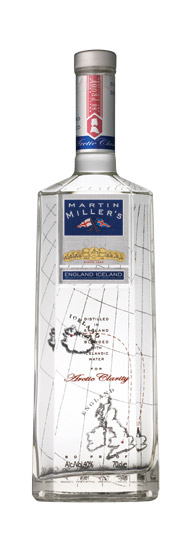
I tasted several gins neat side by side, and the other brands with demineralized water felt heavier and flatter. The Icelandic water gave the spirit a surface tension and also softened the alcoholic burn.
In recent years, more producers of vodka rather than gin have pushed water quality as a selling point. Reyka Vodka uses the same pure Icelandic water as Martin Miller. Beluga Vodka claims water from the most crystalline Siberian source (from a 1,000-foot artesian well). Purity Vodka touts its balanced mix of chemically treated and mineral-rich natural Swedish water, while Leaf Vodka boasts its Alaskan glacial source.
One spirit, though, claims to use the rarest most precious waters of all—and charges an exorbitant price for the pure water luxury. For its Elit “pristine water series” ($3,000 per hand-blown bottle), Stolichnaya sent water scouts to the far reaches of the earth. The Himalayan edition uses water from melting snow filtered through countless layers of rocks in the Himalayas. The New Zealand edition features Blue Spring water that keeps a mysterious blue tint and flows through the Mamaku Range. In the Andean edition (250 bottles), you’ll find water from a natural spring flowing from Colico Lake in the Andean foothills in southern Chile.
Pure water produces some very fine finished products—in those bottles of Stoli and in Martin Miller’s Gin, certainly. It also gives these white spirits, finally, a great story to tell.
