


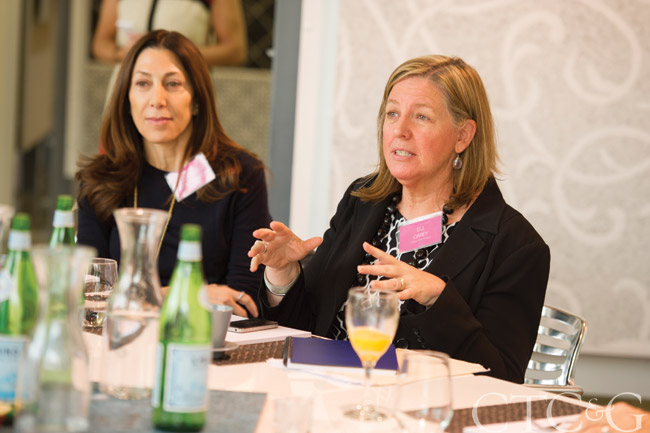
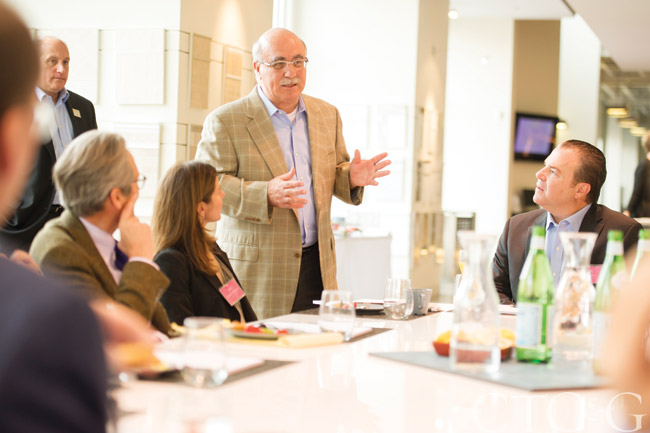
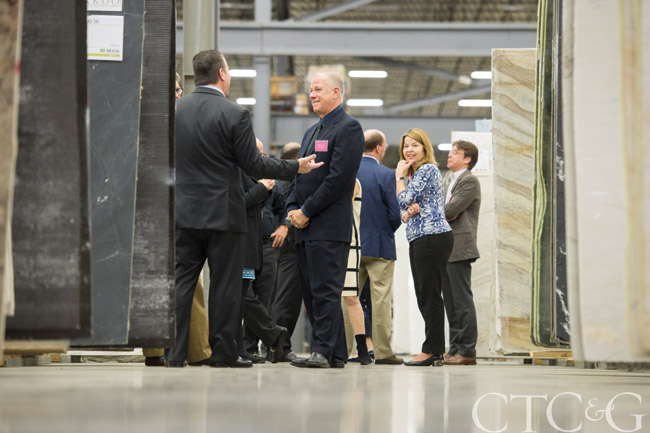
Leading voices in architecture and design gathered recently among the beautiful slabs at AKDO’s Bridgeport showroom to chat with CTC&G about the industry’s state of affairs—particularly in the realm of surface materials. Cottages & Gardens Editorial Director D.J. Carey moderated the discussion and posed questions to the panel.
What are you seeing out there in architecture and design, style-wise, in Connecticut?I s it still traditional?
Bob Tucker: I think on the interior, clients are leaning toward contemporary—with less “stuff.” But with the exterior, people in Connecticut can be afraid to be less traditional.
Jennifer Cohler Mason: It’s transitioning; updated classics. Keep the integrity or shell of a traditional house and update it. Like these mirror-infused tiles, for example—they look fresh and new. People are looking for that.
What’s the difference between modern and contemporary?
Jonathan Wagner: Modern is deeply rooted in the mid-century movement.
Bob Tucker: The term contemporary has been polluted. I’m often afraid to use it. But when you use the word modern, people have a clear view of what you mean. They think of the Glass House.
Jonathan Wagner: And I think there’s more open-mindedness among clients toward modern architecture, versus contemporary. I’ve considered myself a modernist for many years, but no architect in this area could survive doing modern exclusively.
Two rooms that can be totally modern in any house are the bathroom and kitchen. Do you agree?
Jonathan Wagner: The problem is that a house isn’t a series of vignettes, and that’s how a lot of them are treated. If a dialogue between an architect and a client leads to wanting a contemporary or modern house, then follow it all the way through. Go for it! We should be able to design something in the spirit of today. I believe modern houses can fit very nicely within certain neighborhoods in Fairfield County.
What percentage of the surface materials that you are specifying are organic versus engineered?
Paolo Vicente: There’s a mix. People like the organic feel of reclaimed wood, for example, but prefer manufactured materials like Caesarstone for their low-maintenance qualities. It’s probably about 25-percent organic.
Sam Mitchell: It’s not just maintenance. Many are becoming more and more open to the aesthetics of manufactured materials. I think some of it comes from fashion, like the high-tech, engineered materials that we’re wearing all of the time. We don’t always wear wool, silk or cotton.
Jennifer Cohler Mason: It points to form versus function. Many high-end clients want low maintenance in the kitchen and bathroom so they can easily clean with Clorox. You don’t have to worry about red wine or lemon stains. One of the materials I use a lot for vanities and kitchen countertops is Glassos. It looks beautiful and is indestructible. It’s a balance.
Does marble have more cachet than engineered materials for your clients?
[Collective yes]
Chris Pagliaro: I think the advancement of manmade materials has pushed creativity within natural materials as well. Slabs today are as interesting as art.
Bob Tucker: There are many more options. It used to be either polished or honed finishes, but now there is the new leather and velvet finishes that we were looking at today.
How much of your work is custom?
Jennifer Cohler Mason: Our clients don’t want what the neighbor has—they want what’s happening tomorrow.
Amy Aidinis Hirsch: They want what’s in the magazines.

Guilty as charged! Do you come into a place like AKDO with a set idea or looking to be inspired?
Mac Patterson: I come in with a set idea, knowing what stone or color I’m looking for, if I want marble with a strong vein, or something that’s monochromatic.
Chris Pagliaro: I see AKDO like an art gallery. I take clients here without any preconceptions. I ask, “Do you see a painting?” If something strikes them, let’s put it on a wall! We can design around it. That’s the beauty of the products AKDO has to offer. I don’t take notes; instead I feel out a client’s reaction.
Do you personally shop the market often?
[Collective yes]
Suzanne Eason: I come from the fashion industry. Walking into someplace like this is like walking into a fabric house! When you’re out in the market, it can be—dare I say—trendy, but when you come here, things are special and can be recombined. I’m mindful of the project at hand, but always keeping the future in mind. If I see things I like, I file them away.
What’s the “it” surfacing material?
Amy Aidinis Hirsch: Clients ask for Calcutta gold, but it comes with a high price tag and a lot of maintenance. But they can have preconceived ideas that Caesarstone is less expensive, and it’s not.
Jonathan Wagner: That’s where composite materials come into play. You can’t always get the gigantic size in certain stones, but composites can offer large sizes that are seamless. You can do waterfall edges, and there are a ton of color options. Conversely, you can put a hot pan on granite, and you can’t do that with a synthetic.
What about durability?
Chris Pagliaro: The oak floors/granite countertop combination became popular because of its indestructibility. People want Caesarstone because of its alleged indestructibility.
Amy Aidinis Hirsch: I love the jet mist—black with a white vein. It is indestructible. You can put lemon on it, and it’s fine! Or sometimes there is maintenance, but if you love the product enough, it’s worth it.
Mac Patterson: We always try and make a case for patina. It gets used. It’s a working space. It’s not like using the telephone; you cook on it!
I’m seeing a lot of mosaics. Is this a trend?
Chris Pagliaro: Technology has helped. The mosaic isn’t necessarily a million little pieces anymore. There are bolder patterns; you can have fun with it! You can adjust the scale, etc. It becomes art, and can be a statement surrounded by simplicity. It’s something that’s changed in the past 10–15 years.
How important is pricing?
Jennifer Cohler Mason: It’s a balance.
Bob Tucker: It’s our job to be editors of what the client wants. We’re taking all of the clients’ ideas, trying to figure out what’s most important to them, and helping them deal with the compromises they have to make. In the end, a house should not reflect just the architect, but it should reflect its owner.
