


HC&G: Private Gardens of the Hudson Valley [Monacelli] is your second book as a photographer with garden writer Jane Garmey. What made the two of you choose the Hudson Valley as your subject?
JOHN M. HALL: This book fills a niche in the same way that our first book, Private Gardens of Connecticut, does. As in Connecticut, the homeowners whose landscapes are featured are really passionate about their gardens and the region overall.
Were you already familiar with the area?
I know the Hudson Valley pretty well because a lot of people I know started going there in the ’90s, and I was doing some interiors work with them at the time. It’s where sophisticated, creative people were going, and it’s much freer there. It’s a hippie place—I mean, that’s where Woodstock is! And the history is so rich, with period French and Dutch houses and robber baron mansions built when the railroad was coming through.
What’s distinctive about Hudson Valley gardens?
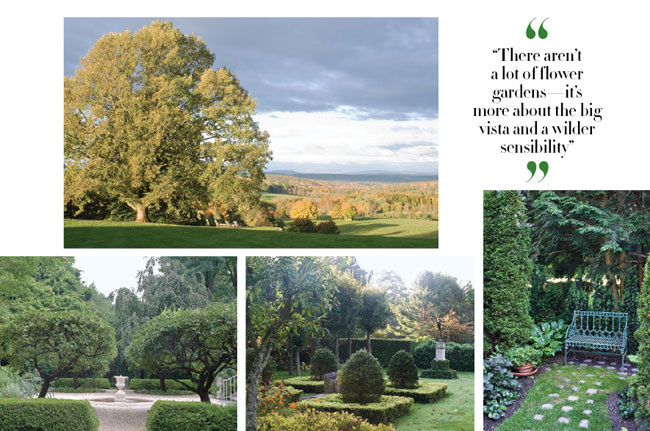
There aren’t a lot of flower gardens. It’s more about the big vista and a wilder sensibility—it’s not manicured and European. And then there are people like Dick Jenrette, who is so knowledgeable about 19th-century classical architecture. He bought his house, Edgewater, from Gore Vidal, a wreck that he restored beautifully. It’s complemented by a sublime 18th- and 19th-century garden.
Why should people plant elaborate gardens today?
As fragmented and disjointed as society is, the earth is still a big deal, especially for educated, wealthy people who think that the world is being encroached on. Some of these homeowners have that sense of social consciousness; some are retired and have that back-to-the-land ethos. It is a way to connect, and it’s very satisfying to get your hands dirty.
What’s the most surprising thing you came across while researching gardens for the book?
A property in Millbrook with boardwalks through the wetlands—it’s a great feature. And a rock garden with little species delphiniums growing in the most hostile environment.
What makes a successful garden?
One that respects its site and the natural environment. Planting a rose garden in Phoenix, Arizona, is just stupid, and trying to have crape myrtles in Montauk is just plain wrong! Most of the gardens in the book adhere to this notion, although I do love people who take chances, like Richard Eagan, who has a garden where pokeweed is popping up everywhere.
How did you get into garden photography?
I studied architecture and ended up hating it, but I loved taking photographs. I lived and worked in Paris for a while, then came back to New York and began shooting interiors, which led to an organic segue into garden photography. I like doing it because no one bothers me. I’m up shooting at five a.m., when the light is right. No one wants to get up that early!
