


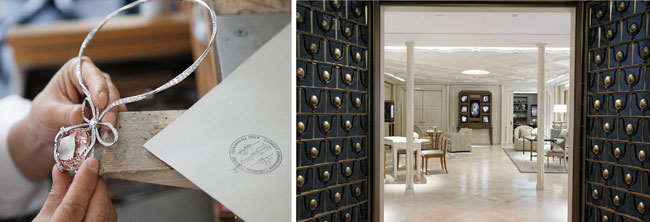
For 175 years, Tiffany & Co. has made hearts flutter
and beat faster with the help of its iconic blue box tied with a white satin ribbon (red satin ribbon is used during the holidays). Founded by Charles Lewis Tiffany in 1837, the store started out on lower Broadway. In 1940, after several moves, it settled into its present location at 727 Fifth Avenue at the corner of 57th Street and began to sell more than just its namesake diamond rings. During Tiffany’s reign, the company acquired many important jewels, and Mr. Tiffany was dubbed “The King of Diamonds” by the press and his society clients. Today, Tiffany & Co. has 250 boutiques worldwide.
What is the origin of Tiffany Blue, the distinctive robin’s-egg color that graces all things Tiffany? Turquoise was a popular gemstone in the Victorian era. And that iconic shade of blue was selected by Mr. Tiffany for the cover of his Blue Book, the company’s annual brochure of exquisite jewelry that’s still published today.
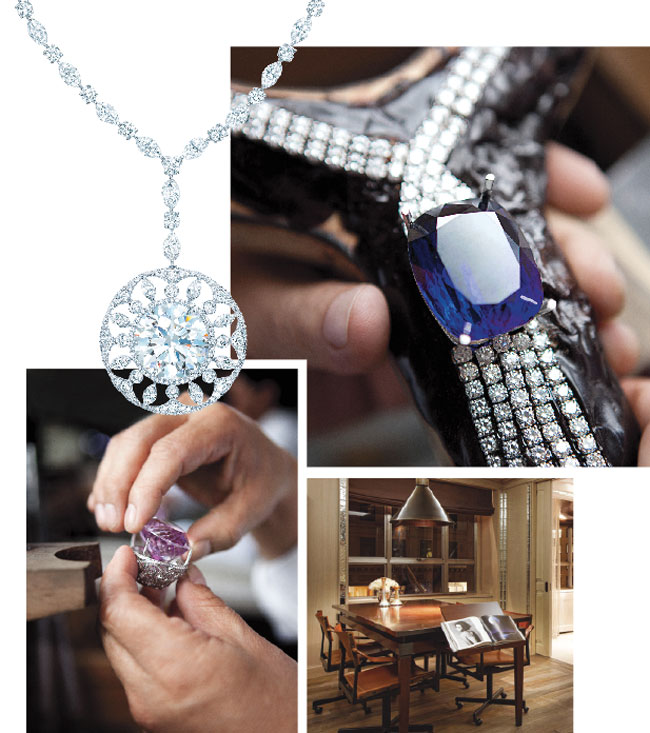
The elegant flagship store is the location of Tiffany’s high jewelry atelier, where statement pieces are literally handcrafted by an in-house team that includes nine jewelers, three setters and two polishers. High jewelry, or statement jewelry, generally features precious gems of at least five carats that are graded as close to flawless as possible. All of the one-of-a-kind and statement pieces are produced here in a light-filled workroom, several stories above the main floor. Gemstones are sorted, set in gold or platinum, with or without other stones or pavé diamonds, polished and made ready for display and sale. Here is where the sketches and designs from the archives, such as those by Tiffany’s own legendary high jewelry designer Jean Schlumberger, come to life.
Statement pieces are also designed around one particular, large-carat gemstone, like a 12-carat Tanzanite, or a 20-carat emerald, as Tiffany acquires them. One craftsman works on a piece from beginning to end. This can take days or weeks until the final piece is deemed perfect and ready to sell. Pieces can take up to two years to finish, based on procurement of gemstones, and this is all accomplished by Tiffany’s team of in-house designers, who are always on call and available to design one-of-a-kind pieces for clients who travel to New York.
Several floors below the workroom is the recently opened Tiffany Salon that displays and sells the same unique jewels that are produced upstairs. Basically, the jewelry moves between floors. This jewel of a space was designed by Robert A.M. Stern Architects and is the only salon of its kind in the Tiffany universe.
The 2,900-square-foot salon resembles a 1920s grand residential- style apartment. Visitors are greeted by double doors of cerused ash inlaid with a patinated bronze pattern inspired by famed Tiffany window designer Gene Moore’s display of eggs resting in crystal goblets. “The salon design takes its cues from the grand traditions of Coursier, Fontaine and other great decorators of the Empire and post-Napoleonic era in France, refined to reflect 21st-century elegance and glamour,” says Paul Whalen, a partner at Robert A.M. Stern Architects.
Furniture crafted by artisans working in the New York area, along with fabrics, wall coverings and carpeting in a soft color palette of grays and blues accented with pearl and platinum tones complete the look. There is even a library where Mr. Tiffany used to sketch his designs, as well as a dressing room in cool light blue where clients can model the jewelry.
Tiffany’s diamonds have their own unique path to beauty. In 2003, the company opened Laurelton Diamonds, a cutting and polishing center located in northwest Canada. According to Tiffany & Co. Chairman Michael J. Kowalski, this wholly-owned subsidiary provides an important link in the supply chain of Tiffany’s sourcing and supply of diamonds that are used “mêlée” or micro pavé and in the larger carat statement pieces that are made in the upstairs workrooms.
How did Tiffany mark its 175th anniversary? Craftsmen reset the famous yellow Tiffany Diamond—a 128.54-carat stunner, originally purchased in 1878 by Charles Lewis Tiffany. The new setting includes more than 100 carats of brilliant white diamonds and was returned to the main floor for permanent display.
