


The first order of business was removing a 1970s addition from the back and a badly done porte-cochère that hid the classic front porch. “Once that was gone, you could see the building,” he says. “The only thing that hadn’t been beaten on was the front staircase. The rest we stripped down to the studs.”
The goal was to restore the house’s graceful lines, while simultaneously adding complementary spaces to meet the needs of an active family. “We wanted a house that we fit in, but wasn’t so huge that we never saw anyone,” says the wife.
For the more formal rooms, Patterson’s improved floor plan took advantage of existing spaces. A former parlor is now a wood-paneled billiards room. The dining room regained its original shape; it is now connected to the living room through matching portals. “During the demolition, we discovered they’d been there at one time,” says the architect. “We made these tall and skinny to make it feel very vertical.”
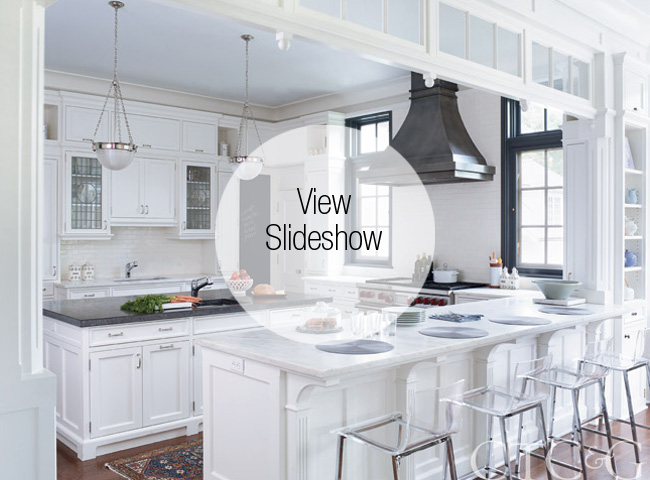
A new addition in the back includes an open kitchen, breakfast and family room. There are five bedrooms on the second floor, including a reconfigured master, and two bedrooms and an office on the third floor. Throughout, Patterson incorporated custom millwork and Victorian-era detailing, which changes slightly from room to room. “It gives each one a different feel,” he says. “Then, as you move from the front rooms to the back, you keep the same vernacular, but you take it down a step.”
When it came time for the interiors, the homeowners called upon the design expertise of Jane Capellini. “I wanted to create a comfortable, timeless home that bridged the historical structure and the client’s youthful lifestyle,” she says. To that end, Capellini chose a calm, but sophisticated palette—gray, beige, cream and khaki—then introduced pops of color. And not just any color: “The client loves green, orange and purple,” says the designer.
High on the priority list was making every room kid and dog friendly. Equally important, the homeowners wanted to reuse the lighting fixtures—some original and some added over the years. “We spent months and months just on the lighting alone,” Capellini says.
To add visual and textural punch, she incorporated a mix of metals, fabrics and accessories throughout the home: pewter and polished nickel, grasscloth and linen, leather and bamboo, antique velvet and vinyl. “I believe the design of a space is all about layers,” she says. “Details are essential to keeping it intriguing and not cookie cutter.” In the living room, the client’s own lime-green sofa inspired the elegant but playful tone; custom club chairs are covered in green with a wide stripe; the silk cream draperies are trimmed with little green glass beads and bells. A pink vintage over-dyed rug in the dining room anchors a traditional table and chairs. The family room’s bamboo Roman blinds and stools offer a modern twist on a Victorian staple.
In the light-filled breakfast room, Capellini created a custom tack board for the children’s artwork. Comprised of geometric linen squares, it hangs to the right of the table, and it is one of the wife’s favorite details. “People comment on it all the time,” she says. “The whole bulletin board makes it feel like a family home, rather than just another designed house.”
