


Here’s what Ryan Salvatore of Burr Salvatore Architects wants you to know…

This pool house is fashioned from the same materials as the main residence. “It was located as close to the shore as we could put it,” says architect Ryan Salvatore.
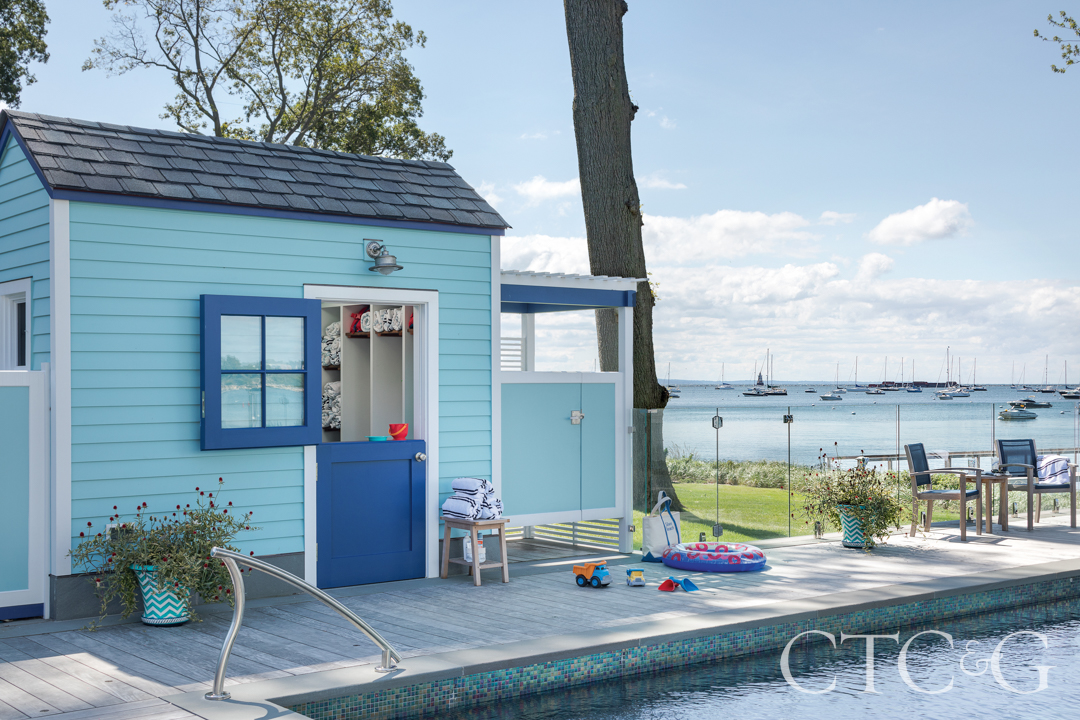
This pool house continues both the architectural style and palette of the other buildings on this waterfront compound.
1. The pool house does not need to look like a miniature version of the main residence.
“We almost always think the pool house is an opportunity to make a conscious departure from the style of the main house. Sometimes when the pool house feels like a mini main house, it can seem too matchy-matchy,” Salvatore says. “If anything, we look to the pool house as a foil. It can be a folly in the landscape, rather than a little sister to the main house. And let’s be clear—the guest staying there should know they are not the king of the castle!”
2. On that note, consider keeping it small.
“We would probably declare that too often they’re too big and they look like a scaled-down version of the main house. It’s not so much a size issue, though, as it is an identity,” Salvatore advises. “It needs to be differentiated and less serious.”
3. Take the property’s setting into account.
“Waterfront pool houses tend to be more casual, perhaps because they take a beating from the elements and are thus conceived more as cabanas that can be seasonally boarded up, rather than miniature houses,” the architect shares.
4. You will need to follow local regulations.
“Towns often limit building heights, what amenities they can include, and size. Satisfying a program within those restrictions can be a huge challenge,” Salvatore warns.
5. Be intentional with materials used.
“There are always new building materials and technologies that permit us to achieve design ambitions more richly. The key is to use them in sensible ways that do not objectify the possible,” Salvatore says. “We are interested in timelessly beautiful outcomes, not those that reek of the here-and-now.”
