


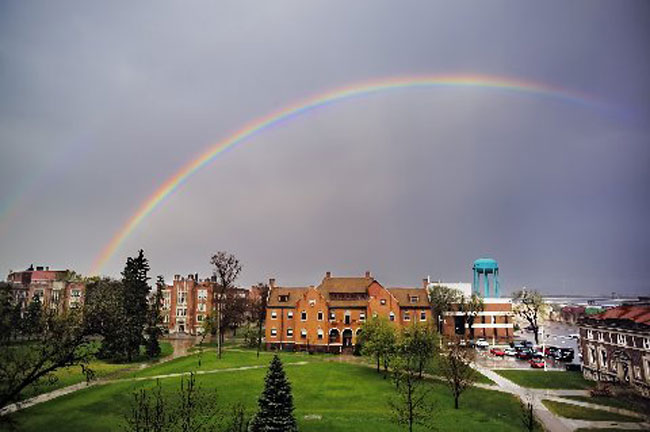
There is plenty of room for a rainbow in the North Dakota sky
Situated in the remains of a glacial lakebed, the plains of eastern North Dakota are perfectly flat. Except for an occasional line of windbreak trees, the lush greens and golds of wheat, potato, sugar beet, corn and sunflower crops barely show up as a narrow band straddling the horizon. Seven-eighths of the world is sky. No wonder that air services have risen to play a prominent role in the region.
Like the renegade pilot trying to mow down Cary Grant in “North by Northwest,” crop sprayers were an early utilization of flying machines. Then in the 1960s the Air Force moved in. The Grand Forks Air Force Base, named for my hometown and sited partially on the land where my grandparents raised wheat and my uncle George used to milk his dairy cows, became one of the front lines in America’s system of defense.
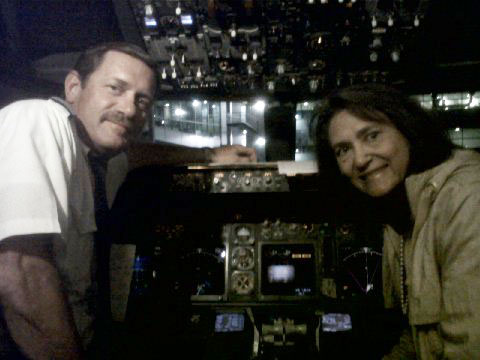
Visiting Captain Craig Rheaume in the flight deck of the Sun Country flight from New York to Minneapolis
Another relative, my cousin’s son Craig Rheaume is a pilot now for Sun Country Airlines. Occasionally he’s assigned the route back and forth from Minneapolis to JFK, and I arranged to go back home as one of his passengers on a recent flight. Paged to the boarding gate in terminal 4 by Captain Rheaume, I was hugged and invited to visit the flight deck where I met co-pilot Robin and helpful flight attendants Linda and Beverly. It was a kick to hear a familiar voice announcing our take-off and landing.
Back on the ground, during the five hour drive back from Minneapolis to North Dakota, Craig, a former farm boy, told me how he learned to fly at the University of North Dakota with the intention of spraying his own crops. Eventually he specialized in weather modification—a harrowing job that requires flying through storms to seed the clouds to suppress hail and increase rain.
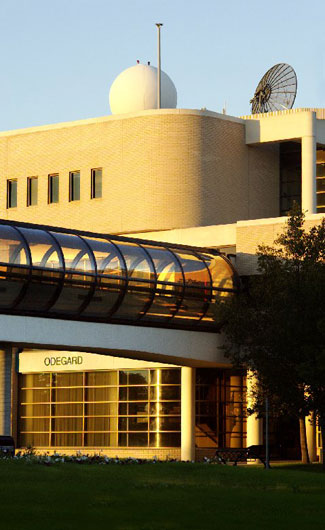
In 1961 he got his BS degree in Aeronautical Sciences and Geography at the university’s Odegard School of Aerospace Sciences, which offers an exceptional, unusual education in aerospace and related sciences. The full curriculum is overwhelming. Besides pilot training, students can work toward a Master of Science Degree in Space Studies where they are taught about planetary science, space engineering, life support systems, space policy, law and history.
The program in atmospheric sciences focuses on cloud and climate change, satellite remote sensing, radar meteorology. Sustainability is the focus of another degree in Earth System Science and Policy.
pictured above: The University of North Dakota’s Odegard School of Aerospace Sciences
All this is offered on a campus with attractive red brick buildings and active Greek sororities and fraternities lining University Avenue, a block away from the street where I grew up.
Never mind temperatures that can hover around zero degrees in the middle of winter.
The weather is often a source of jovial contention for Air Force men who find themselves stationed 16 miles west of the university at the 5400- acre GF Air Base. Originally a home to the Strategic Air Command, the base’s mission evolved to safeguarding the anti-ballistic missiles installed nearby. Since the 1991 Strategic Arms Reduction Treaty eliminated some of those warheads, the base has become part of Air Mobility Command providing humanitarian support—airlifting, aerial refueling and aeromedical evacuations—for all U.S. armed forces. Reconnaissance Global Hawks are also stationed there.
I was in high school when the base opened in 1957, bringing all sorts of new, diverse friends and influences to the community. In a way it made my hometown more cosmopolitan. Yet I still remember a balmy summer afternoon, long before the concrete runways were laid, when my grandmother taught me to recognize the call of the mockingbird while we sat picnicking from her yellow basket beside the little converted railroad cook shack that served as their farmhouse.
Less than an hour’s drive from the base, lying between two farm fields near Cooperstown, the Ronald Reagan Minuteman Missile State Historic Site preserves one of the launching sites for America’s weapons of mass destruction. Above ground behind an 8-foot high fence, a simple one-story building designated Oscar-Zero housed the missile support staff. Visitors see the kitchen, bunks, and pool table accommodations that served the teams stationed there to protect and potentially monitor the launches of 60-foot high ICBMs with nuclear warheads.

Steel and reinforced concrete blast doors protected the underground launch facility and equipment rooms protecting and monitoring ICBM missiles.
Thirty feet down behind 2-foot-thick concrete and reinforced steel are cubicles that housed the generating equipment and the Launch Control Center where two-man crews were shut in for a day at a time at the ready to employ twin keys that would set off the missiles if the command was phoned in.
A few miles south at the remains of an actual “silo,” visitors can view the support security system and the massive blast door the missile had to shoot through in order to release. Although there has been a scale-back, three Minuteman fields still are operative—150 nuclear missiles on alert in North Dakota, Montana, and Wyoming. The others were shipped to California and imploded.
Ambassador John Kenneth Galbraith used to say that if North Dakota were a country, it would have been one of the biggest nuclear powers in the world. But locals recall that on two occasions when the Air Force scheduled demonstration shootings of the missiles, they failed to fire. I once asked my father why he wasn’t nervous, living so close to all those munitions. “Honey,” he told me, “we never worry. We never worry because we know they never work.” So far we have been so lucky that we’ve never had the chance to find out.
