


Drawing inspiration from vintage textiles and graphics from the 1960s and ‘70s, Cristina Buckley imagines her career choice may have been different if she had not become a Schumacher-represented designer and collaborator. “I feel like if I had to do another job, I would like to be an archivist of textiles, which has such a rich history,” says Buckley, “especially at a place like Schumacher, where they worked with amazing artists like Paul Poiret and Josef Frank.” She continues: “There were so many different styles, art deco, and traditional, beautiful florals, I just love it.”
Raised in New York City, Buckley came by her love of graphic patterns early in life, influenced by her commercial artist patents. “My mother designed cosmetic packaging, and my father was a graphic designer who created advertising design and logos that aimed to convey certain messages when people looked at them,” referring to her inherent design philosophy. “There’s something about the purity of that I’m drawn to, as opposed to something more flowery or impressionistic.”

Upon graduating from FIT, Buckley began work as a set designer in film and television, where a passion for textiles developed and led to her first job in the industry at Schumacher. In 2005, Buckley began an impressive Los Angeles stint at Kelly Wearstler, where she created all of the brand’s home product collections. After launching her first wallpaper line in 2018, celebrating saturated color and bold graphics, Buckley took on the design director role for Schumacher’s textiles, wallcoverings, and furniture in 2020. Ultimately, her creative partnership with the iconic brand came full circle, when Buckley became her own exclusive representative in showrooms worldwide.
“My first collection with Schumacher was just wallpaper,” recounts the designer, “but after a couple of patterns (one of them called “Fancy Beast” depicting lattice with a leopard print background) we decided to develop into indoor-outdoor fabrics, as they had a very preppy Hamptons look.”
Now based in East Hampton, Buckley works out of her sunlight-filled home studio, walls adorned with inspiring mood boards. Beginning with an initial sketch, Buckley often consults her collection of vintage fabrics, wallpaper, and books to “spark some thought and get things moving,” making sure not to overwork a design.
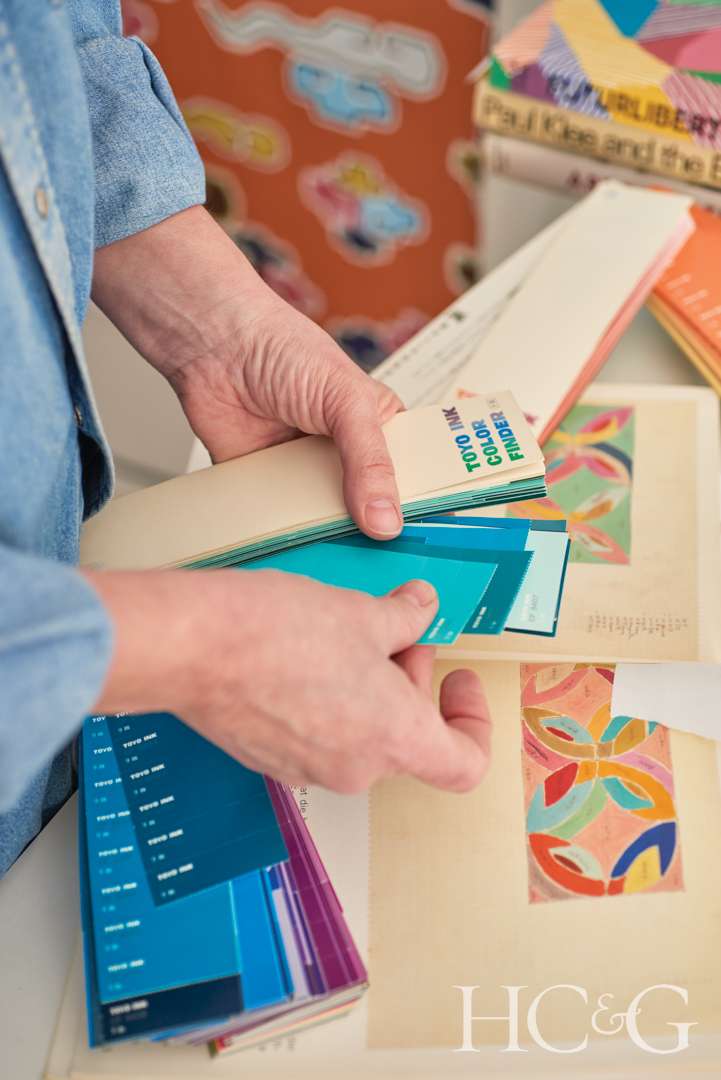
Buckley references a collection of color charts when designing wallpaper motifs.
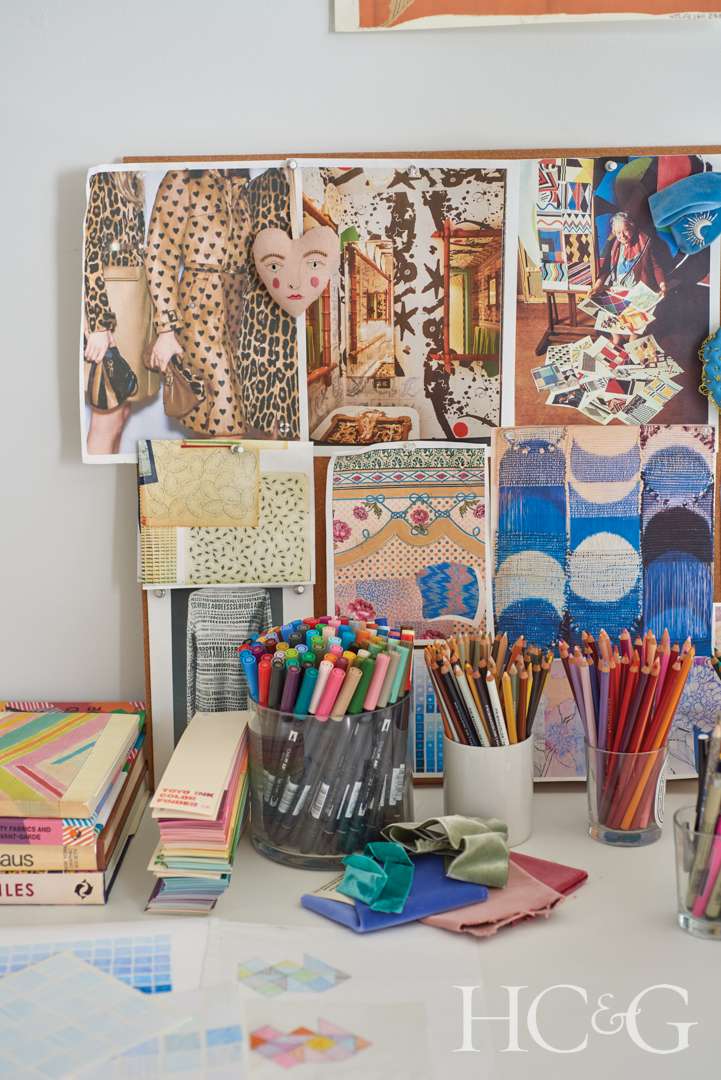
Tools of the trade, inspiring mood boards, clippings, and vintage fabric samples.
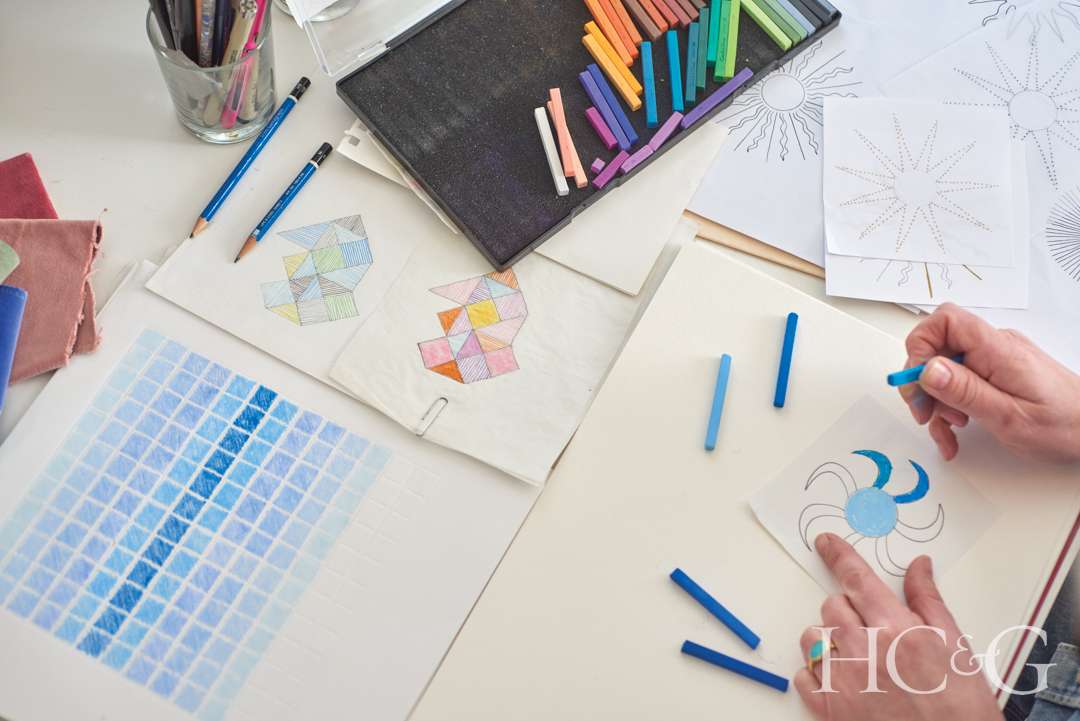
Old-school design techniques involve sketching and coloring graphic motifs on tracing paper.
“I find the initial doodle of something has the heart of the idea,” she explains, “and that’s why I save all of my sketches and tracings because they’re kind of vital.” Incorporating “old school” techniques, motifs, and shapes are drawn on tracing paper and then taped onto a piece of larger white paper to form a repeated layout. Buckley then tapes the early-stage piece to the wall to avoid any gaping negative space or obvious repeat in the design, allowing her to “step back from it and see if the scale and movement make sense,” while finding a balance between all those things. “Wallpaper design has strict technical parameters around repeat size,” she continues, “which can sometimes be creatively limiting.”
Once happy with the layout, the work is re-traced, and coloring begins, sometimes with pastel chalk.
“When I started in this field, everything was hand-painted, and you literally would do color combinations with gouache paint,” the artist recalls. “You had to be great at mixing and matching colors by hand, which is a talent unto itself.” Now, with the help of computer scanning, Buckley can adapt digitized layers of the motif shown in different color combinations, rotated, and scaled up or down.

“Once the final design is approved, Schumacher takes over the production aspect, selecting the best weaving mill or screen printer to send something to,” says the artist, “based on their capabilities.”
With a line of needlepoint pillows and a Tibetan rug-inspired printed velvet on the design horizon, Buckley seems to be venturing beyond the popular second coming of wallpaper, all stemming from a somewhat organic process. “At a certain point when I’m working, I have a pretty clear idea of what I want the final pattern to be,” she notes. “I’m kind of a quick decision-maker, so it’s a fairly fast process.”
