


When architect Christopher Pagliaro proclaims, “Glass, glass, glass!” hes not just echoing a personal mantra, but outlining the core philosophy behind his residential designs. Pagliaro believes the architecture of a home should not be confined by the walls that separate one space from another, but instead, should open up to create an unbroken connection with the environment. “I don’t believe that the wall of a house should be the wall of ones experience,” he explains. “I believe the wall of a home should be as far as the eye can see.”
Nowhere is this belief more clearly demonstrated than in the home perched on a property overlooking Long Island Sound he designed for a couple with four children. But while the property seemed ideal, having the desirable water views across the street instead of on the backside of the property posed a challenge. “The homeowners bought the site for the water, and I felt a responsibility to give it to them,” says the architect. “So I placed the structure diagonally and twisted the house to the views.”

The strategic orientation coupled with floor-to-ceiling corner and divided light windows emerged as a study in how glass can frame its surroundings. “I hate choosing which wall to look through, so the 90-degree corner window placement creates a panoramic experience,” he adds.
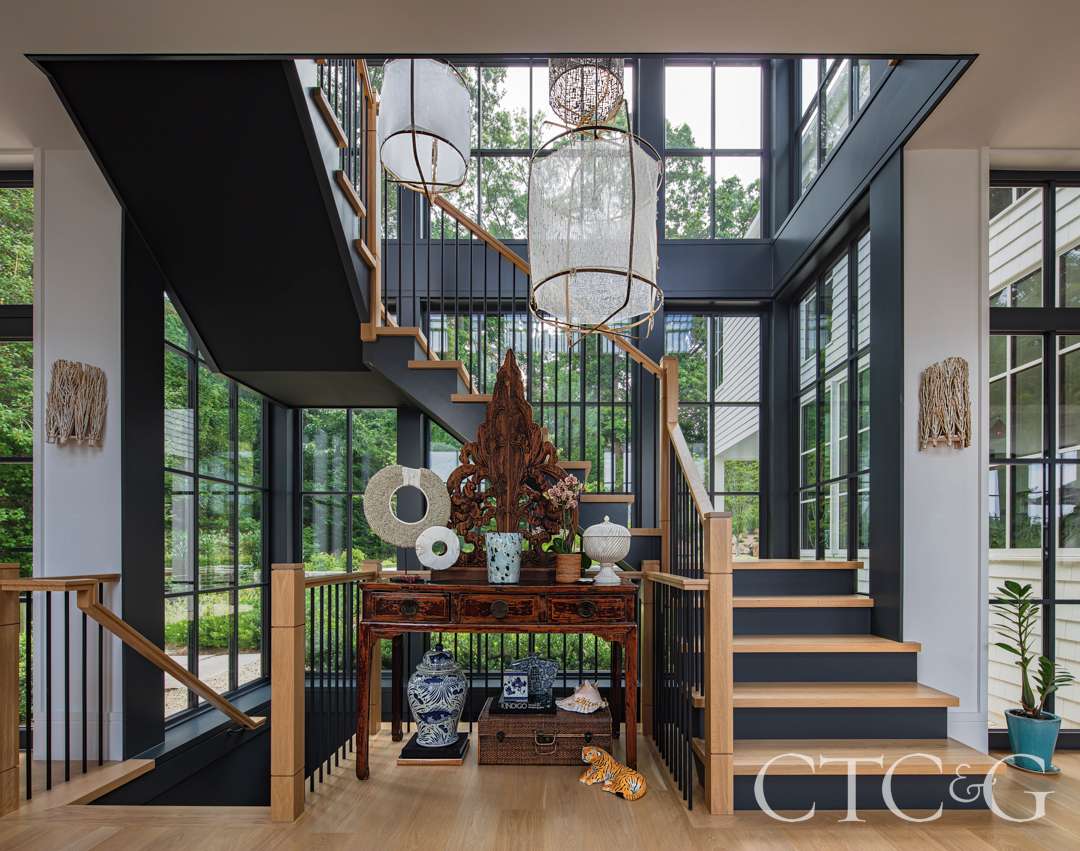
The non-oak parts of the stair are painted charcoal gray to link them to the outside. The silk and bamboo light fixtures are from Global Lighting.
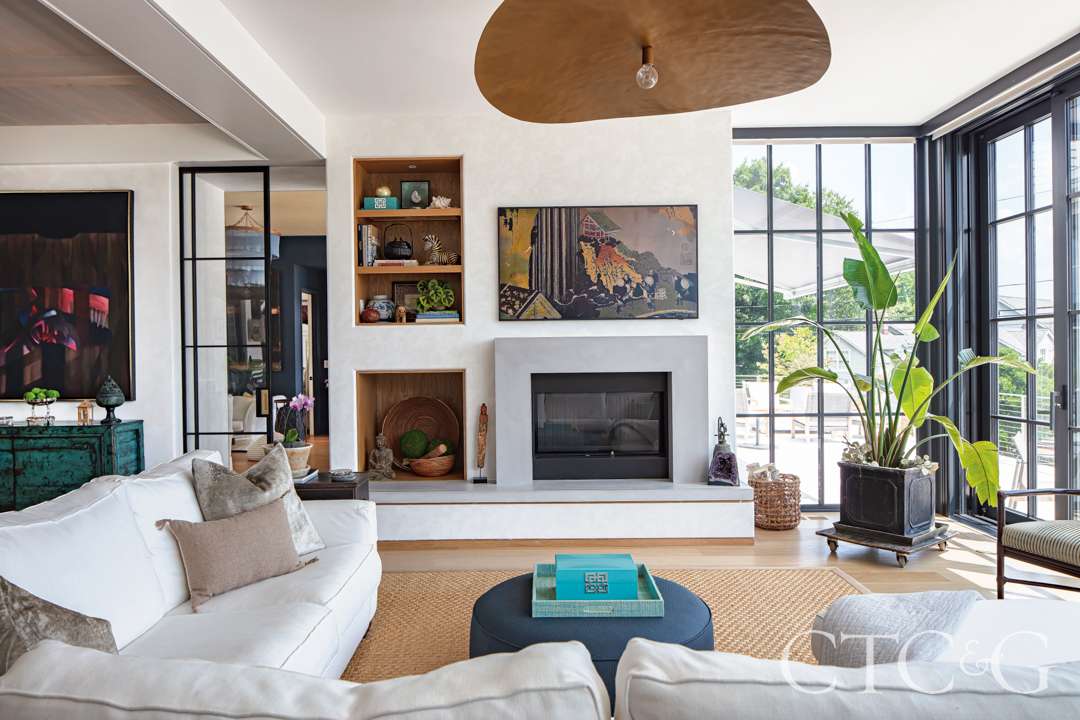
In the great room, a sectional was reupholstered in a performance fabric, and a new hammered-brass light fixture is from Banana Republic Home.
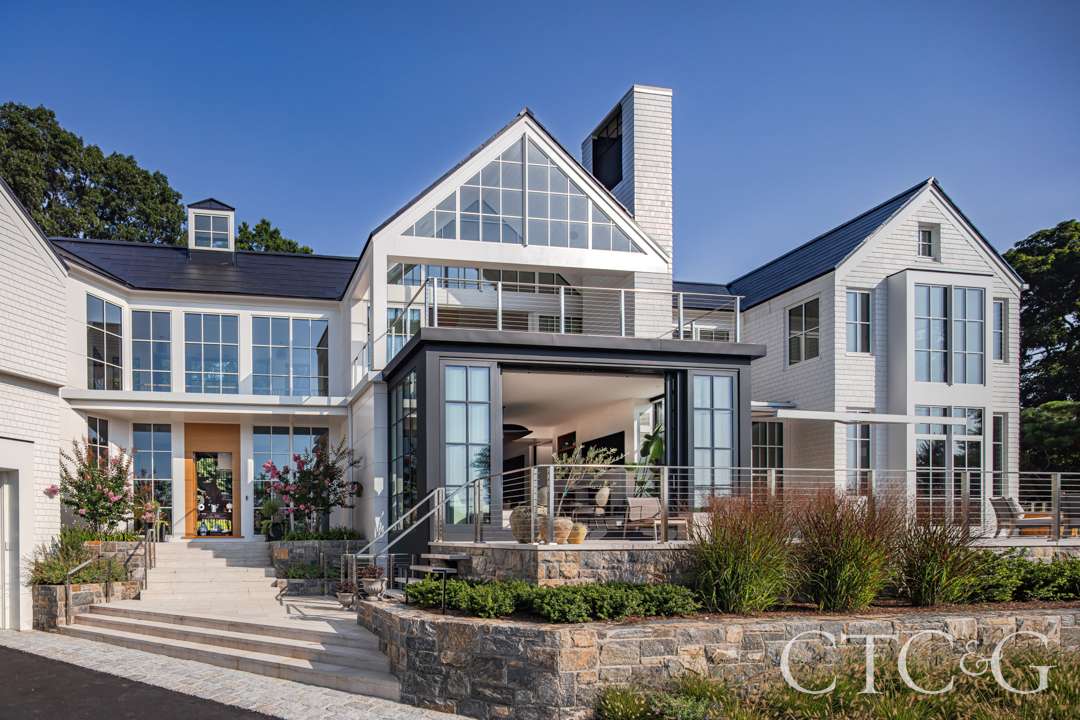
The home’s great room is housed in a charcoal gray extension on the front and the staircase similarly encased on the back exterior.

The marble island top and backsplash complement Shaker-style cabinets by Highland Woodcraft. Pendants are from Visual Comfort.
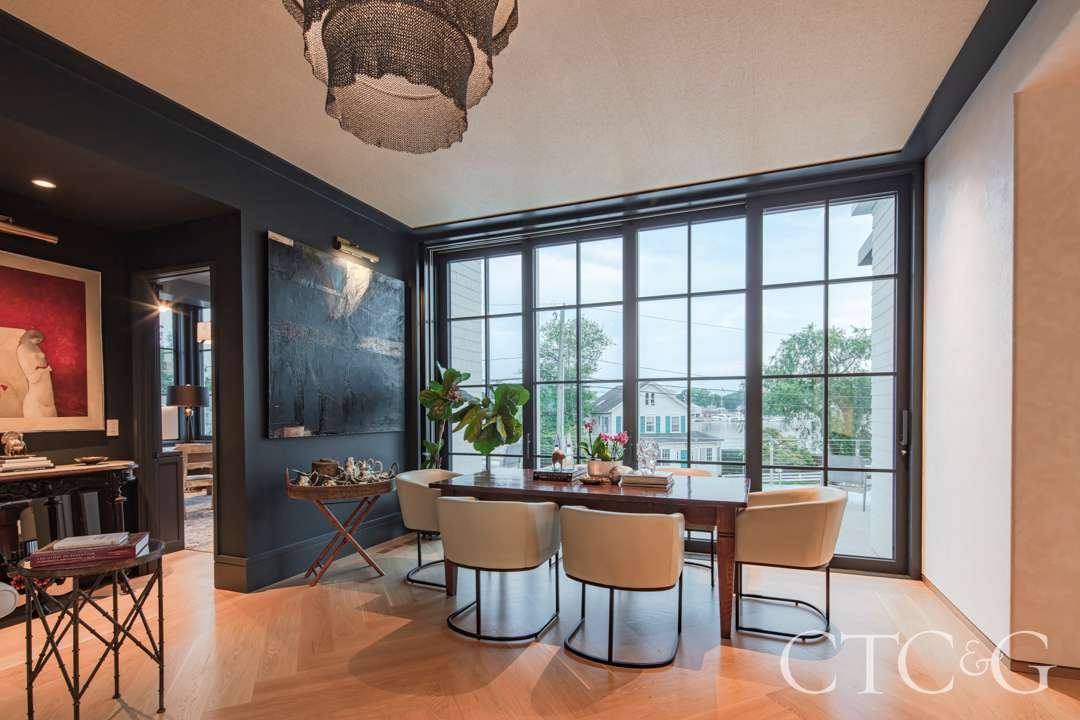
Artwork by Fernando de Szyszlo suits the tone of the room dubbed “the oasis.”
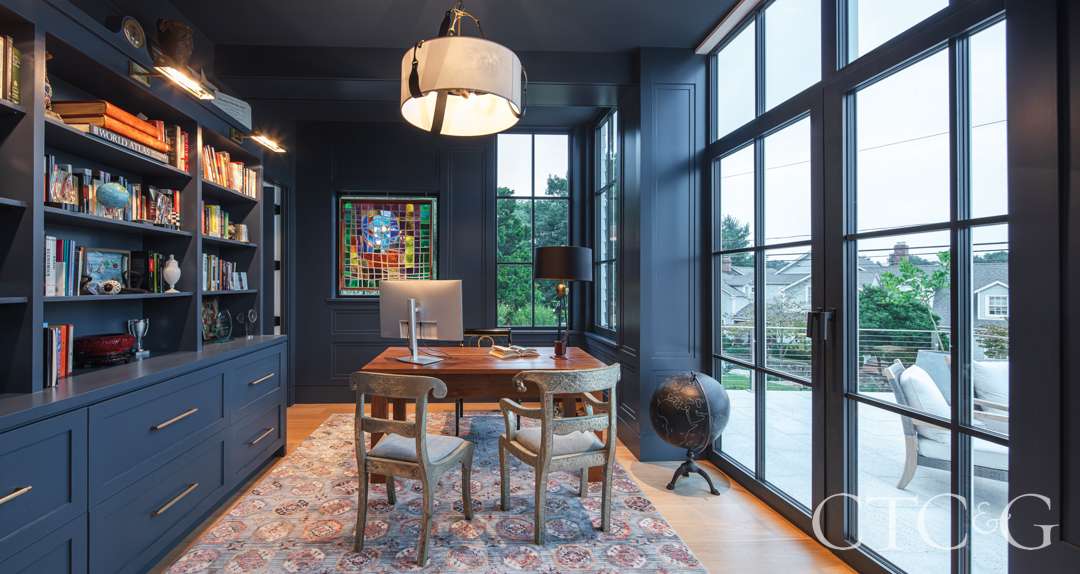
A Hubbardton Forge ceiling fixture through Chloe Winston Lighting Design illuminates the home office.
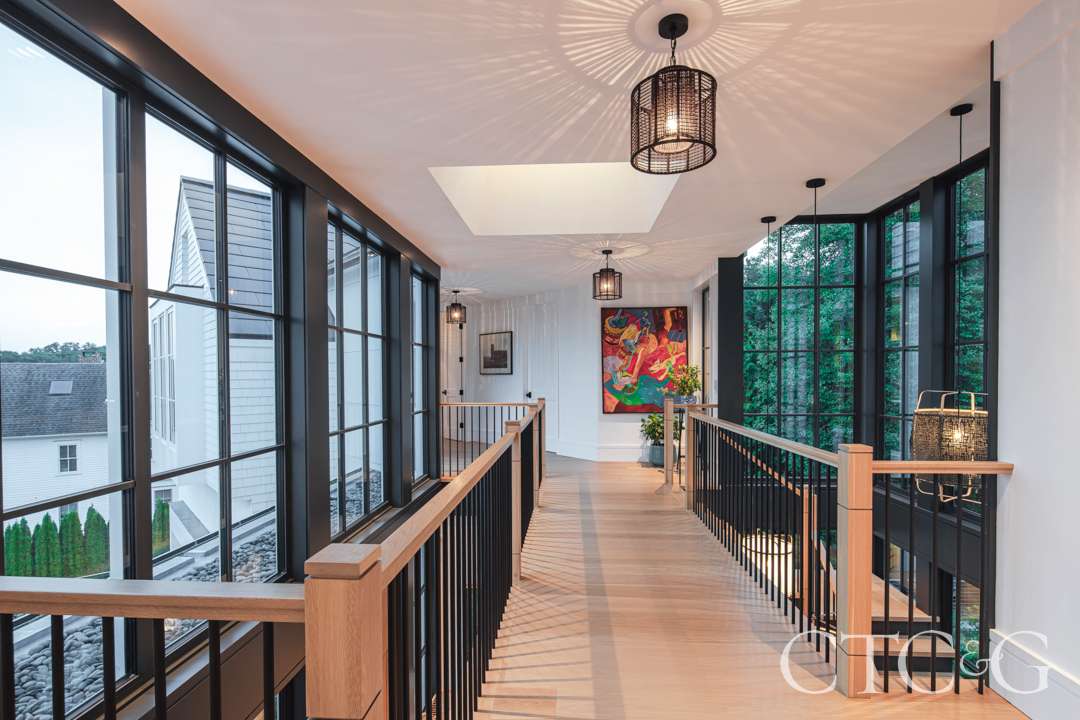
Transparency defines the upper-level hallway with water vistas on one side and garden. views on the other, while matte black Crystorama fixtures light the way.
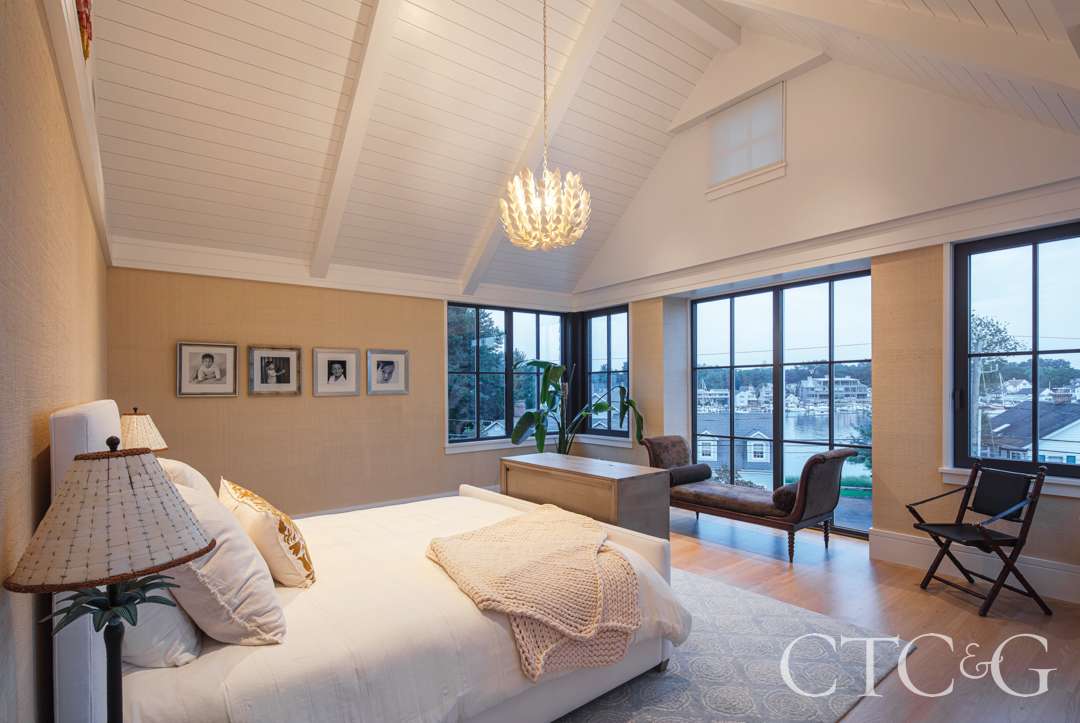
In the primary bedroom, a Palecek pendant illuminates a Serena & Lily bed, while Thibaut grasscloth adds texture to the walls.

When it came to the overall design, the homeowners—a sophisticated, well-traveled couple—wanted a home that was both contemporary and also reflective of their travels while avoiding the somewhat overplayed modern farmhouse concept. So in lieu of flat roofs and exposed beams, the architect incorporated classic New England shingle siding, which grounds the design in its location, with sharp geometric angles and expansive glass elements that mark it as something distinctly modern.
In contrast, the interiors had to be soft and intimate while accommodating the homeowners’ extensive collection of furniture and art. “People have commented that half the job was done for me because I already had furnishings to work with,” says interior designer Lauren Vallario of Lauren Vallario Designs. “But finding places for everything was really quite challenging, so I approached it like a puzzle and made sure pieces not only fit but that they were highlighted appropriately.”

An existing sectional reupholstered in performance fabric resembling soft canvas, for example, found new life as the great room centerpiece, and a carved Chinese sculpture emerged as a statement piece in the entry where it is backed by a switchback staircase completely encased in glass. By day, the upward ascension affords garden views and come evening, a trio of hanging fixtures—one black paper, one white cotton and one white silk, cast a soft glow.
“I mocked up those pieces and hung them from various places in the ceiling to get the placement just right,” says Vallario, noting she and the architect worked closely together on lighting. “Chris delivered a solid palette of recessed lighting, and I supplied the more decorative pieces like the black metal and brass fixture in the great room and the organic woven dining room chandelier.”

The duo also collaborated on creating intimate experiences within a larger framework with the architect-designed wood ceiling delineating the dining room, and Vallario’s choice of dark painted cabinets setting the kitchen apart. For cohesion, a lime wash finish on the stove hood and surrounding wall then repeats on the fireplace wall, as well as on the entrance to a hidden retreat dubbed “the oasis.” With its moody deep blue walls and grasscloth ceiling, the latter serves as both a social zone and a personal escape.
About the duo’s working relationship, Pagliaro says, “Lauren and I worked closely together, constantly refining ideas to ensure that every decision supported the overall vision.” The end result is a timeless, modern residence that feels rooted in its Connecticut surroundings while offering a sophisticated balance of openness and intimacy.
