


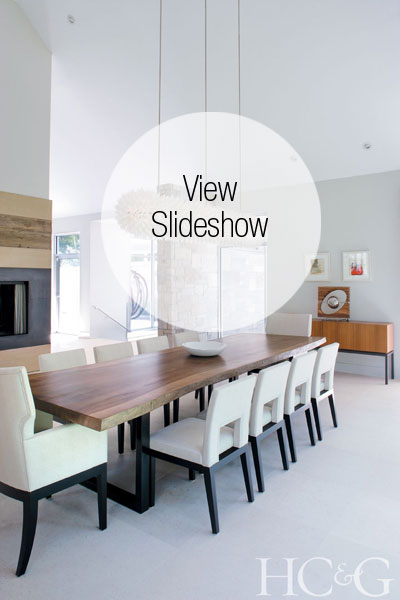
The sign at the foot of the drive reads “TMF,” code for The Modern Farmhouse, the name given to this East Hampton getaway by its adventurous, art-loving owners. Where once stood a simple red-painted wood structure, there are now three contemporary ones clad in Western red cedar, punctuated with sweeping panels of glass and trimmed in aluminum
Connected by breezeways, each pavilion serves a distinct purpose: relaxing in the one on the left, with guest rooms, sitting room and library; entertaining in the middle, the location of the formal living room, dining room and kitchen; and enjoying privacy on the right, where the master suite is situated. surrounding woods give all the rooms in the home a secluded feel, further enhanced by an inviting pool that almost seems to embrace the entire house.
The home was designed by architect Bruce Nagel, who describes it as a “landscape of linked structures reminiscent of those seen on farms,” and it appealed to its new owners on many levels, according to their new York–based designer and art consultant, Betty Wasserman. Having decorated five previous houses for the couple, including their primary residence in Manhattan, Wasserman instinctively understands their likes and dislikes. “They’ve always had great taste,” she says, “leaning toward the modern and becoming more discriminating over the years. Most exciting for me: They’ve really developed a deep commitment to building a first-rate art collection.”
Comfortable elegance suited for frequent entertaining was a specific mandate. Knowing the pair feels most relaxed surrounded by neutrals, Wasserman came up with a palette of cream, dove gray, pearl and variations of white to complement a color scheme dictated by the limestone floor and Van Tassell granite entry. The breadth of color is deftly captured in ten pillows—each a slightly different hue—arranged on the curved Vladimir Kagan sofas in the living room.
“We added splashes of color via some of the art, bathroom tiles and accessories,” says Wasserman. “But because the overall range is so restrained and the architecture equally strict, texture was of paramount importance, especially for the upholstery.” To increase interest, she combined several textures within different areas: a European walnut bench cushioned in Mongolian lamb alongside stainless steel–legged chairs in the sitting room; a wool shag rug and calfskin lamp shades in the master bedroom; and André Joyau’s driftwood-clad fireplace and swivel chairs covered in a Pierre Frey mohair in the living room. The drapes are made of Larsen’s sheer snowdrift fabric, which diffuses strong summer sun through its cloud-like puffs into lacy shadows. Wasserman’s insights as a fellow Hamptons resident served her well on the project: “i understand how the sun, changing throughout the day, affects color.”
To further soften harsh angles in the undeniably contemporary rooms, Wasserman also introduced distinctive lighting fixtures. suspended above the walnut slab dining table is a Helen Bilt chandelier created from hundreds of light bulbs; a cascade of cone-shaped lights shaded in Japanese rice paper—her conception, John Wigmore’s construction—illuminates the living room.
The designer’s art background led the couple to invest in some key pieces, including Gary Gissler’s word portrait, which hangs in the space between the living room and dining room. A trained psychotherapist, Gissler wrote words gleaned from conversations with the homeowners directly on the canvas, using graphite and ink on Gesso. some are large, others so small they require a magnifying glass to decipher.
The wall hanging by Soraida Bedoya in the formal living room is a porcelain rendition of shapes resembling bed coils placed on a linen ground. And the collection’s pièce de résistance is Joel Perlman’s oxidized-steel Seven Ponds II, in the poolside court-yard. “Wary at first,” Wasserman recalls of her clients’ reaction to the sculpture, “but there was no turning back after they reviewed a book of his work. Creating the perfect home for my clients while filling it with exceptional art has been a rewarding project. it’s a very cool ‘modern’ farmhouse.”
