


For a couple with two grown children, building the right home on a nine-acre site in Litchfield County was in part about preserving a family legacy that began two generations prior. “It was the husband’s grandparents’ property,” interior designer Dana Koebbe explains. “But the 1950s-style ranch that occupied the land didn’t speak to their lifestyle, which included hosting events and big family gatherings.”

The decision made to scrap the existing residence, the couple turned to architect Teo Sigüenza to craft a sophisticated country retreat devoid of rustic cliches that could eventually be passed on to their offspring. His response was a Shingle Style revival with a strong sense of place. “This house couldn’t be in Montana or Florida,” says Sigüenza, who incorporated classic gables and shed roofs and used materials like Alaskan yellow cedar, which would age gracefully over time into a beautiful gray patina. “When you are here, you know you are in New England and nowhere else.”

Sprawling luxuriously along its hillside locale, the residence—built by the team at Morgan Construction—forms a curve meant to mimic an embrace. “It has a boomerang shape that makes it feel like it has open arms waiting for those who arrive,” says Sigüenza, noting the main interior spaces are identified by the outside shapes. “When you see the large gable on the front, you know there’s a large public space contained there,” he adds. Once inside, the flow of the house guides family members and guests into the various spaces, with each room offering views of either the rolling meadows just beyond the door or the far-off mountains.
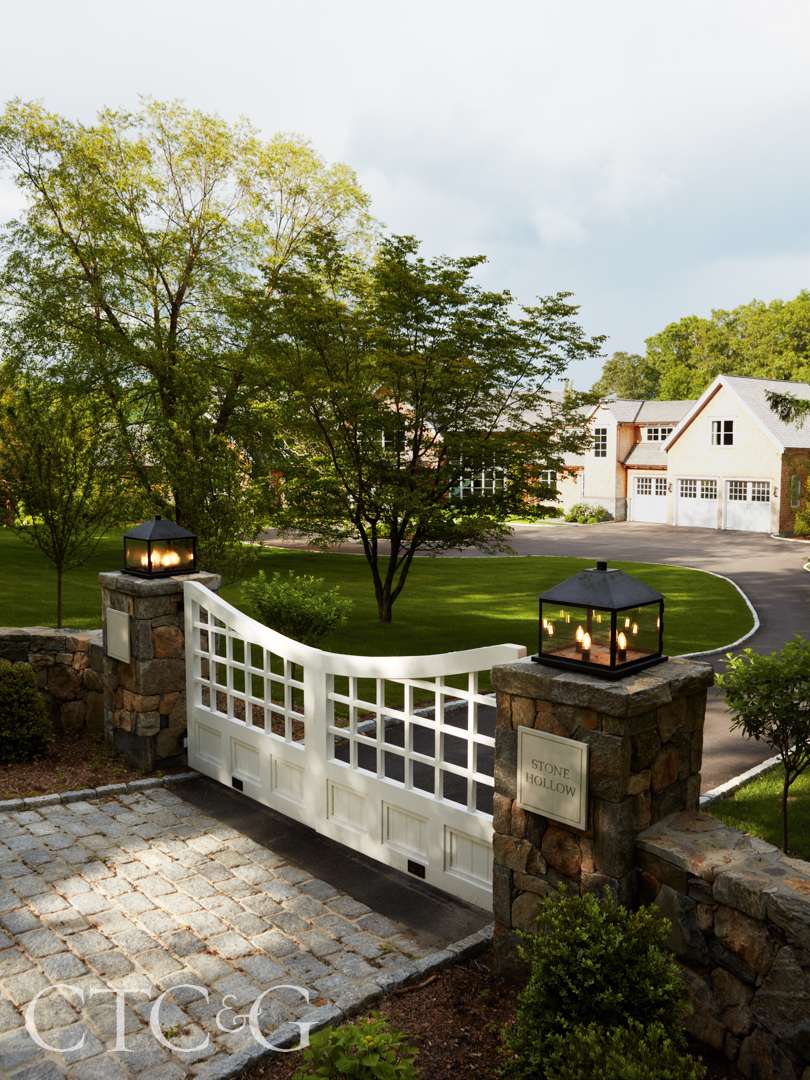
A new gate topped with custom lanterns from Ball & Ball is in keeping with the home’s New England style. The home was built by Morgan Construction.
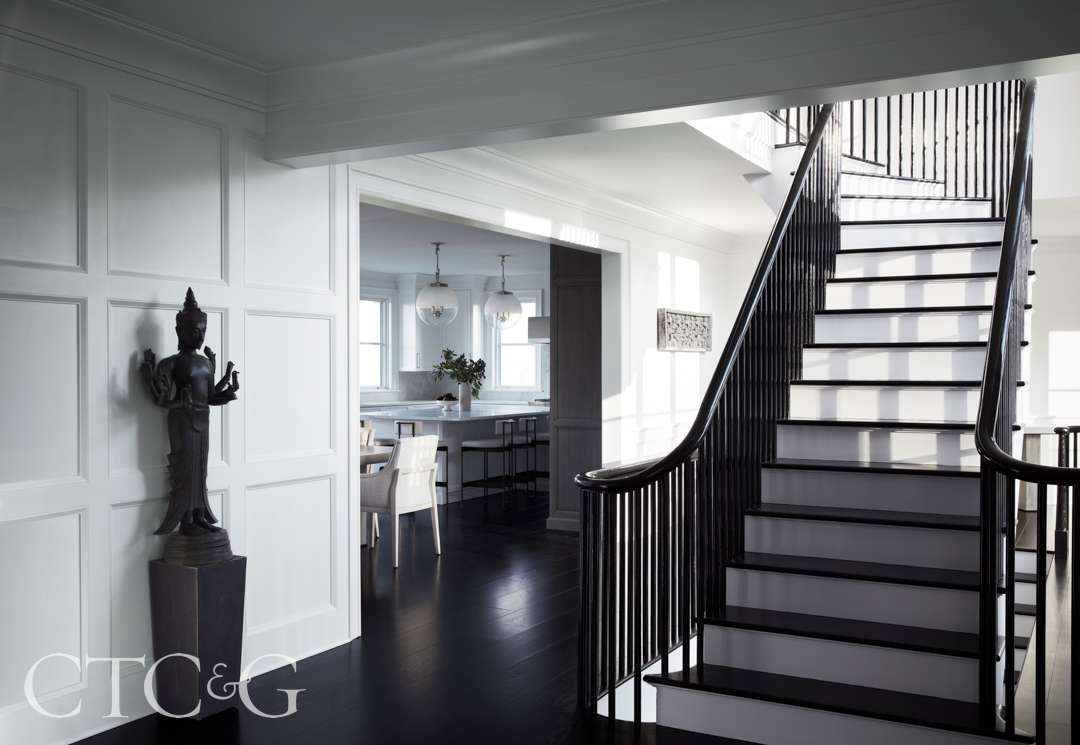
A statue from the homeowner’s travels rests against a paneled wall, the latter introduced by interior designer Dana Koebbe to add character.
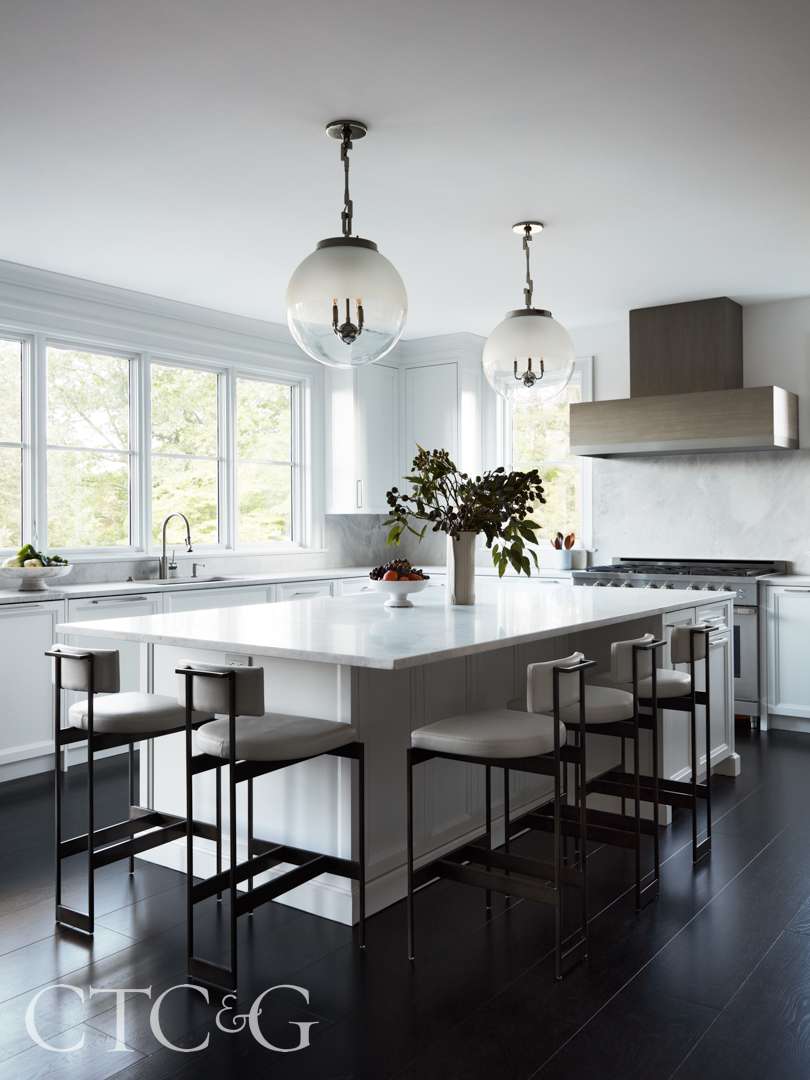
Urban Electric pendants warm the island topped with honed quartzite from LaPietra Tile & Stone. Custom-designed cabinets from John June Custom Cabinetry are painted in Benjamin Moore’s Chantilly Lace. The counter stools are from Powell & Bonnell.
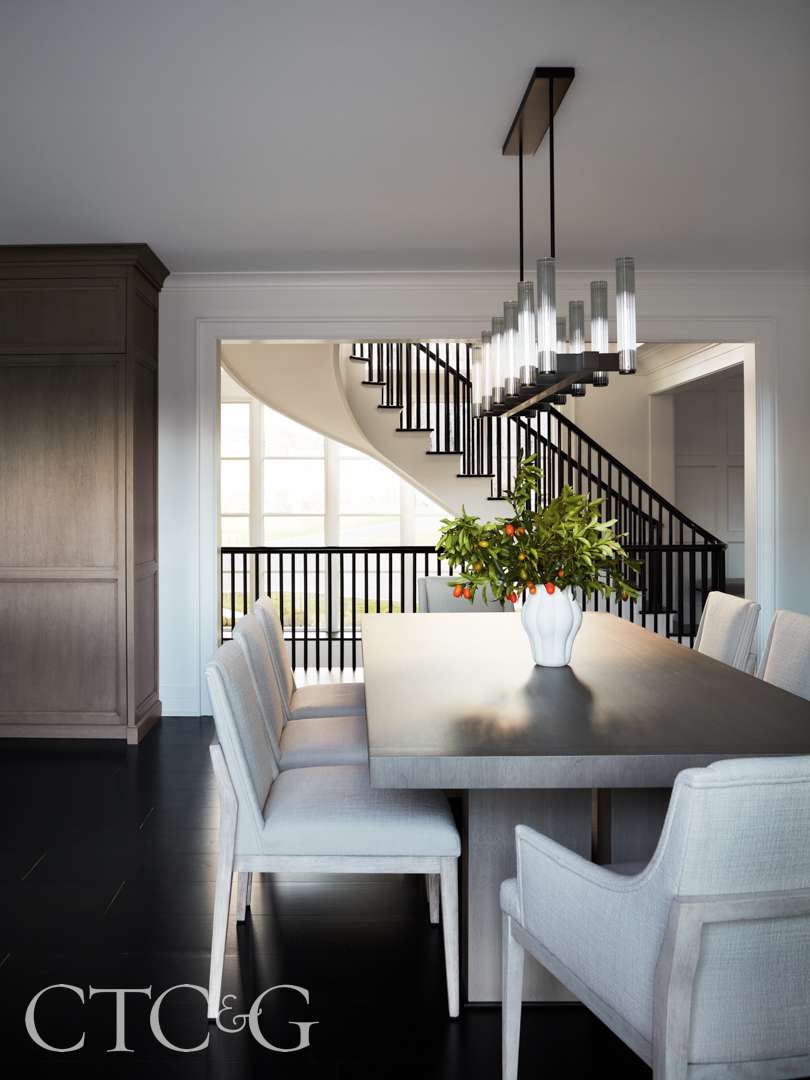
Located in the kitchen, a Robert James Collection table and Theodore Alexander chairs handle both casual and formal dining needs. The John Browning Studios chandelier is through the Bright Group.
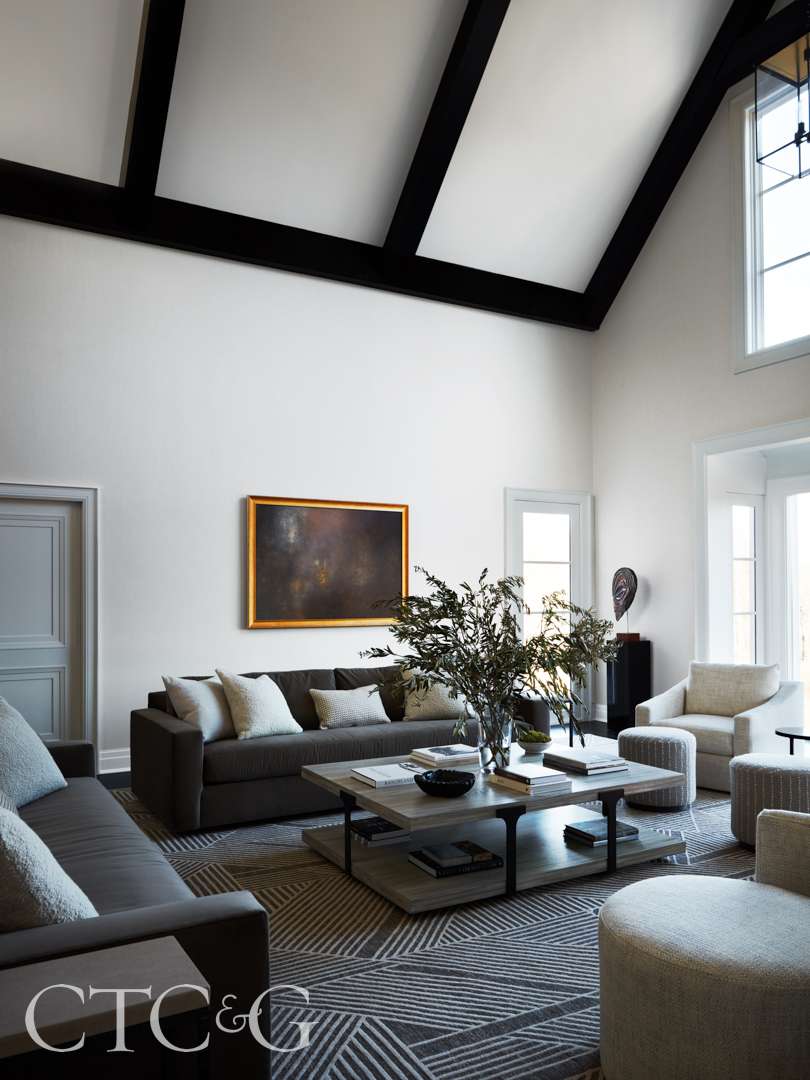
Cushy Verellen sofas and swivel chairs provide multiple seating possibilities in the great room. A rug from Fayette Studio complements the black wide-plank oak floors, and the footstool ottomans wear a Rosemary Hallgarten fabric.
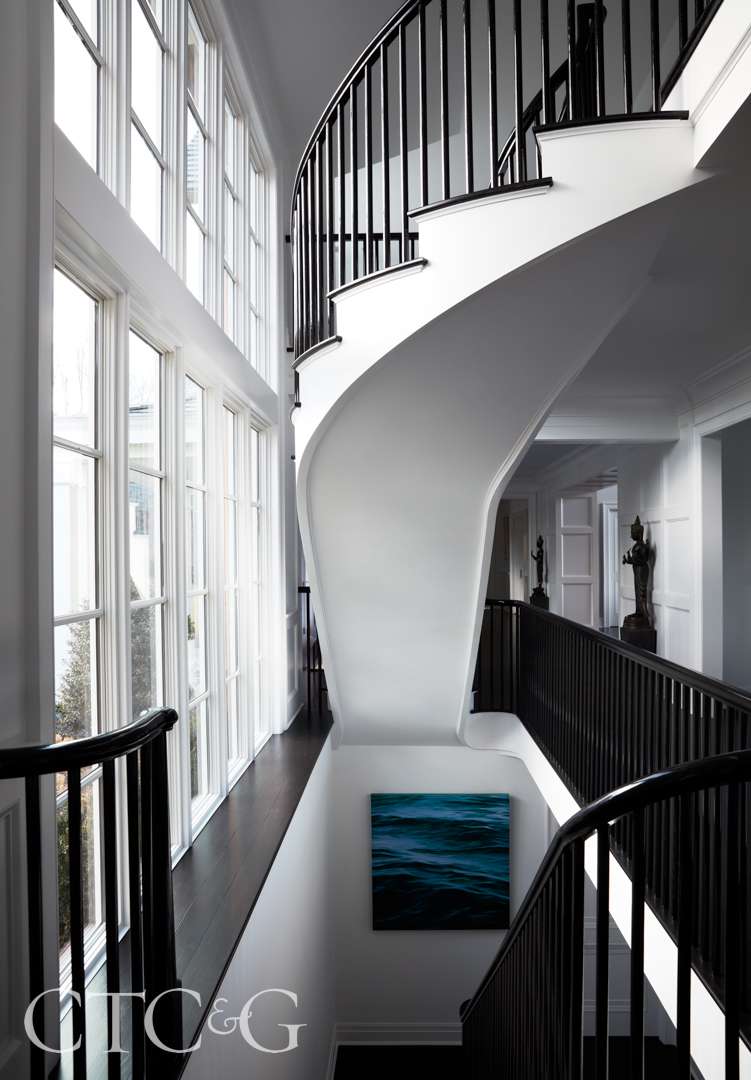
Architect Teo Sigüenza collaborated with Koebbe on the design of the commanding staircase. Originally conceived as a straight stair, the addition of a slight curve transformed it into a piece of sculpture.
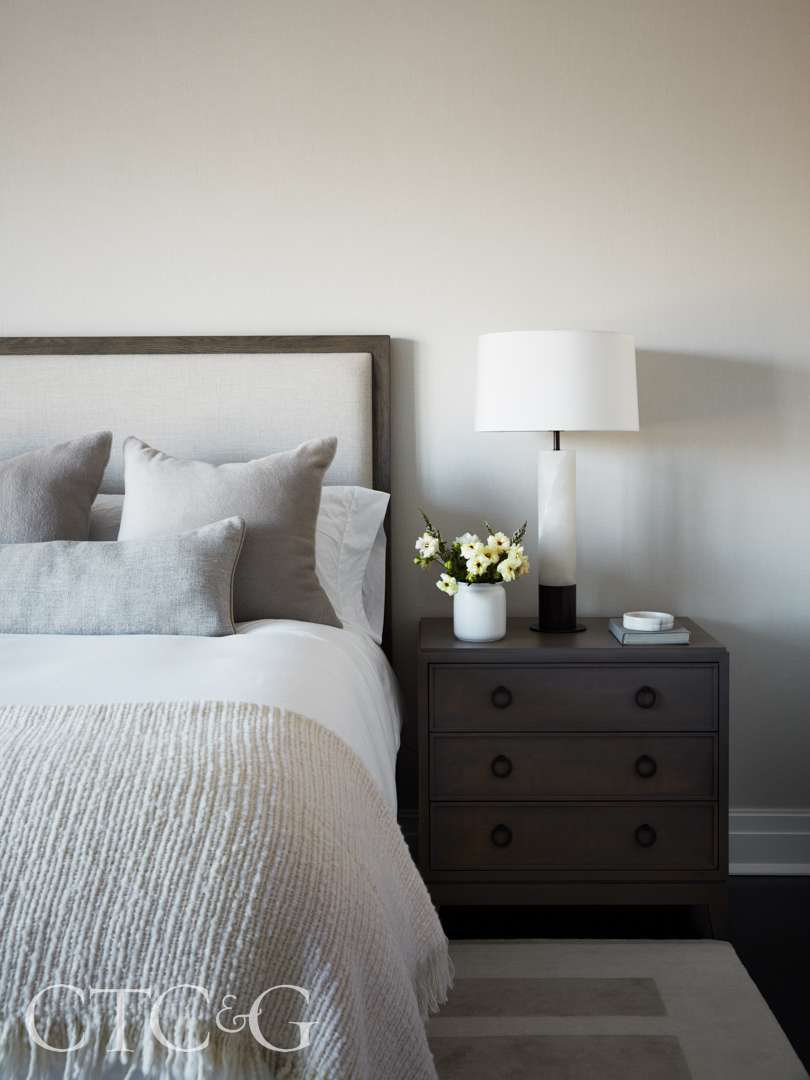
A throw blanket from Bungalow rests at the end of an RH bed in the primary bedroom, which has walls wrapped in linen from Aesthetics Wallcoverings. An Arteriors table lamp tops a custom walnut nightstand.
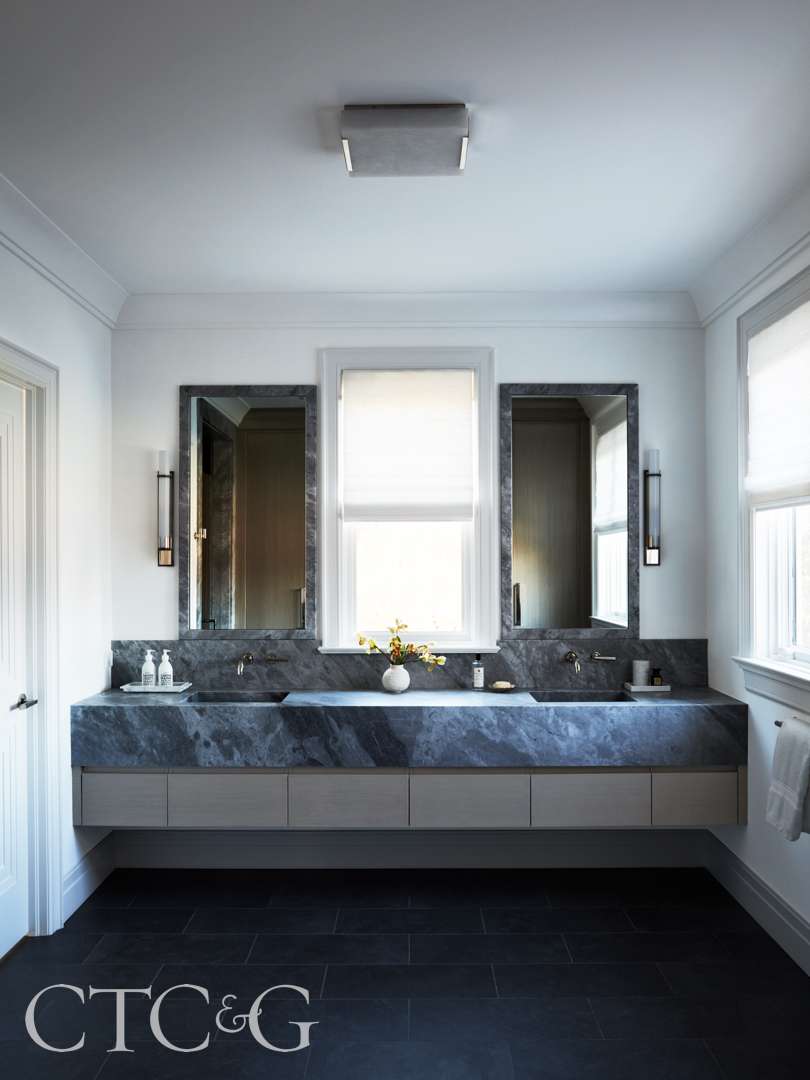
Urban Electric sconces flank the mirror in the primary bathroom where the marble vanity top is from LaPietra Tile & Stone.
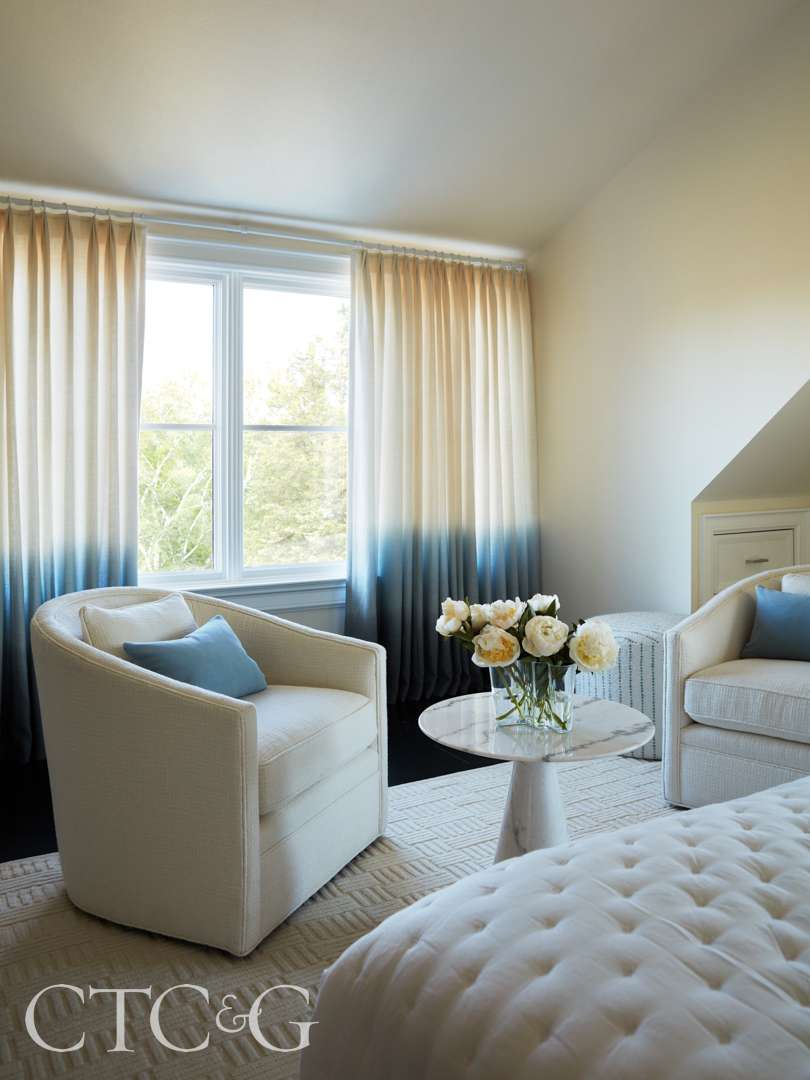
Custom draperies in a Rosemary Hallgarten ombre alpaca and linen fabric deliver a distinctive touch in the guest bedroom. Highland House Furniture swivel chairs flank a marble Nuevo side table.
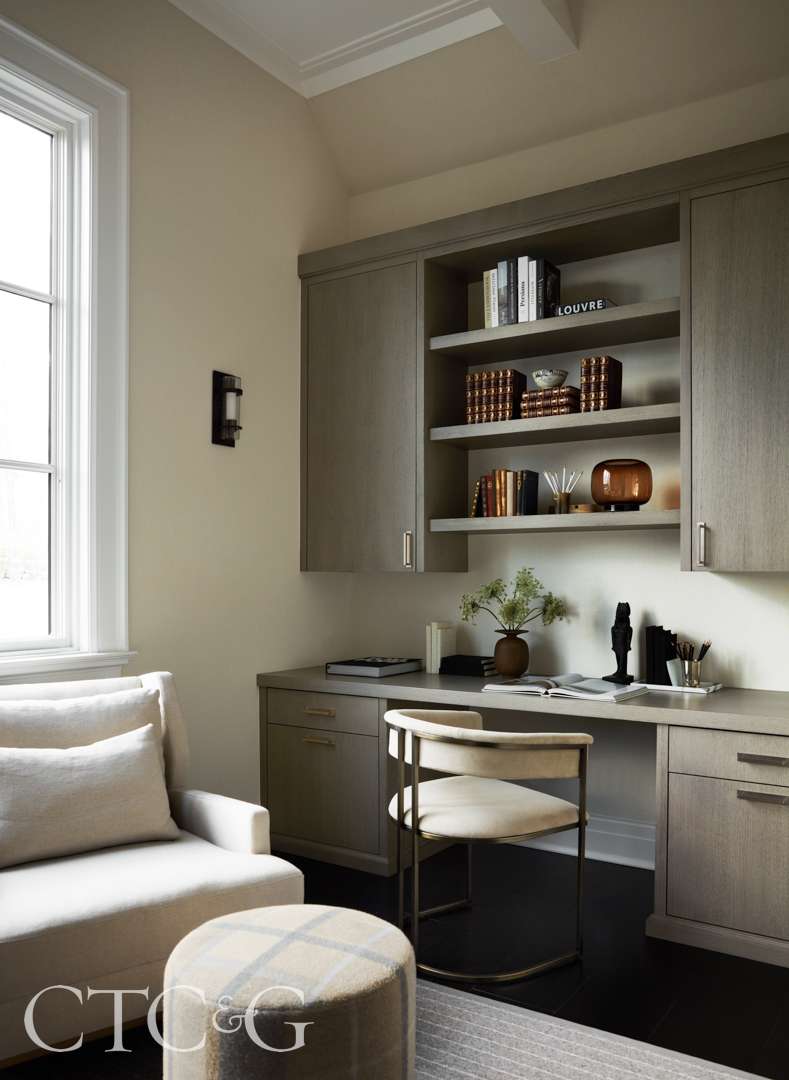
A custom built-in desk by John June Custom Cabinetry provides workspace in the office, where an Interlude Home desk chair sports suede from Edelman Leather.

Teak chairs and a sectional from RH gather around the firepit, and the custom ottomans wear blue Perennials fabric.
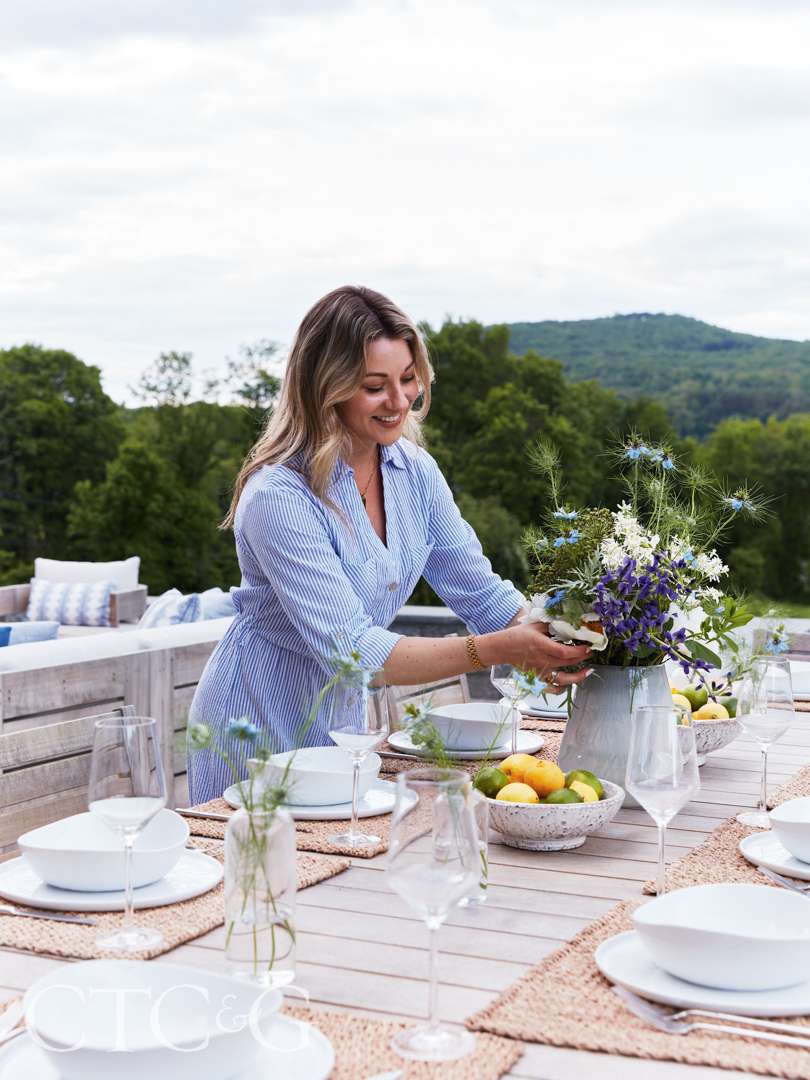
Interior designer Dana Koebbe sets a Janus et Cie table with dishes and flatware from Crate & Barrel.
Meanwhile, Koebbe set about creating interiors marked by a mix of traditional elements with more contemporary flourishes. In the great room, for example, the beams in the soaring ceilings are painted a sleek black. “A lighter wood color would turn things too rustic,” she says. “The black is more sophisticated and complements the black wide-plank oak floors.” Along with linen walls, the overall effect is warm with a modern edge.
For additional warmth, the designer piled on the textures starting with a hand-knotted wool Nepalese rug. “We loved the brown and ivory tones,” she says, and followed by sofas upholstered in deep, rich performance velvet. The clean lines of the wood coffee table with bronze legs contrasts nicely with the soft textiles.

The neutral palette continues in the kitchen where the crisp white cabinets sport a beveled edge, the sculpted bronze metal bar stools are upholstered in off-white leather seats, and the stained, rift-cut oak stove hood features a stainless-steel edge band. “The hood is a fun unexpected element with the more traditional cabinets,” says Koebbe, who chose an understated stained walnut table and bouclé fabric for the oak-framed chairs in the adjacent dining room meant to complement, rather than compete with, the artistic curving staircase. About the latter she adds, “It was originally drawn to be straight, but I suggested adding a slight curve to make it special and more sculptural.”

For the three-room primary suite—which includes an ensuite office—elements like the linen headboard and soft alpaca mohair bed pillows inform the shift into the private quarters. Alabaster marble lamps on bespoke walnut nightstands add to the calming ambience. In the bathroom, a grigio marble countertop with an incorporated sink and a matching backsplash is striking, and, in lieu of hardware, the drawers have integrated pulls for a streamlined modern look.
Despite the contemporary accents, Koebbe was careful to avoid trends. “We wanted something that would age gracefully and not feel outdated in a decade,” she says. “We focused on materials that were timeless that would only get better with age.”
