


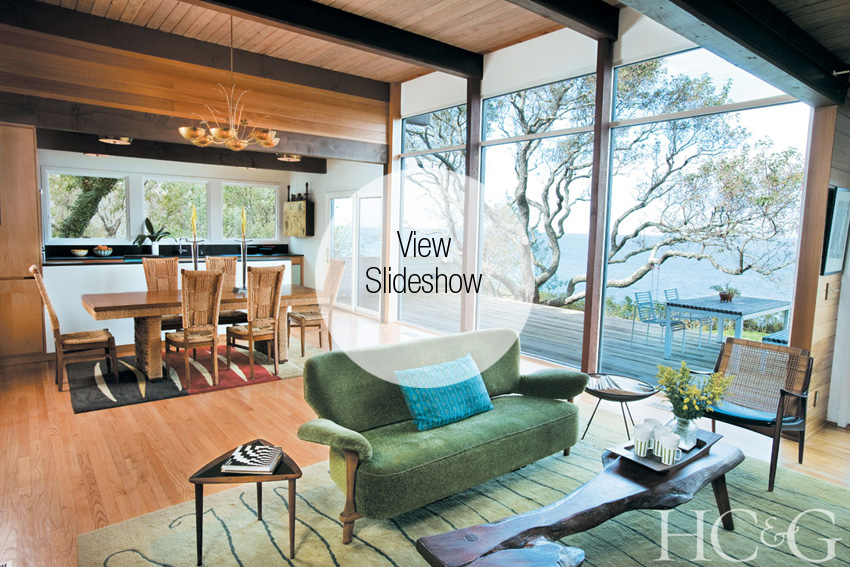
By the time they’d been married for six years, Elizabeth and Jesse Gordon had already owned three houses on the North Fork. The first was a tiny beach house on the water, the second a Craftsman-style home in Greenport, and the third a large contemporary designed to look like a farmhouse. All were lovely, but not quite right. Then the couple stumbled on their current weekend home, a modernist beauty on the water in Orient.
Their somewhat finicky disposition stemmed from a style problem. Even though their most recent abode, the modern farmhouse, was roomy, “we felt like we were living in a shell of a home that was just a repository for our stuff,” explains Jesse, a lawyer in Manhattan. Elizabeth, a cookbook author, yearned for a kitchen that opened to the living area, allowing her to test recipes while the couple’s daughters were within her sight. As a major collector of mid-20th-century furniture, accessories, and art, Jesse wanted a place with character and history to display and enjoy his treasured finds. He grew up summering on the North Fork and continues to go to yard sales, flea markets, and antiques shows every Saturday with his father. “He is my partner in crime,” says Jesse. “I started by collecting pen knives at age five.”
So the couple casually began looking at real estate. Upon seeing their current house and its 180-degree water view, Elizabeth knew it was perfect. But it wasn’t love at first sight for Jesse, who saw only an overgrown property and a shabby exterior. “It was daunting,” he says. A water view was actually possible through the deteriorated exterior siding, which was original to the 1950s house.
Built for Millicent Hamburger, a modern-dance teacher who studied under Martha Graham, the home is believed to be one of the earliest modernist structures in the area and was designed by Olindo Grossi, the dean of architecture at Pratt Institute from 1958 to 1969. Miss H, as she was called by her students, loved to paint, draw, dance, and spend time on the beach and lived in the house until she died at age 101. The good news: An undisturbed floor plan was still in place, and a unique mosaic floor in the entry hall, installed by Miss H, was in great shape. The bad news: The home, known as “The End of the Road,” had not been maintained well for the last decade or more and was almost too true to its name.
Three months later, the Gordons, still a bit wary but captivated by the house’s potential, made another visit to the property, armed with information from structural engineers, an architect, and a builder. Despite their concerns, they knew it could become the house of their dreams and hired architect Jane Stageberg to help them achieve their vision.
“Our plan was not to modernize or drastically change the design, but to keep it as original as possible,” says Jesse. “We had to replace all the interior paneling, and we used the same material. When the cedar arrived, I would go through each board to check the color, the knots, and the grain. Plenty of loads were shipped back—I am meticulous about detail.” Indeed: All corners and joints were mitered for a seamless appearance, and Jesse installed Kerf kitchen cabinets made of birch plywood with colored laminate panels, which resemble those common in the 1950s. To open up the living areas, a wall of cabinets between the dining room and the kitchen was removed. The master bedroom gained a few square feet through an addition over an existing ground-floor room, allowing more windows and another deck, thereby expanding the water view. Now measuring 2,750 square feet, the home feels even bigger due to the large expanses of glass and the many levels within.
After a year and a half in planning and another year and a half in construction, the Gordons say the house was worth the wait. “It’s a good house filled with happy spirit,” says Elizabeth. “I knew it would be perfect for our family. And Jesse is so pleased that our daughters can summer on the North Fork, like he always did.”
