


Piper Heidsieck Rare Champagne (with tiara) … Grey Goose has terroir …
Smell the dirt of To Kalon vineyards … The Italians come to town …
Brunello and burgers at the new Ai Fiori

When I am asked to SoHo House to sip vintage Champagne in a private loft, I dash right over to the Meatpacking District. The event was organized for SoHo Wine Club members to hear about Rare Champagne. As I entered, I saw Magnums of Piper-Heidsieck Rare laid on ice in an old-fashioned claw-foot tub in the middle of the room. It would be a good night.
What sets this Champagne apart—besides its expressive minerality coming from its Chardonnay-heavy blend—is its one-of-a-kind exquisite black bottle onto which the name and vintage are etched in gold. Designed by a Parisian jeweler, Rare’s ornate label band, made in an intricate gold lacy pattern, can be removed from the bottle and worn as a tiara at the end of the night. (I can fantasize what that night would be like.)
Rare is produced only in exceptional years—in the last 36 years only 6 vintages were made. At the vintage tasting, I sat with novelist and The Wall Street Journal wine columnist Jay McInerney (Bright Lights, Big City; Hedonist in the Cellar, Bacchus & Me), and his wife, Anne (looking ravishing in a leopard-print dress and huge emerald pendant). We first sipped the Piper-Heidsieck Rare vintage 2002 and worked our way back, tasting Rare 1998 and1979. Little plates were matched with the vintages: raw scallops with lemon rings with the 2002, duck confit and figs for the ’98, and sea bass curry with the ’79 (a brilliant pairing because the aged bubbly had taken on marvelous mineral notes, which accented the curry spice). McInerney is very much into older vintage Champagne and the ‘79 was opened especially early for him to taste before leaving for dinner at Le Bernadin. A new handsome packaging of the ‘79 vintage—a black box with different compartments and a gold key to open it—was unveiled for the first time. It is a gift that only the SoHo Club might afford at $1600 … but, of course, that includes the gold tiara.
Even spirits with overwhelming brand recognition still need to put a high-gloss shine on their image from time to time. An elaborate event was held by Grey Goose: A vodka cocktail pairing dinner, educational demonstrations and even smoke. The distiller or Maitre de Chai, Francois Thibault, who created the brand for Sydney Frank some 15 years ago, was on hand to tell of the vodka’s continuing wonders.
After a hands-on cocktail mixing class to kick off the evening, a group of 40 lifestyle journalists sat down to watch a film showing the wheat fields in the Picardie region of France—wheat from which Grey Goose will be distilled. The winter wheat is sustainably farmed and is milled into flour. We learned every step of the process from the wheat rolling (not crushing) to produce flour with “ideal granularity” and then the five-step column technique. The flour is sent to the Cognac region to be distilled and processed with the pure spring water that runs through the limestone in Cognac. Grey Goose’s new message: “Nature goes into this product.” It seems that spirits world is trying to get on wine’s bandwagon and tout its pride in terroir.
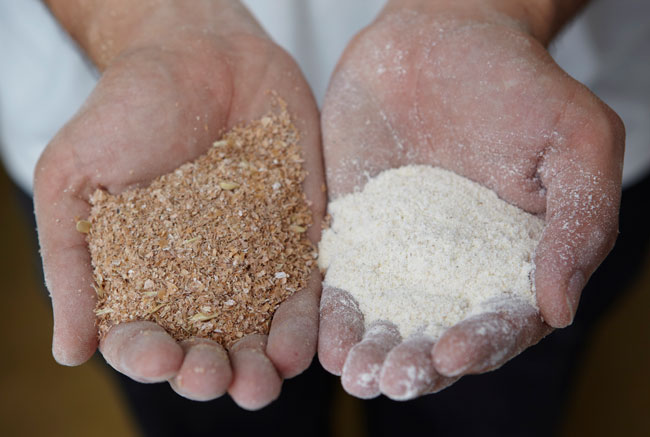
For the first hands-on demonstration, a basket of four breads was presented to each attendee. We were to break open the breads and feel their granularity, which Thibault compared with the fine bakery flour that he uses to make Grey Goose. Later the show got better when, during one of the cocktail pairings, we were each delivered a heavy slab of limestone onto which were placed a silver pouring vessel, a dish of liquid ice and a cocktail. We were instructed to pour cucumber water over the liquid ice. This caused a show along the long table of billowing smoke and erupting bubbles—a nice piece of theatre.
We were then asked to sip the autumn cocktail while smelling fresh cucumber smoke. Incidentally, this aroma-pairing act is big now in the cuisine of Scandinavia where chefs create aromas (pine, forest) to accompany their dishes. The cocktail—“La Poire Sage Harvest” (made from Grey Goose La Poire Vodka, Canton ginger liqueur, lime juice, agave nectar and fresh sage)—was the best of the four seasonal cocktails served and was paired with roasted rabbit with stuffed sage leaves. Cocktail and food matching has been the new thing for a few years now. Though, in my opinion wine belongs at the table, spirits at the cocktail hour.
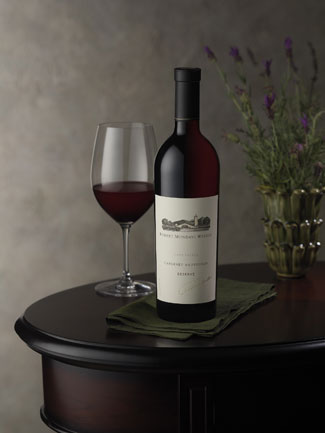
The next night there was yet another demonstration, but this time for wine and terroir. We smelled dirt. This was not just any dirt, it was dirt from the To Kalon vineyard, Robert Mondavi’s most prestigious one. (As you can readily notice, the trend among publicists is to outdo each other with demonstrations and gimmicks to appreciate brands in new ways.)
So, upon entering Hearth in the East Village, we were taken to a bar where women mixed dirt and water in stemmed wine glasses and we were instructed to sniff the dirt. The smell of the wet soil would give us a taste of the place, not just dirt from one site, but a comparison of three prized soils: one from Rogowski Farm in Pine Island, NY (dirt known as Carlisle muck); another from Chickadee Creek Farm in Pennington, NJ (BucB2, Buck silt loam); and finally our star, Robert Mondavi winery, To Kalon Vineyards, Oakville, Napa Valley (Coombs Gravelly Loam). We tasted radishes, a baby lettuce leaf and a grape grown in the soils and could appreciate the earth’s aromas.
Of course, I enjoyed the aromas of the wine over dinner more than this soil sniff. The extraordinary Fume Blanc Reserve To Kalon Vineyard 09 accompanied sweetbreads piccata with hen of woods mushrooms and Pinot Noir Reserve 09 with the pappardelle Bolognese. With the roasted duck and confit turnips, we were wowed with the Cabernet Sauvignon Reserve from 2007 and 1996—a real treat. These were very expensive wines from the best dirt in Napa.
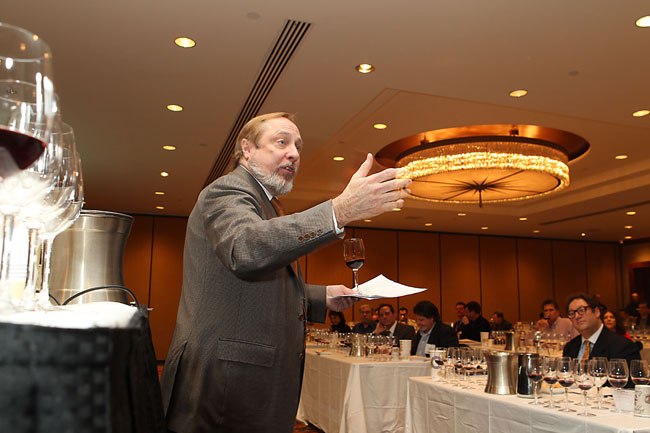
It was indeed a great wine week because all the Italians descended on Manhattan to show off their new vintages in an event called The Italian Wine Masters. I attended a fascinating seminar, The Waiting Game: Age-Worthy Brunello di Montalcino, Chianti Classico, Vino Nobile di Montepulciano. Kevin Zraly, who for 40 years has taught the Windows of the World Wine School class (now at the Marriott Marquis), is a riveting lecturer. We sniffed, tasted, compared the attack and the length of finish of each wine and all of the elements of these three regional wines from Sangiovese grapes, all from Tuscany. And once again learned that terroir is everything; the same grape variety tastes differently even though the vines are planted in regions near one another.
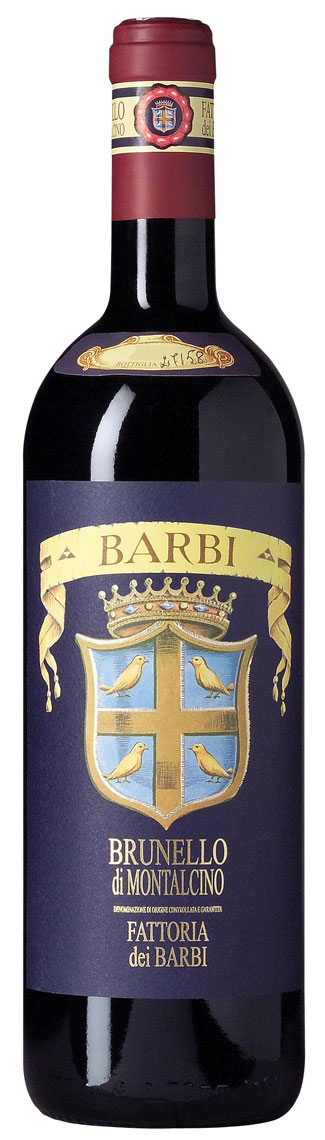
Afterward, at an intimate lunch with one of the top Brunello makers at the new stunningly designed Ai Fiori restaurant at the Setai Hotel, I was able to savor a Brunello di Montalcino 2004 from Fattoria dei Barbi. It felt humbling to sit near Stefano Cinelli Colombini, who is the 23rd generation of this family, a noble family from Siena. “No Popes or Cardinals in the family,” he reported. “Only an ancestor—Giovanni Colombini who founded a monastic order. There’s still a beautiful important church in Venice.” The winery was started in 1352 with property in Montalcino and a castle (now belonging to Villa Banfi) and the family winery, Fattoria del Barbi, dates from 1790. Oh, how I love lineage like this and Stefano is now single again. Hmmm. He expounded on the best food accompaniments: “Brunello pairs with protein. With wild boar and steak. And actually probably an ideal pair is a very fatty succulent hamburger, because the wine has enough acidity to cut through the fattiness.” So, Brunello and burgers it was. (At Ai Fiori, the burger is the $20 gourmet version, of course. And the high-low pairing of the $300 Brunello 04—on the wine list—and the burger was inspired.) When bidding me goodbye, Stefano asked me to visit his castle in Italy. Maybe there’s a sequel there to Under the Tuscan Sun.
