


The first tasks Josh Evan Goldfarb and his design partner, Michael Edward Moirano, undertook for this Old Greenwich house were to fill it with light and pattern. Although it was a circa-2004 contemporary take on the classic Shingle Style—with plenty of bay windows that brought in an abundance of natural light—the rooms needed the kind of glow that indicated the arrival of a new young family. And while the bucolic views outside those windows reveal the patterns of nature, the homeowners wanted colorful, stylized versions of flowers and foliage inside as well.

“It all started with the lighting,” Goldfarb emphasizes, and because both designers have an eye for novel fixtures, every source that now shines brightly inside makes a particularly strong aesthetic statement. A pair of bronze Italian sconces, for instance, elegantly tapered like palm fronds, seem to grow organically on the floral wallpaper that blooms on the living room walls. In the formal dining room, Murano glass chandeliers from the 1970s, whose amber glass arms appear like upside flowers, provide “a lovely, warm sheen in the room,” says Moirano, “and they complement the 1940s dining chairs that have a really cool shape. Joshua and I built out the palette of the room with those chairs and then, the lighting fixtures.”
Meanwhile, a Sputnik galaxy of golden planets orbits over a kitchen dining table, while a branch-like plaster fixture vaults the ceiling in the girl’s bedroom. Of that latter fixture, Moirano emphasizes, “We specified the robin’s egg blue color because we wanted to balance out and counter the kinds of traditional colors you find in a little girl’s room.”

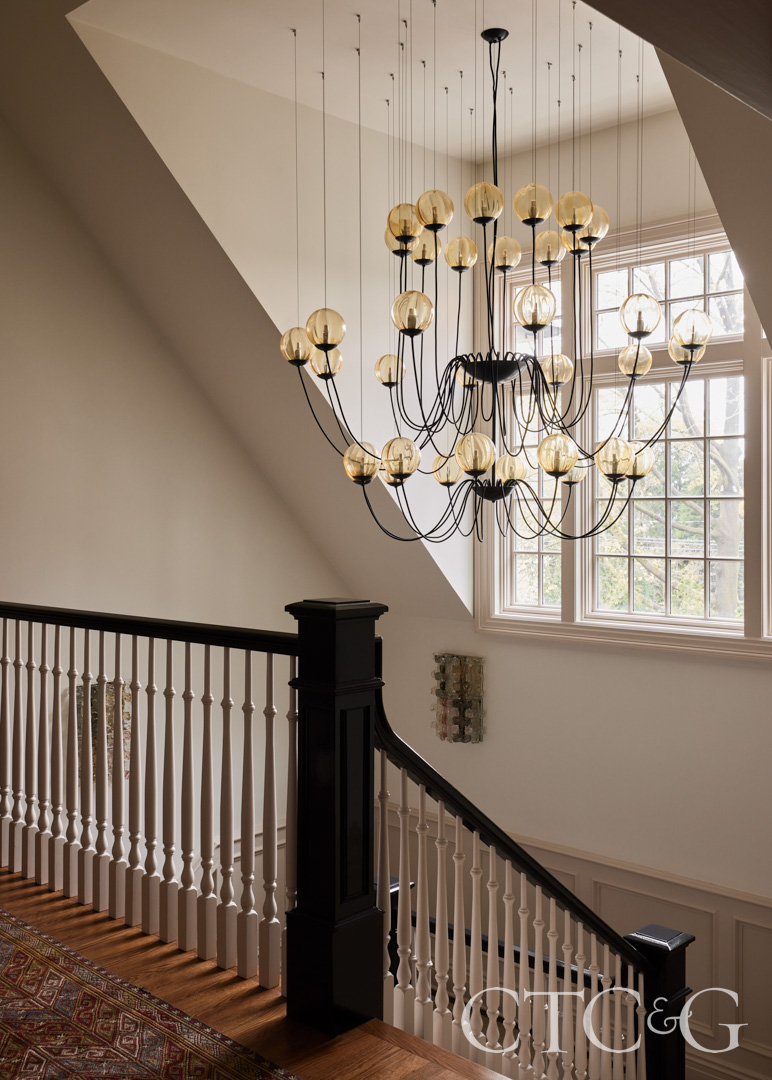
While every lighting source is both a conversation piece and a practical element, the most dramatic one spills down the main stairwell. What is known as “The Puppet,” from the Italian maker Vistosi, perfectly echoes its name, as each of its clear-glass orbs hangs by a wire, poised, it seems, to dance like a puppet. “The fixture required a very complicated directive for a non-art installer to get it right and to find the perfect way to mount it,” says Moirano. But, as he insists, “The sconces in the stairwell are what really steal the show there,” he says, indicating a pair of rectangular units composed of black, yellow, pink and clear glass. “That traditional space in the house, a stairwell, becomes something really great and distinctive when the lights are lit.”
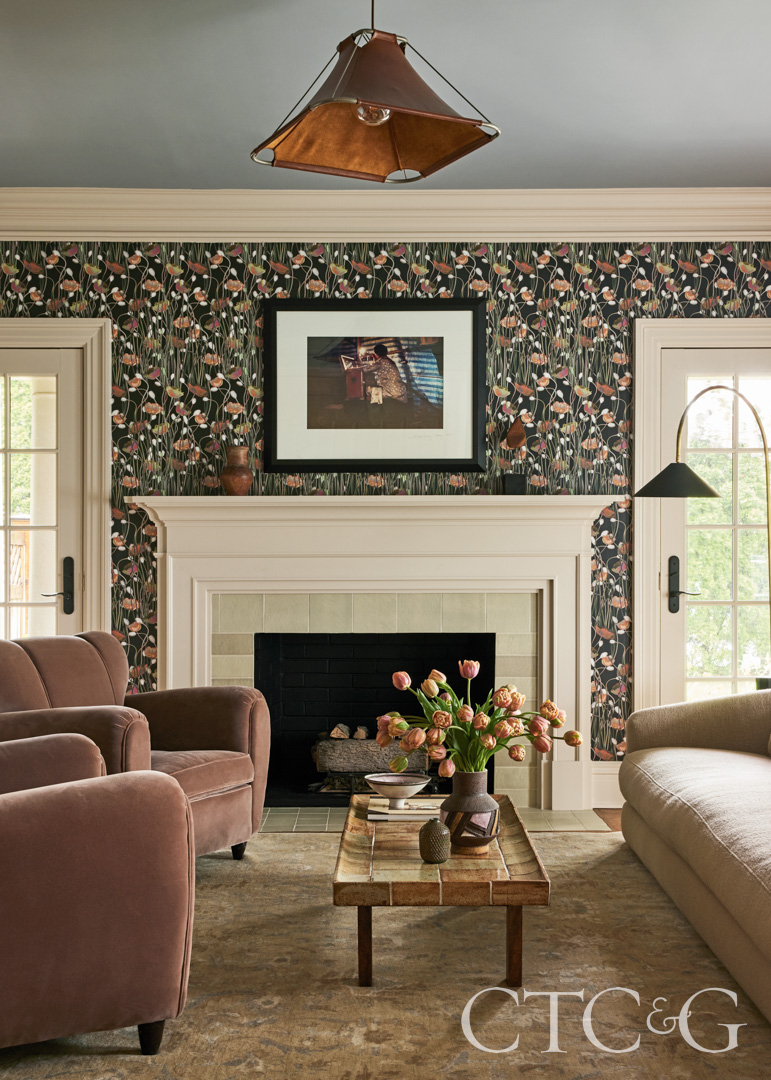
In the den, the flowers in Rouse Phillips’ “Poppies Autumn” wallpaper are always in bloom. Armchairs from 1stDibs face a Stahl + Band sofa across a bronze-metal Roger Capron coffee table.
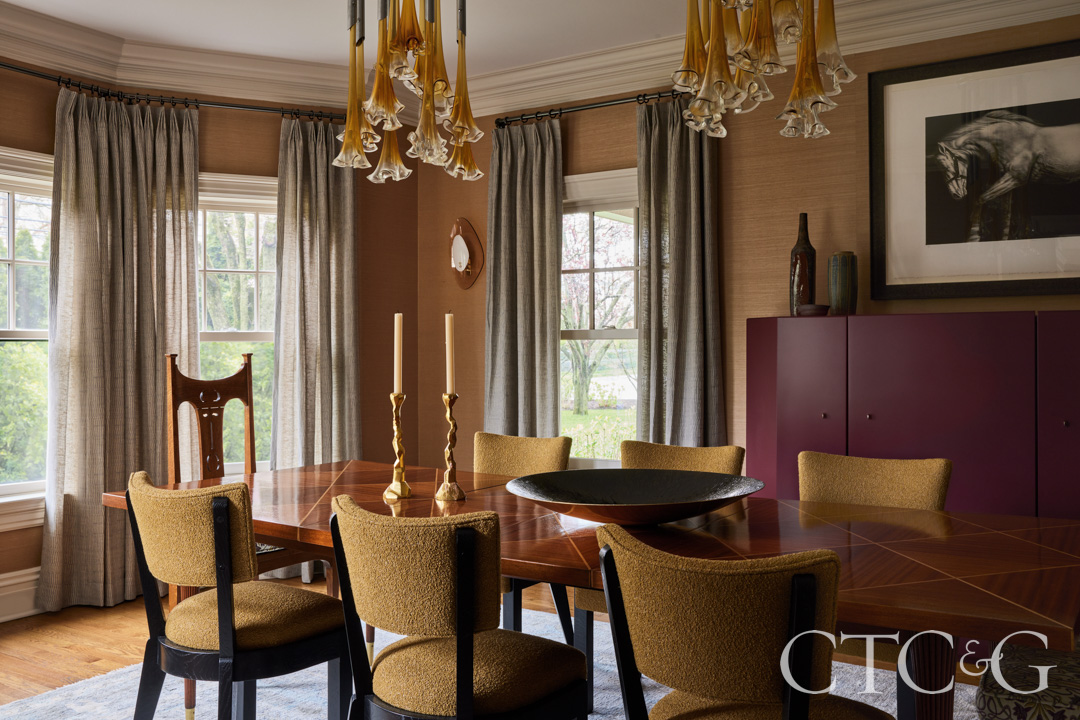
In the dining room, a French 1940s oak table is set with chairs that the designers found in Italy. Murano Glass chandeliers are complemented by a grasscloth wallcovering from The Sign.
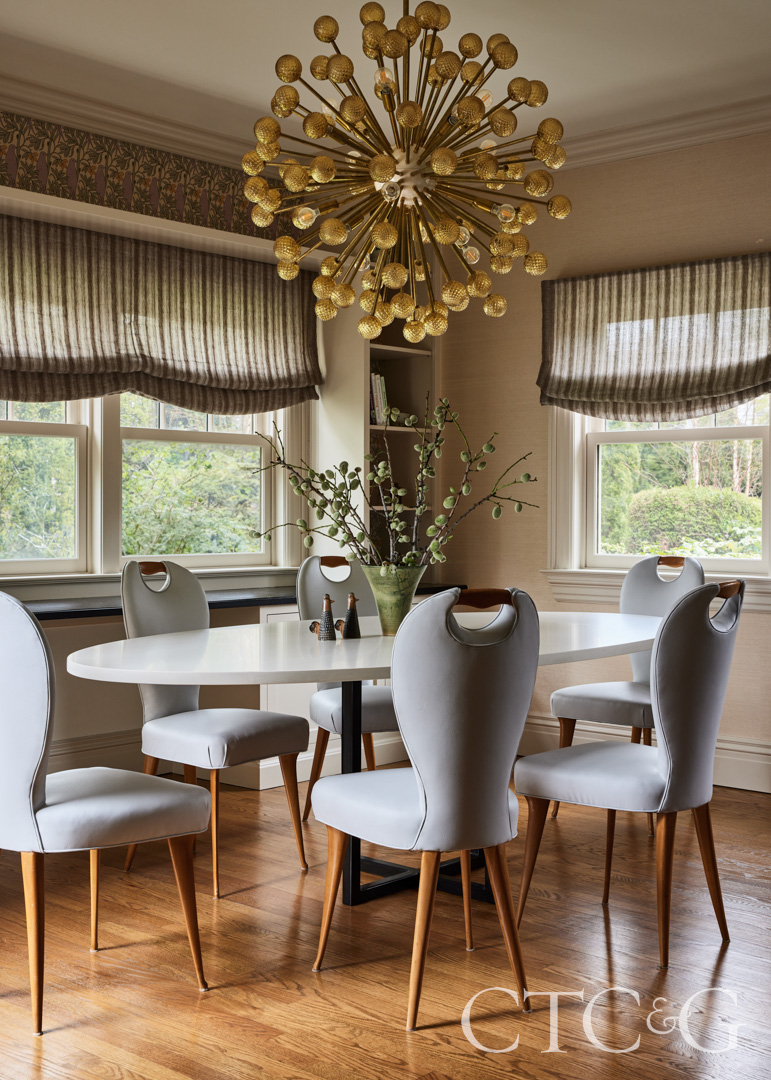
A custom Sputnik chandelier, fabricated by Fabio Ltd., illuminates the adjacent eating area, where the table is topped with Lapitec’s Bianco Crema stone through ABC Stone.
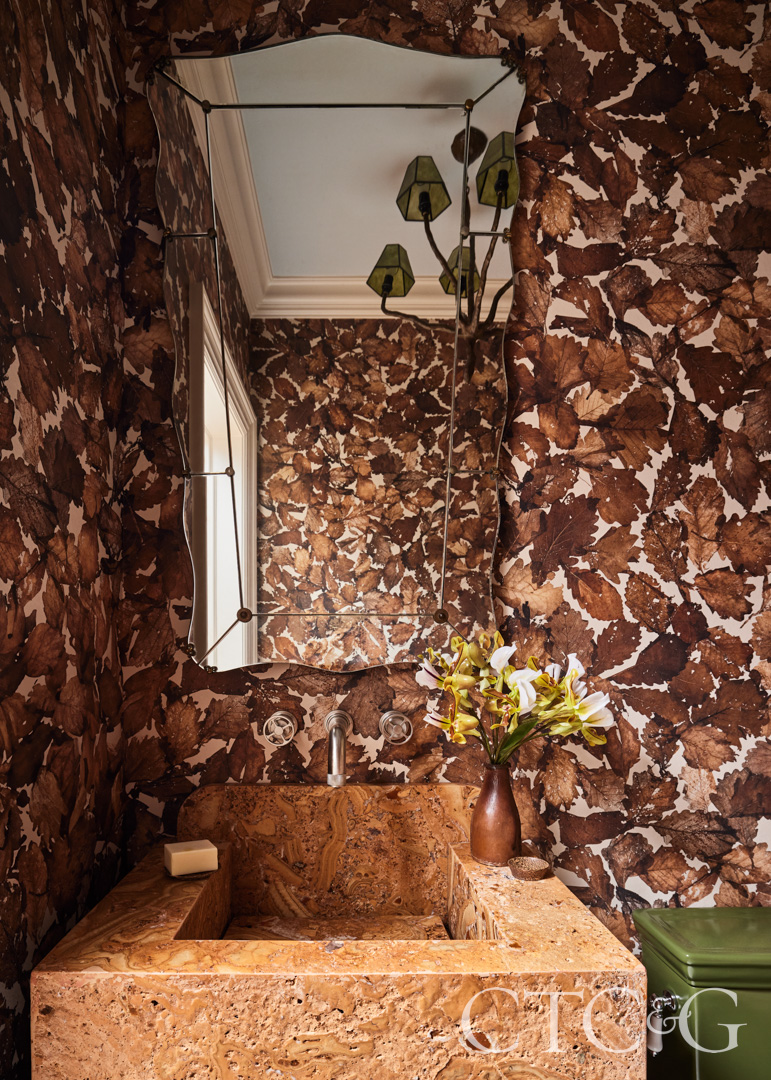
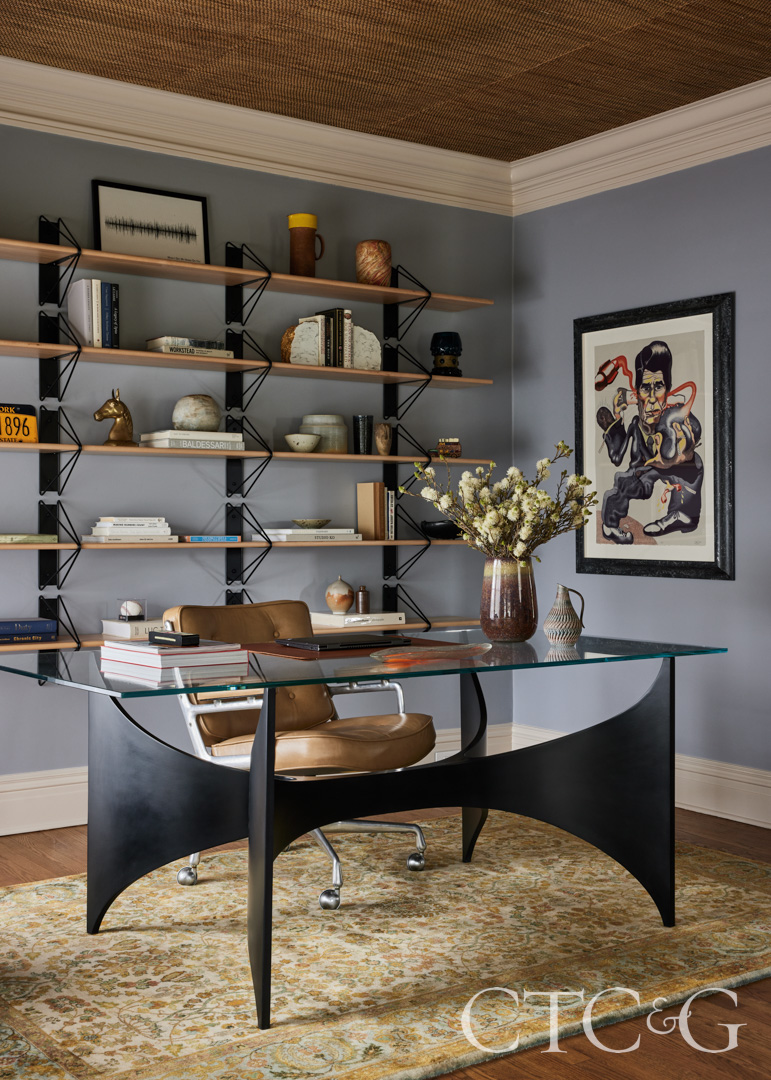
An open bookshelf unit from Souda covers the wall of the husband’s office behind a vintage Manfredo Massironi desk.
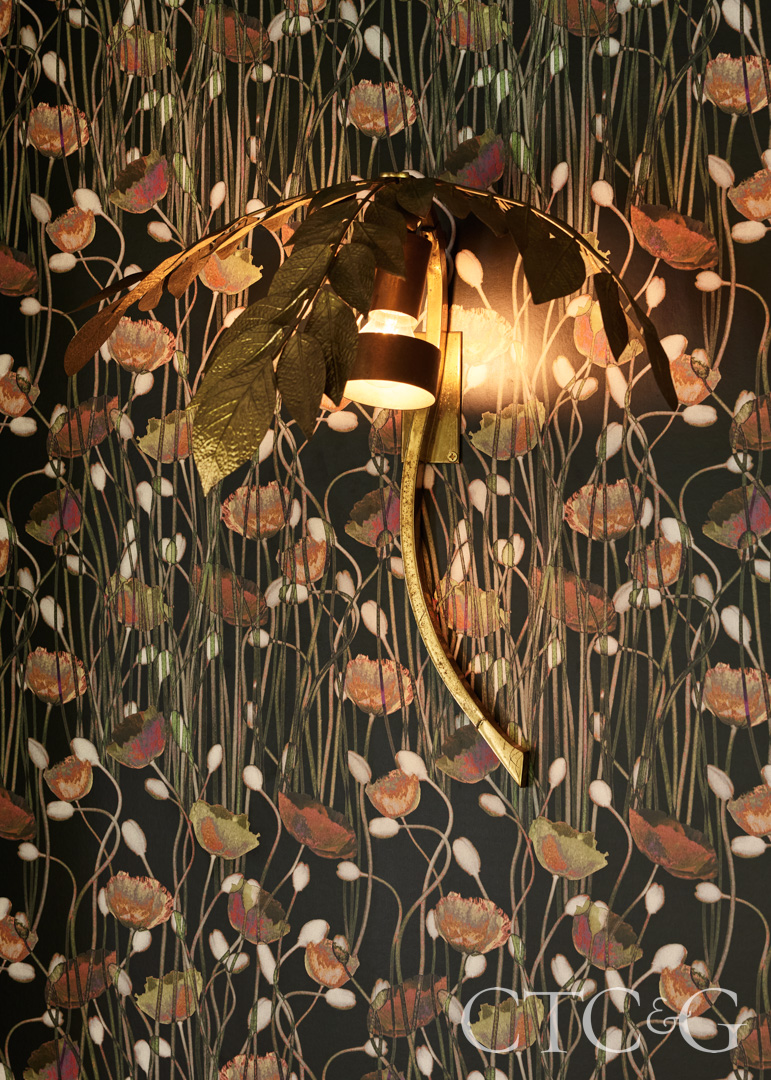
Brass wall sconces, dating from the 1970s, appear to grow organically on the walls.
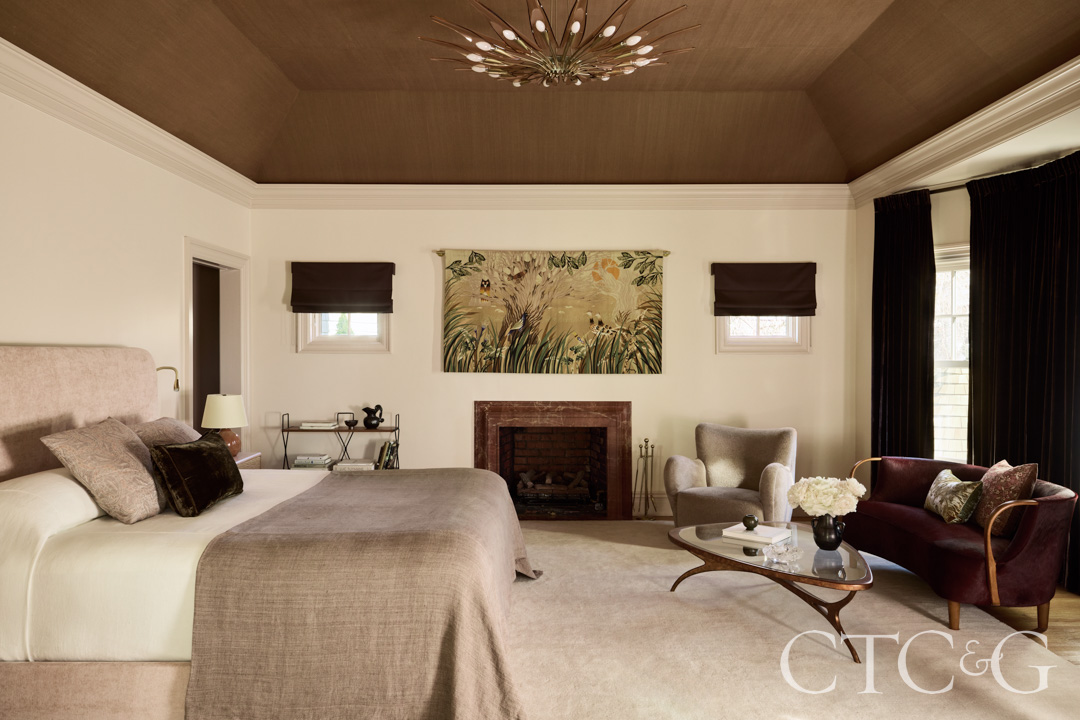
In the primary suite, a custom bed through Luther Quintana Upholstery is dressed with Matouk bedding, while a Max Ingrand chandelier is set within the room’s tray ceiling, while a vintage French tapestry hangs above a fireplace from Jamb.

The dressing room is imbued with a soft light that filters through Rubelli draperies.
The move to Connecticut represented a dramatic departure for the couple with two young children, for they had been living in what Goldfarb calls “a cool loft in Tribeca” when they decided to flee the then Covid-silenced city for a new suburban life. At that time, Goldfarb and Moirano had only recently established their design business—Evan Edward (their middle names)—with Goldfarb manning their Miami locale and Moirano the New York office. “This represented an early Evan Edward project,” Goldfarb confesses, “but the clients were immediately wonderful, dear and supportive people to work with.”

While the young designers admit to having had a kind of carte blanche in designing the rooms, the wife had one stipulation. “She loved wallpaper and that served as a key design direction,” says Moirano. “This house represented her move to the suburbs and nesting in place with her children—and something about floral-motif wallpaper clicked with her and made any room feel more intimate.” Goldfarb and Moirano selected Rouse Phillips’s exuberant “Poppies Autumn” pattern, whose namesake flowers intertwine and meander and appear to grow wild amid a dark background. “We had originally chosen that paper for the powder room,” says Goldfarb, “but she really likes dark colors and since she uses the formal living room as her own at-home office, she liked the pattern’s take on an otherwise traditional design.”

For the husband’s office, however, Benjamin Moore’s calming Pigeon Gray backdrops a highly sculptural desk that the designers found in Italy. The 1970s lacquered-wood desk—whose form harkens to an Alexander Calder stabile—delicately makes contact with the floor. Elsewhere in the room, Goldfarb and Moirano found an exceptional Richard Hersberger for Pace chair and ottoman and reupholstered them in an olive velvet corduroy, pairing it with an offbeat Raak 1960s standing lamp.
Designers remember their earliest commissions—and successes. “I associate this project with a very warm, young family, who were as excited as we were to be designing these rooms,” recalls Goldfarb. Adds Moirano, “Every project we do looks completely different, and it’s always about channeling our clients’ energy. We really wanted to give them an extremely personal home and we did.”
