


Edward O’Hara’s art does not simply observe nature; it collides with it. While his recent exhibition, Edges: Works on Canvas and Paper, occupied the Boathouse at Silver Sands in Greenport this spring, the shoreline’s raw rhythm is what truly drives the collection. The location carries a unique family weight: O’Hara, raised on Long Island, is the father of Silver Sands’ Executive Chef, Finn O’Hara. This connection turned the show—the first ever hosted in the Boathouse on Pipes Cove—into more of a homecoming than a traditional gallery event.

For decades, the high-altitude world of branding and design defined O’Hara’s professional life. A Queens College art graduate, he built a career on strategy and exactness, but that studio experience eventually rang hollow. “I began to feel a growing distance between myself and the surface,” O’Hara notes. Now semi-retired on a 60-acre farm in Highland, he has traded the controlled studio for the unpredictability of the Hudson Valley outdoors. It was there that he first discovered how to use local grasses as a natural medium, a technique that serves as the foundation for this, his fourth solo show.


O’Hara uses foraged reeds (from approved private properties) to create textural imprints on canvas.

Inspired by the North Fork shoreline, Edward O’Hara uses native grasses to create abstract works rooted in place and process.

The process of painting the reeds and then pressing them between paper creates the life-size impressions.

O’Hara’s latest work implements washes of color drawn from the North Fork’s dawn and the shifting mist of the open sky.
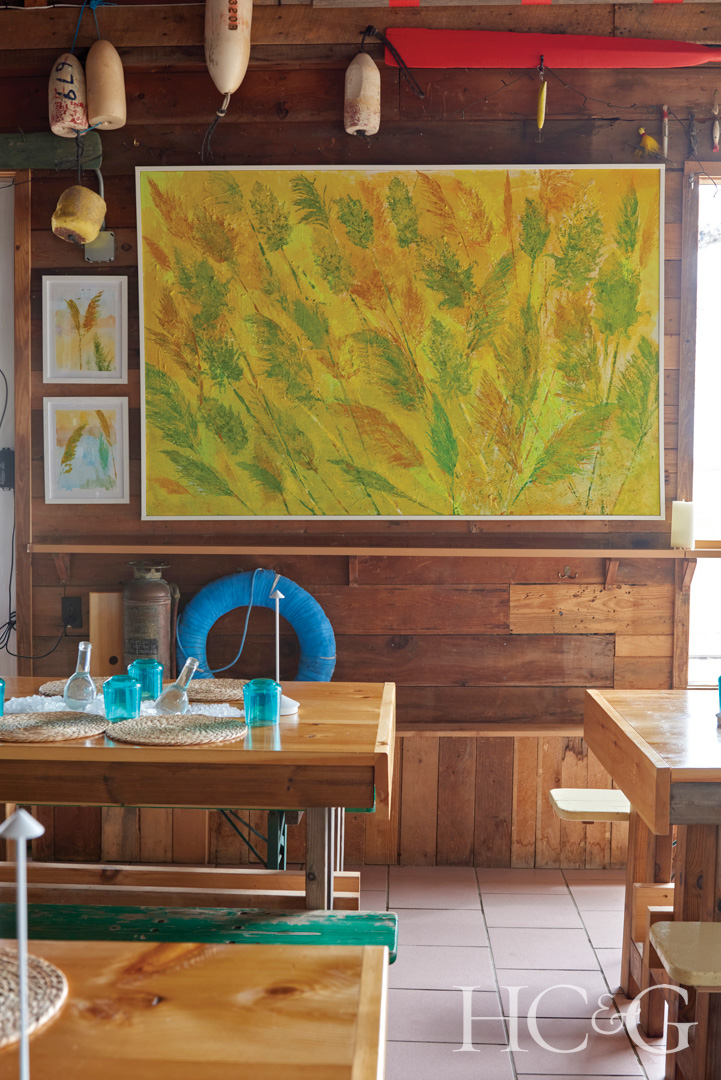
Edges: Works on Canvas and Paper occupied the Boathouse at Silver Sands in Greenport this spring, displayed throughout the rustic restaurant. Above the table is Edges 20, 2026, acrylic, ink, sand, and pebbles on canvas.

Edges 14, 2026, acrylic and ink on paper, 15” x 12”.
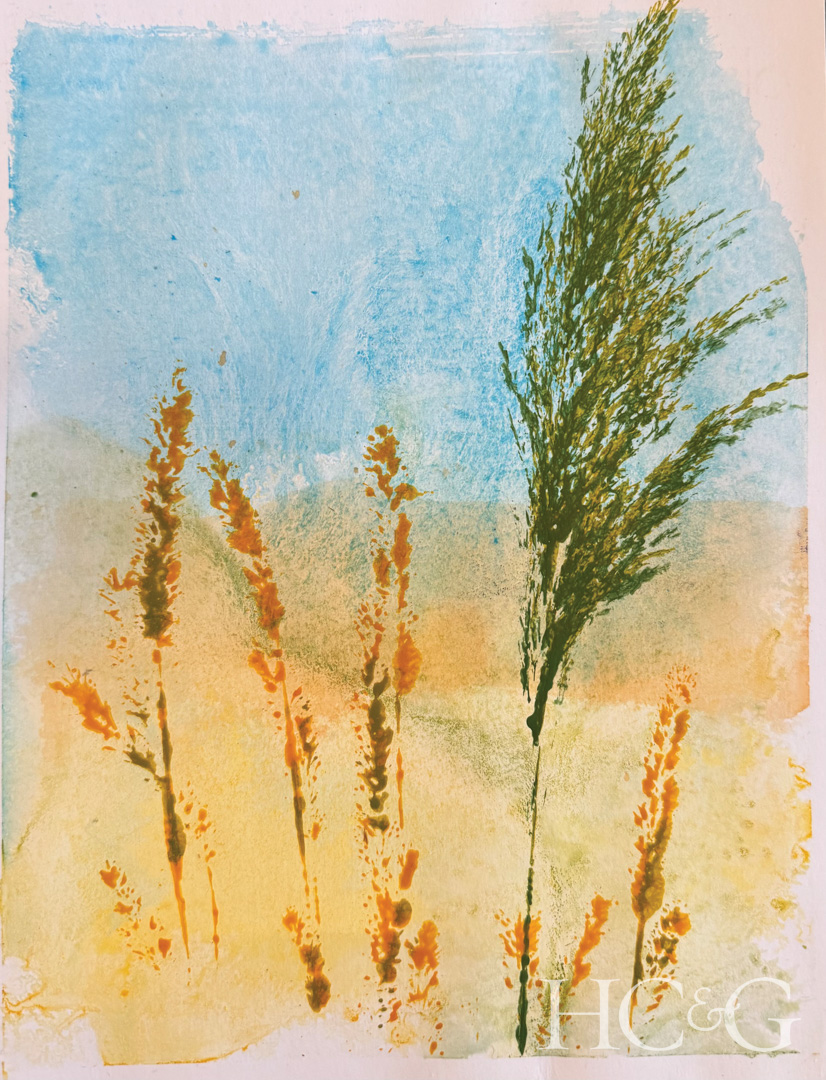
Edges 15, 2026, acrylic and ink on paper, 12” x 9”.
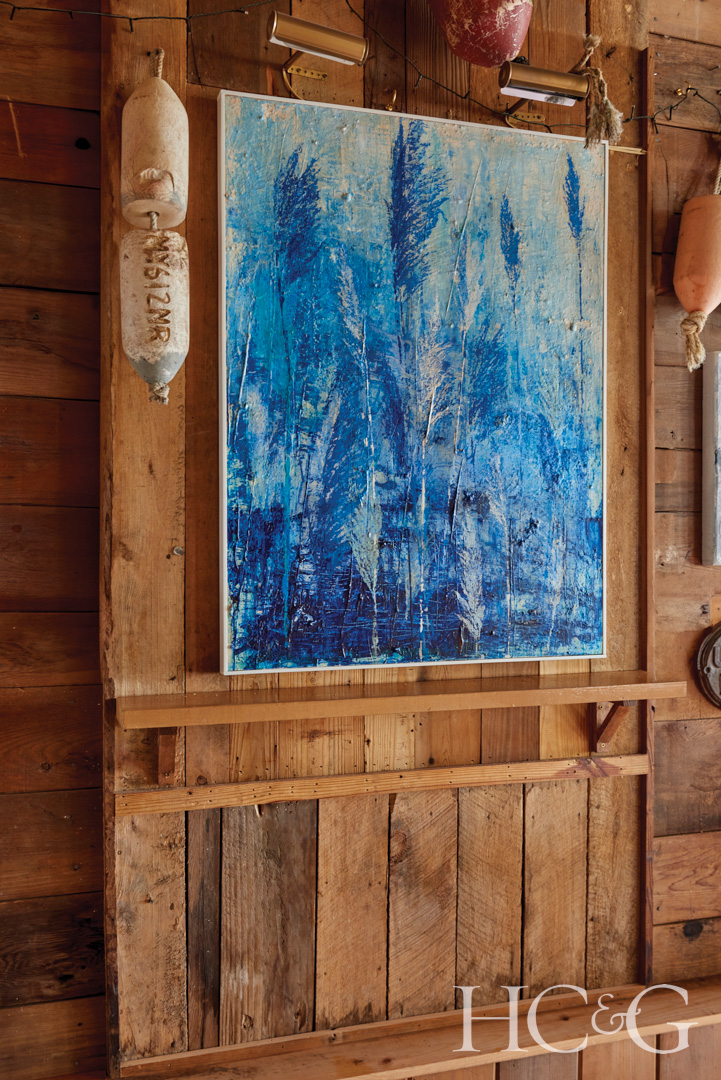
Edges 17, 2026, acrylic, ink, sand, and pebbles on canvas, 40” x 30”.
This immersion begins long before pigment touches the surface. O’Hara deliberately gathers site-specific materials— coarse reeds, sand, and seashells—directly from the Greenport shore. He doesn’t just use these elements; he collaborates with them, letting the grit of the sand and the curve of a reed leave their own archival mark of texture and memory on the canvas. He then layers these pressings with washes of color drawn from the North Fork’s dawn and the shifting mist of the open sky.

The process eventually shifts to a physical engagement, in which O’Hara uses his body to press the paper or canvas into the earth. As he describes it, the work is no longer an image of nature but an “event with nature,” recording a direct encounter with the land over time. Amid the heat and changing light, the plants carry their own history onto the surface, creating sharp, calligraphic gestures that shift between abstraction and representation.
This exchange reflects a site-specific energy unique to the “edge”—that shifting threshold where the land meets the water. Interestingly, O’Hara’s work parallels his son’s cooking; just as Finn grounds his menu in local oysters and the seasonal harvest, Edward’s paintings physically inhabit the landscape that inspired them.

Though the exhibition at the Boathouse concluded in late May, the work remains an intense reflection on a shared history shaped by the waters of Long Island. For O’Hara, the creative path leads toward something essential. “These works hold not only the imprint of grasses and reeds,” he says, “but also the imprint of return: to family, to memory, to home, and perhaps ultimately, to love itself.”
