


There’s a certain confidence in designing a home around pieces that already have a past. For interior designer Chrissy Ritter, this Upper East Side apartment wasn’t about filling rooms with new furniture or chasing a particular aesthetic. Instead, it was about creating a home that felt as though it had evolved over years, one antique, one auction find, and one meaningful object at a time.
The apartment itself, a classic five in a 1925 prewar building, offered timeless bones, from gracious proportions to a wood-burning fireplace. Its owner, a young lawyer with an assured sense of personal style, was equally fearless in her approach to color. “She’s the ideal client,” says Ritter. “She knew what resonated with her, but she trusted the process.”

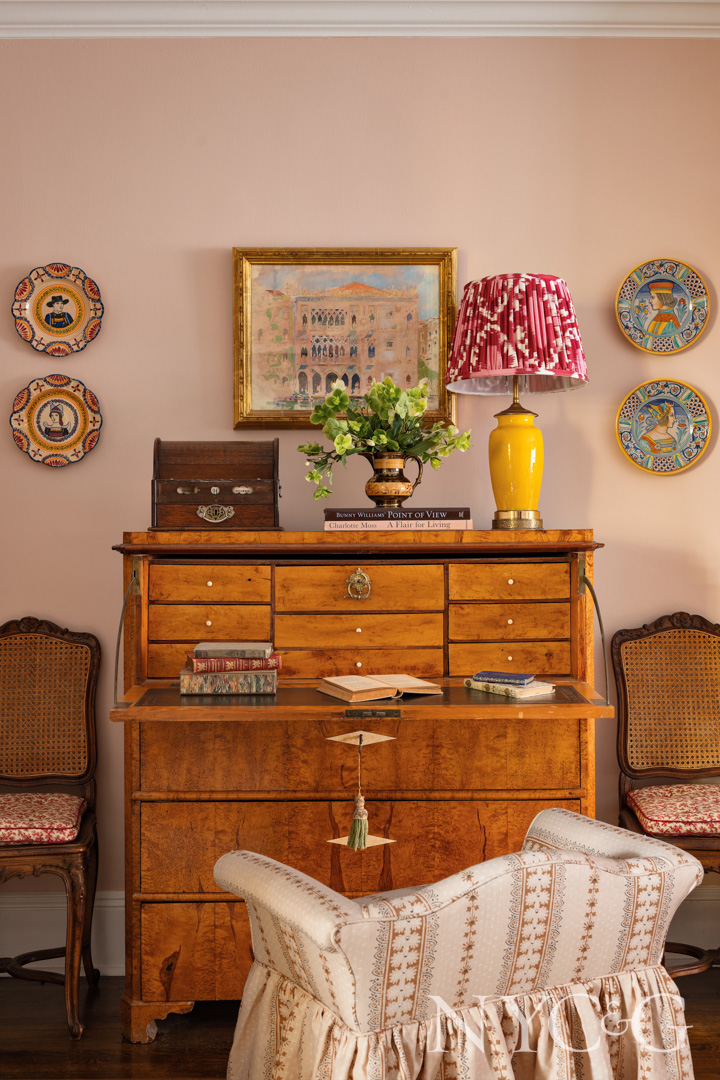
That confidence shaped every decision from the outset. Rather than settling on a single palette, Ritter presented multiple color stories for each room, drawing from inspiration images, conversations, and the client’s affinity for textiles and antiques. Each selection was instinctive. Family pieces and auction finds, including a handsome Biedermeier inlaid secrétaire, were folded effortlessly into the design, creating rooms that feel inherited as much as designed. Nowhere is that philosophy more evident than in the living room. Ritter began by sampling what felt like every imaginable shade of pink before arriving at the perfect one. “Pink is surprisingly difficult,” Ritter says with a laugh. “We wanted it to behave almost like a neutral, not sugary or precious, but warm and sophisticated.”
Against those softly blushed walls, an armless vintage sectional discovered at auction was reupholstered in chocolate-brown velvet, preserving its Turkish corners and original down cushions. The pairing of dusty pink and rich brown established the room’s warm palette. Vintage swivel chairs were kept in their original Lee Jofa upholstery, while an old suzani found new life as an ottoman. Each piece contributes its own history, making the room feel assembled over decades rather than months.
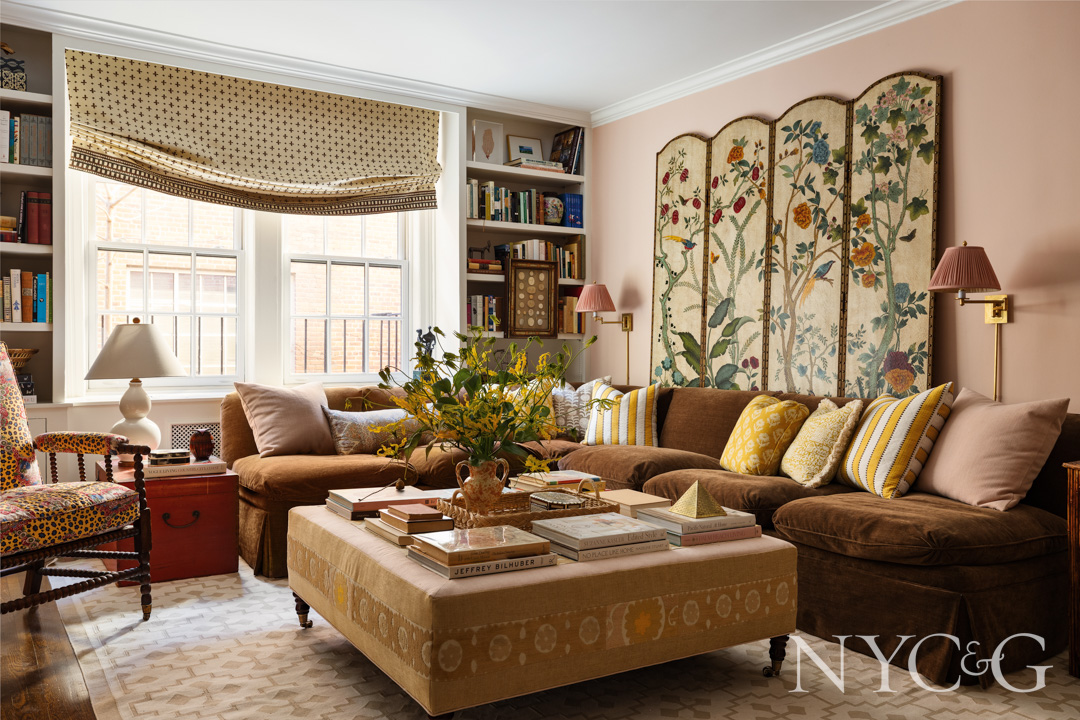
In the living room, sconces from Visual Comfort covered in Nushka lampshades frame the sectional sofa covered in a Kravet fabric. A hand-painted leather screen from 1stDibs is displayed against the wall.

A wall covering from Cole & Sons envelops a hallway. The ceiling fixture is from The Antique And Artisan Gallery.
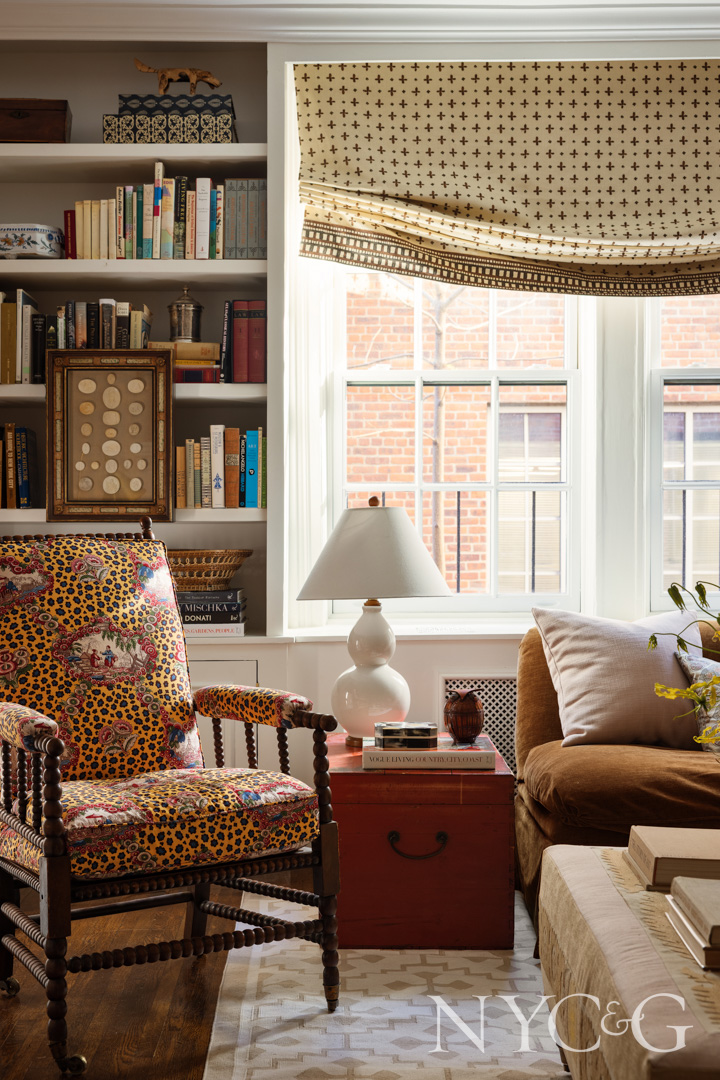
A spool chair is covered in Chinese Leopard Toile by Brunschwig & Fils. The Roman shade fabric is by Katie Leede, available through Holland & Sherry.
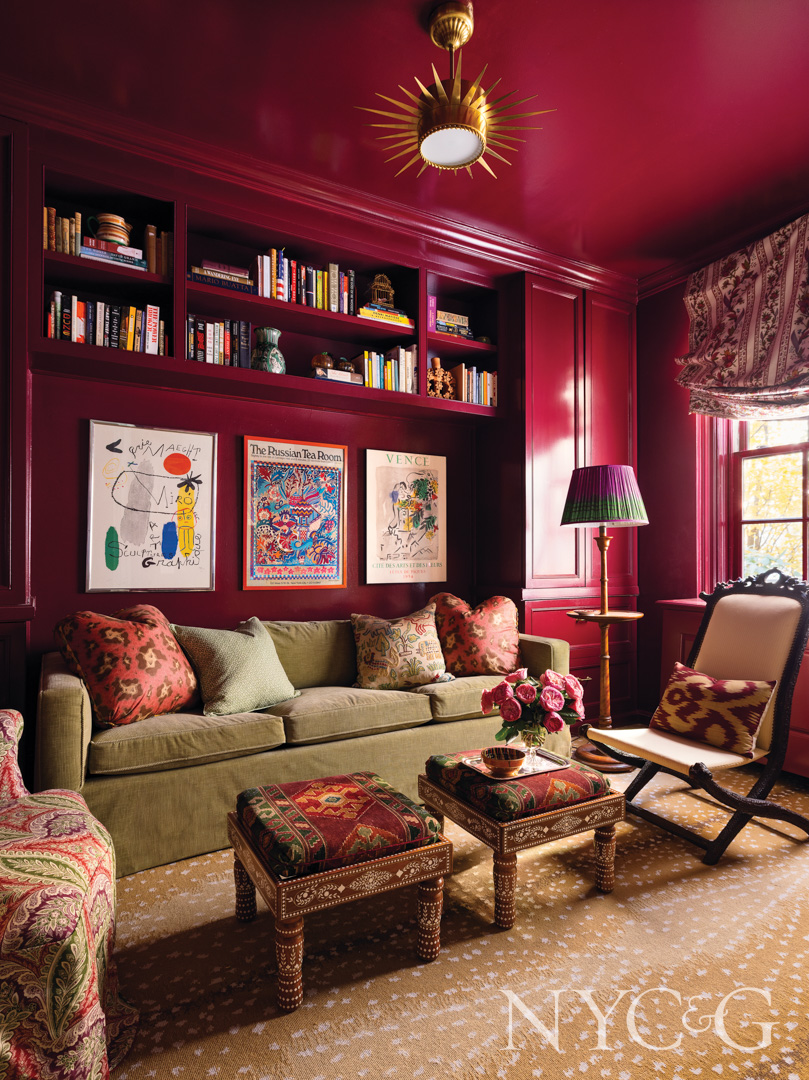
The walls of the study are covered in a high gloss finish of Benjamin Moore’s Radicchio. The rug by Stark is complemented by ottomans from Chairish. The sofa, recovered by Plaza Park Interiors, is covered in a velvet fabric from Cowtan & Tout.

In the dining area, a custom banquette by Plaza Park Interiors is covered in a fabric from Cowtan & Tout.
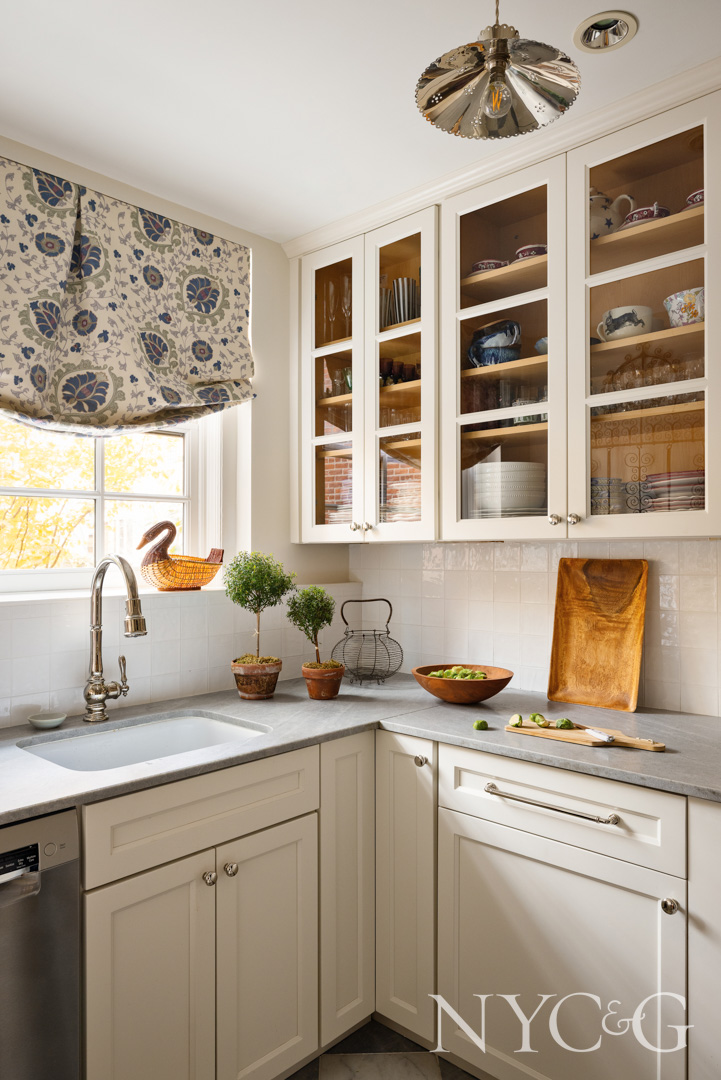
The kitchen cabinetry was refaced by Renovation Partners NY. The faucet is from Kohler, and the Roman shade fabric is from Cowtan & Tout.

In the primary bedroom, bed hangings from Thibaut match the roman shade fabric, while the bed hanging liner is from Schumacher. A vintage settee is covered in a fabric by Nathan Turner from James Showroom.
That same narrative continues into the dining room, where a banquette upholstered in a bold floral sits alongside an antique table already owned by the client. Guy Goodfellow wallpaper introduces graphic pattern and movement, while woven chick blinds replace formal draperies, reinforcing the relaxed English character the client admired. By closing off the second entrance, Ritter was able to build the custom banquette and give the room a stronger sense of purpose, transforming what could have felt like a pass-through into a true space for gathering.
The kitchen proves that transformation doesn’t always require demolition. Rather than gutting the space, Ritter focused on cosmetic updates that delivered maximum impact: checkerboard flooring, refaced cabinetry, new hardware, a fresh backsplash, and a custom Roman shade. The result is a reminder that thoughtful design often comes from reimagining what’s there rather than starting over.

Perhaps the apartment’s boldest expression is the study. Originally imagined as a glossy brown library, the room took an unexpected turn after Ritter discovered a Pierre Frey Braquenié fabric alive with berry, crimson, and plum tones. “It felt like the palette found us,” she explains, “and that couldn’t be ignored.” By color drenching the space in Benjamin Moore’s Radicchio, Ritter created an immersive jewel box that feels equally suited to preparing legal briefs or curling up with a good book.

The bedroom offers a quiet counterpoint without abandoning the apartment’s layered character. A floral note wraps the windows and bedhangings almost like a contemporary toile. A vintage bed sits alongside a reupholstered settee in a crisp horizontal stripe, proving that serenity doesn’t require sacrificing pattern.
For Ritter, the apartment’s success isn’t measured by a single statement piece but by the feeling it leaves behind. Auction finds, inherited furniture, recovered upholstery, and antiques sourced from every corner give the home a sense of permanence that’s difficult to manufacture. It feels lived in from the moment you walk through the door, celebrating the beauty of objects with stories and leaving plenty of room for new ones to be collected over time.
